Home › The Dragon › The Dragon: Moffatt
The Dragon: Moffatt
Mr. Moffatt learnt personally from a Mr. Beveridge, son of Mr. Peter Beveridge, of Swan Hill station, that he had actually seen one, and that his account quite tallied with those of the blacks. In answer to an inquiry which I addressed to Australia, I received the note attached below.* Mr. Henry Liddell, who was resident on the Darling River in 1871-72, informs me that he has heard from stock-riders and ration-carriers similar accounts to that of Mr. Moffatt, with reference to the existence of large serpents of the boa species in an adjacent locality, viz. the tract of country lying to the east of Darling and Murray junction, in the back country belonging to Pooncaira station.
They described them as being numerous, in barren and rocky places, among big boulders; fully forty feet long; as thick as a man's thigh; and as having the same remarkable odour described by Mr. Moffatt. They spoke of them as quite common, and not at all phenomenal, between Wentworth and Pooncaira. 6 The Anaconda, in regard to which so much myth and superstition prevails among the Indians of Brazil, is thus spoken of by Condamine, in his Travels in South America. "The most rare and singular of all is a large amphibious serpent from twenty-five to thirty feet long and more than a foot thick, according to report. It is called Jacumama, or the mother of the waters,' by the Americans of Maynas, * See Proceedings of Royal Society of Tasmania, September 13, 1880. Mr. C. M. Officer states-" With reference to the Mindi or Mallee snake, it has often been described to me as a formidable creature of at least thirty feet in length, which confined itself to the Mallee scrub. No one, however, has ever seen one, for the simple reason that to see it is to die, so fierce it is, and so great its power of destruction. Like the Bunyip, I believe the Mindi to be a myth, a mere tradition." and commonly inhabits the large lakes formed by the riverwater after flood." * " In Ulloa, also, in his Voyage to South America,+ says: the countries watered by that vast river (the Maranon) is bred a serpent of a frightful magnitude, and of a most deleterious nature. Some, in order to give an idea of its largeness, affirm that it will swallow any beast whole, and that this has been the miserable end of many a man. But what seems still a greater wonder is the attractive quality attributed to its breath, which irresistibly draws any creature to it which happens to be within the sphere of its attraction. The Indians call it Jacumama, i.e. 'mother of water'; for, as it delights in lakes and marshy places, it may in some sense be considered as amphibious. I have taken a great deal of pains to inquire into this particular, and all I can say is that the reptile's magnitude is really surprising."
John Nieuhoff, in his Voyages to Brazil,§ speaking of the serpent Guaku or Liboya, says: "It is questionless the biggest of all serpents, some being eighteen, twenty-four, nay thirty feet long, and of the thickness of a man in his middle. The Portuguese call it Kobra Detrado, or the roebuck serpent, because it will swallow a whole roebuck, or any other deer it meets with; after they have swallowed such a deer, they fall asleep, and so are catched. Such a one I saw at Paraiba, which was thirty feet long, and as big as a barrel. This serpent, being a very devouring creature, greedy of prey, leaps from amongst the hedges and woods, and standing upright upon its tail, wrestles both with men and wild * Pinkerton's Voyages, vol. xiv. p. 247. † Ibid., vol. xiv. p. 514. ‡ It is interesting to compare this belief with stories given elsewhere, by Pliny, Book viii. chap. xiv., and Ælian, Book ii. chap. xxi., of the power of the serpents or dragons of the river Rhyndacus to attract birds by inhalation. § Pinkerton's Voyages, vol. xiv. p. 713. beasts; sometimes it leaps from the trees upon the traveller, whom it fastens upon, and beats the breath out of his body with its tail."
The largest (water boa) ever met with by a European appears to be that described by a botanist, Dr. Gardiner, in his Travels in Brazil. It had devoured a horse, and was found dead, entangled in the branches of a tree overhanging a river, into which it had been carried by a flood; it was nearly forty feet long.
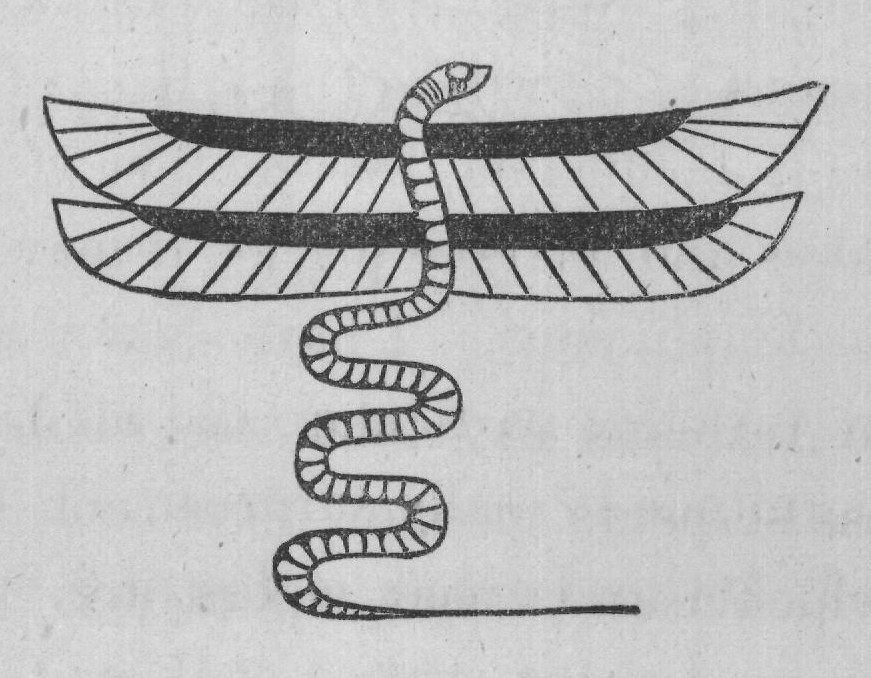
FIG. 35. EGYPTIAN FOUR-WINGED SERPENT, CHANUPHIS, OR BAIT. (From " Serpent Myths of Ancient Egypt," by W. R. Cooper.) Winged Serpents.
The next section relates to winged serpents, a belief in which was prevalent in early ages, and is strongly supported by several independent works.