Home › The Dragon › The Dragon: Kircher
The Dragon: Kircher
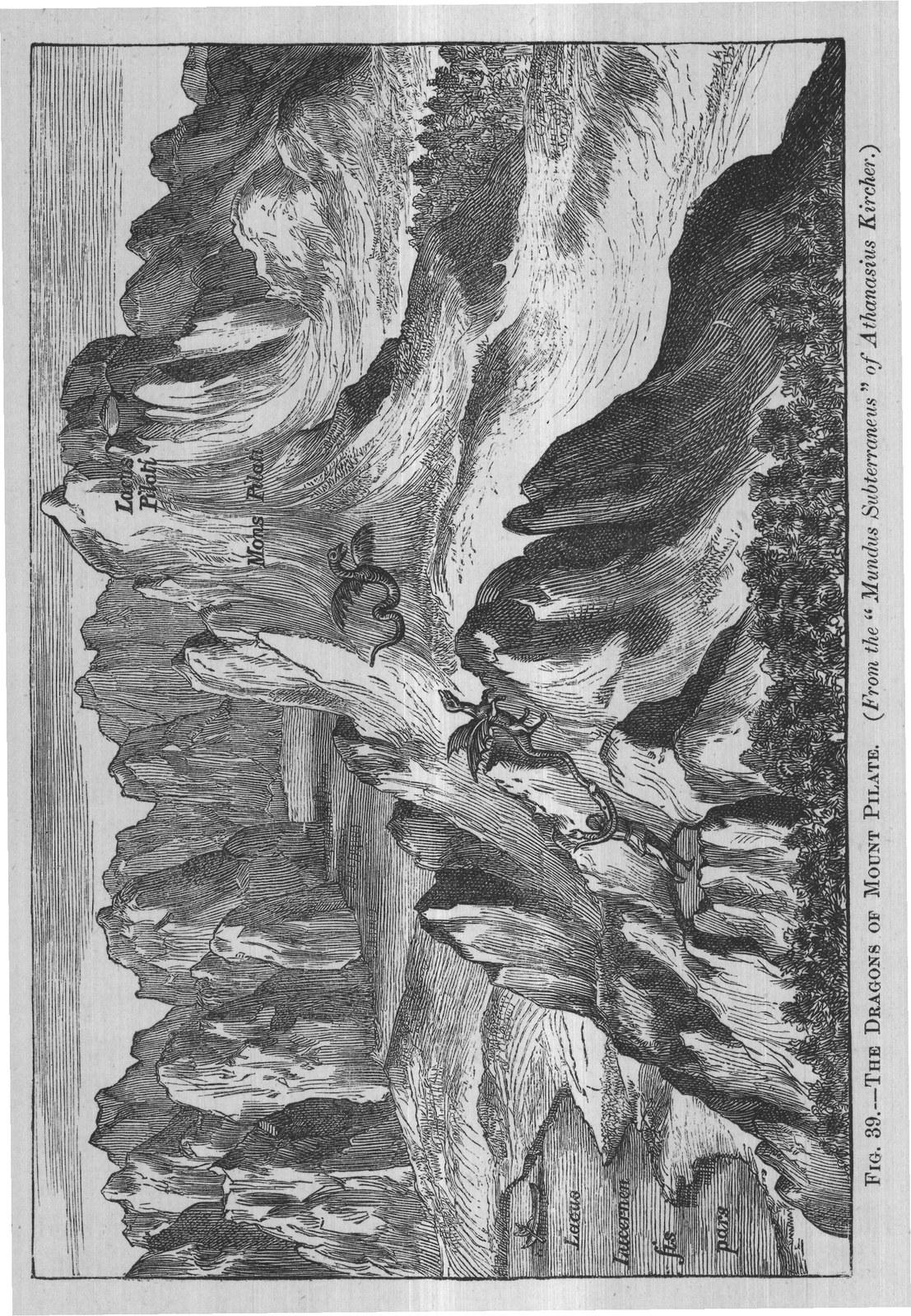
Lacus Lucernen pars Lacus Pilati Mons Pilati FIG. 39.--THE DRAGONS OF MOUNT PILATE. (From the "Mundus Subterraneus" of Athanasius Kircher.) more tender than their reputation. Unharmed by them he remained for the six winter months, without any other sustenance than that which he derived from licking the moisture off the rock, in which he followed their example. Noticing the dragons preparing for flying out on the approach of spring, by stretching and unfolding their wings, he attached himself by his girdle to the tail of one of them, and so was restored to the upper world, where, unfortunately, the return to the diet to which he had been so long unaccustomed killed him. In memory, however, of the event, he left his goods to the Church, and a monument illustrative of his escape was erected in the Ecclesiastical College of St. Leodegaris at Lucerne. Kircher had himself seen this, and it was accepted as an irrefragable proof of the story.
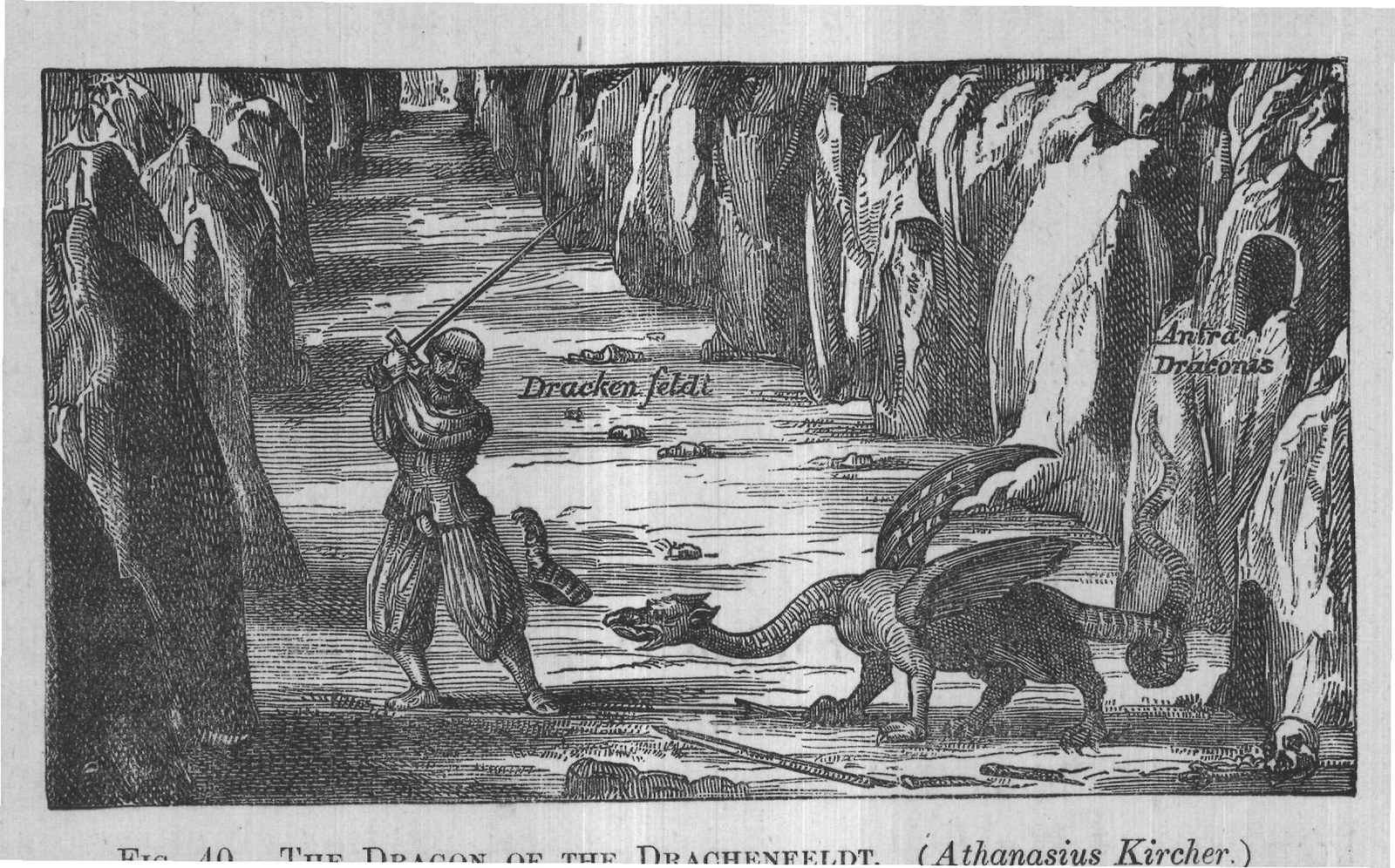
Another story is an account also given by A. Kircher,* of the fight between a dragon and a knight named Gozione, in the island of Rhodes, in the year 1349 A.D. This monster is described as of the bulk of a horse or ox, with a long neck and serpent's head-tipped with mule's ears-the mouth widely gaping and furnished with sharp teeth, eyes sparkling as though they flashed fire, four feet provided with claws like a bear, and a tail like a crocodile, the whole body being coated with hard scales. It had two wings, blue above, but blood-coloured and yellow underneath; it was swifter than a horse, progressing partly by flight and partly by running. The knight, being solicited by the chief magistrate, retired into the country, when he constructed an imitation dragon of paper and tow, and purchased a charger and two courageous English dogs; he ordered slaves to snap the jaws and twist the tail about by means of cords, while he urged his horse and dogs on to the attack. After practising for two months, these latter could scarcely retain their frenzy at the mere sight of the image. He then proceeded to * Athanasii Kircheri Mundus Subterraneus, Book viii. 27. Rhodes, and after offering his vows in the Church of St. Stephen, repaired to the fatal cave, instructing his slaves to witness the combat from a lofty rock, and hasten to him with remedies, if after slaying the dragon he should be overcome by the poisonous exhalations, or to save themselves, in the event of his being slain. Entering the lair he excited the beast with shouts and cries, and then awaited it outside. The dragon appearing, allured by the expectation of an easy prey, rushed on him, both running and flying; the knight shattered his spear at the first onset on the scaly carcase, and leaping from his horse continued the contest with sword and shield. The dragon, raising itself on its hind legs, endeavoured to grasp the knight with his fore ones, giving the Antra Draconas Dracken feldt FIG. 40. THE DRAGON OF THE DRACHENFELDT. (Athanasius Kircher.) latter an opportunity of striking him in the softer parts of the neck. At last both fell together, the knight being exhausted by the fatigue of the conflict, or by mephitic exhalations. The slaves, according to instruction, rushed forward, dragged off the monster from their master, and fetched water in their caps to restore him; after which he mounted his horse and returned in triumph to the city, where he was at first ungratefully received, but afterwards rewarded with the highest ranks of the order, and created magistrate of the province.* Kircher had a very pious belief in dragons. He says: "Since monstrous animals of this kind for the most part select their lairs and breeding-places in subterraneous caverns, I have considered it proper to include them under the head of subterraneous beasts. I am aware that two kinds of this animal have been distinguished by authors, the one with, the other without, wings. No one either can or ought to doubt concerning the latter kind of creature, unless perchance he dares to contradict the Holy Scripture, for it would be an impious thing to say it when Daniel makes mention of the divine worship accorded to the dragon Bel by the Babylonians, and after the mention of the dragon made in other parts of the sacred writings." • Yet Harris, in his Collection of Voyages,† gives a singular resumé. He says:-" We have, in an ancient author, a very large and circumstantial account of the taking of a dragon on the frontiers of Ethiopia, which was one and twenty feet in length, and was carried to Ptolemy Philadelphus, who very bountifully rewarded such as ran the hazard of procuring him this beast. - Diodorus Siculus, lib. iii. terrible as these were they fall abundantly short of monsters of the same species in India, with respect to which St. Ambrose tells us that there were dragons seen in the neighbourhood of the Ganges nearly seventy cubits in length. It was one of this size that Alexander and his army saw in a cave, where it was fed, either out of reverence or from curiosity, by the inhabitants; and the first lightning of its * Probably many of my readers are acquainted with Schiller's poem based on this story, and with the beautiful designs by Retsch illustrating it. + Harris, Collection of Voyages, vol. i. p. 474; London, 1764. ‡ De Moribus Brachmanorum, p. 63. Strabo, lib. 16, p. 75. Bochart Hieroz, p. 11, lib. 3, cap. 13. eyes, together with its terrible hissing, made a strong impression on the Macedonians, who, with all their courage, could not help being frighted at so horrid a spectacle.* The dragon is nothing more than a serpent of enormous size; and they formerly distinguished three sorts of them in the Indies, viz. such as were found in the mountains, such as were bred in caves or in the flat country, and such as were found in fens and marshes. "The first is the largest of all, and are covered with scales as resplendent as polished gold. These have a kind of beard hanging from their lower jaw, their eyebrows large, and very exactly arched; their aspect the most frightful that can be imagined, and their cry loud and shrill; their crests of a bright yellow, and a protuberance on their heads of the colour of a burning coal. "Those of the flat country differ from the former in nothing but in having their scales of a silver colour,§ and in their frequenting rivers, to which the former never come. "Those that live in marshes and fens are of a dark colour, approaching to a black, move slowly, have no crest, or any rising upon their heads.|| Strabo says that the painting them with wings is the effect of fancy, and directly contrary to truth, but other naturalists and travellers both ancient and modern affirm that there are some of these species winged. * Ælian, De Animal., lib. xv. cap. 21. † Strabo, lib. xvi. ‡ Gosse tells us that it is still a common belief in Jamaica that crested snakes exist there which crow like a cock. § Strabo, lib. xvi. || Jonston, Theatr. Animal., tome ii. p. 34, "De Serpentibus." Note. -It is interesting to record that in China, to the present day, the tradition of the gold and silver scaled species of dragons remains alive. Two magnificent dragons, 200 feet and 150 feet long, representing respectively the gold and silver dragon, formed part of the processions in Hongkong in December 1881, in honour of the young princes. Strabo, lib. xvi, Pliny says their bite is not venomous, other authors deny this. Pliny gives a long catalogue of medical and magical properties, which he ascribes to the skin, flesh, bones, eyes, and teeth of the dragon, also a valuable stone in its head. 'They hung before the mouth of the dragon den a piece of stuff flowered with gold, which attracted the eyes of the beast, till by the sound of soft music they lulled him to sleep, and then cut off his head.' " I do not find Harris's statement in Diodorus Siculus, the author quoted, but there is the very circumstantial description of a serpent thirty cubits (say forty-five feet) in length, which was captured alive by stratagem, the first attempt by force having resulted in the death of several of the party. This was conveyed to Ptolemy II. at Alexandria, where it was placed in a den or chamber suitable for exhibition, and became an object of general admiration. Diodorus says: "When, therefore, so enormous a serpent was open for all to see, credence could no longer be refused the Ethiopians, or their statements be received as fables; for they say that they have seen in their country serpents so vast that they can not only swallow cattle and other beasts of the same size, but that they also fight with the elephant, embracing his limbs so tightly in the fold of their coils that he is unable to move, and, raising their neck up underneath his trunk, direct their head against the elephant's eyes; having destroyed his sight by fiery rays like lightning, they dash him to the ground, and, having done so, tear him to pieces."
In an account of the castle of Fahender, formerly one of the most considerable castles of Fars, it is stated-" Such is the historical foundation of an opinion generally prevalent, that the subterranean recesses of this deserted edifice are still replete with riches. The talisman has not been forgotten; and tradition adds another guardian to the previous deposit, a dragon or winged serpent; this sits for ever brooding over the treasure which it cannot enjoy."
I shall examine, on a future occasion, how far those figures correspond to the Persian ideas of dragons and serpents, the azhdaha (Lojj = dragon) and már (gl. = snake), which, as various poets relate, are constant guardians of every subterraneous ganj )گنج = treasure(.
The már at least may be supposed the same as that serpent which guards the golden fruit in the garden of the Hesperides.