Home › The Dragon › The Dragon: Herodotus
The Dragon: Herodotus
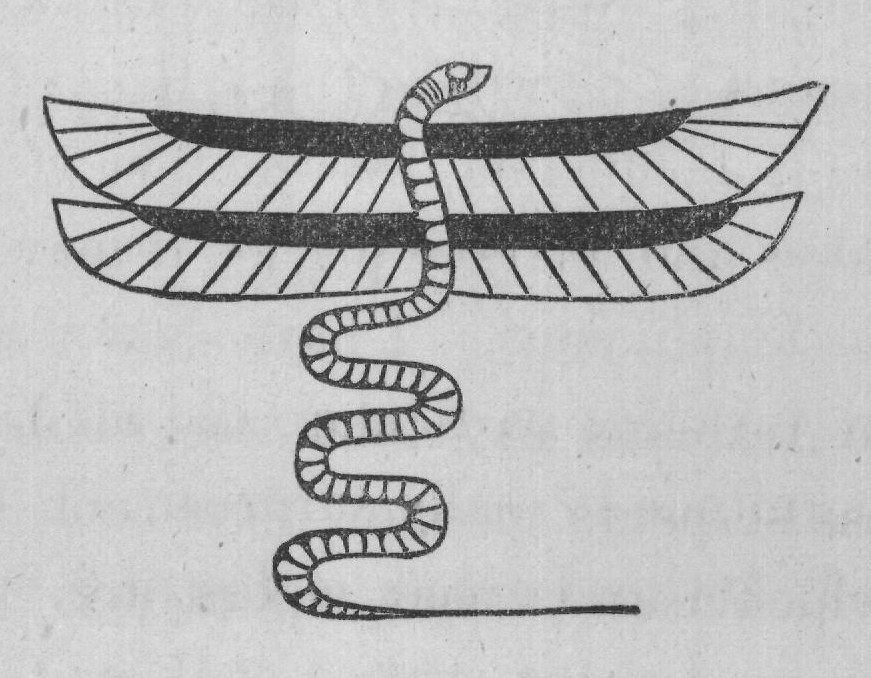
To my mind, Herodotus speaks without the slightest doubt upon the subject in the following passages. "Arabia* is the last of inhabited lands towards the south, and it is the only country which produces frankincense, myrrh, cassia, cinnamon, and ledanum." "The frankincense they procure by means of the gum styrax, which the Greeks get from the Phœnicians. This they burn, and thereby obtain the spice; for the trees which bear the frankincense are guarded by * Herodotus, Book iii. chap. cvii., cviii. winged serpents, small in size, and of various colours, whereof vast numbers hang about every tree. They are of the same kind as the serpents that invade Egypt, and there is nothing but the smoke of the styrax which will drive them from the trees." م FIG. 36. THE SYMBOLIC WINGED SERPENT OF THE GODDESS MERSOKAR OR MELSOKAR. (After W. R. Cooper.) A Again,* " the Arabians say that the whole world would swarm with these serpents, if they were not kept in check, in the way in which I know that vipers are." "Now, with respect to the vipers and the winged snakes of Arabia, if they increased as fast as their nature would allow, impossible were it for man to maintain himself upon the earth.
Accordingly, it is found that when the male and female come together, at the very moment of impregnation, the female seizes the male by the neck, and having once fastened cannot be brought to leave go till she has bit the neck entirely through, and so the male perishes; but after a while he is avenged upon the female by means of the young, which, while still unborn, gnaw a passage through the womb and then through the belly of their mother. Contrariwise, other snakes, which are harmless, lay eggs and hatch a vast number of young. Vipers are found in all parts of the world, but the winged serpents are nowhere seen except in Arabia, where they are all congregated together; this makes them appear so numerous." * Herodotus, Book iii. chap. cviii.
Herodotus had so far interested himself in ascertaining the probability of their existence as to visit Arabia for the purpose of inquiry; he says, "I went once to a certain place in Arabia, almost exactly opposite the city of Buto, to make inquiries concerning the winged serpents. On my arrival I saw the back-bones and ribs of serpents in such numbers as it is impossible to describe; of the ribs there were a multitude of heaps, some great, some small, some middle-sized. The place where the bones lie is at the entrance of a narrow gorge between steep mountains, which there open upon a spacious plain communicating with the great plains of Egypt. The story goes, that with the spring the snakes come flying from Arabia towards Egypt, but are met in this gorge by the birds called ibises, who forbid their entrance and destroy them all. The Arabians assert, and the Egyptians also admit, that it is on account of the service thus rendered that the Egyptians hold the ibis in so much reverence." He further describes the winged serpent as being shaped like the water-snake, and states that its wings are not feathered, but resemble very closely those of the bat. FIG. 37. THE SYMBOLIC WINGED SERPENT OF THE GODDESS EILEITHYA. (After W. R. Cooper.) Aristotle briefly states, as a matter of common report, that there were in his time winged serpents in Ethiopia. Both two and four winged snakes are depicted among the Egyptian * Herodotus, Book ii., chap. lxxv. + Ibid., Book ii., chap. lxxvi. ‡ Ibid., Book i., chap. v. sculptures, considered by Mr. Cooper to be emblematic of deities, and to signify that the four corners of the earth are embraced and sheltered by the supreme Providence.