Home › The Chinese Dragon › The Chinese Dragon: Aldrovandus
The Chinese Dragon: Aldrovandus
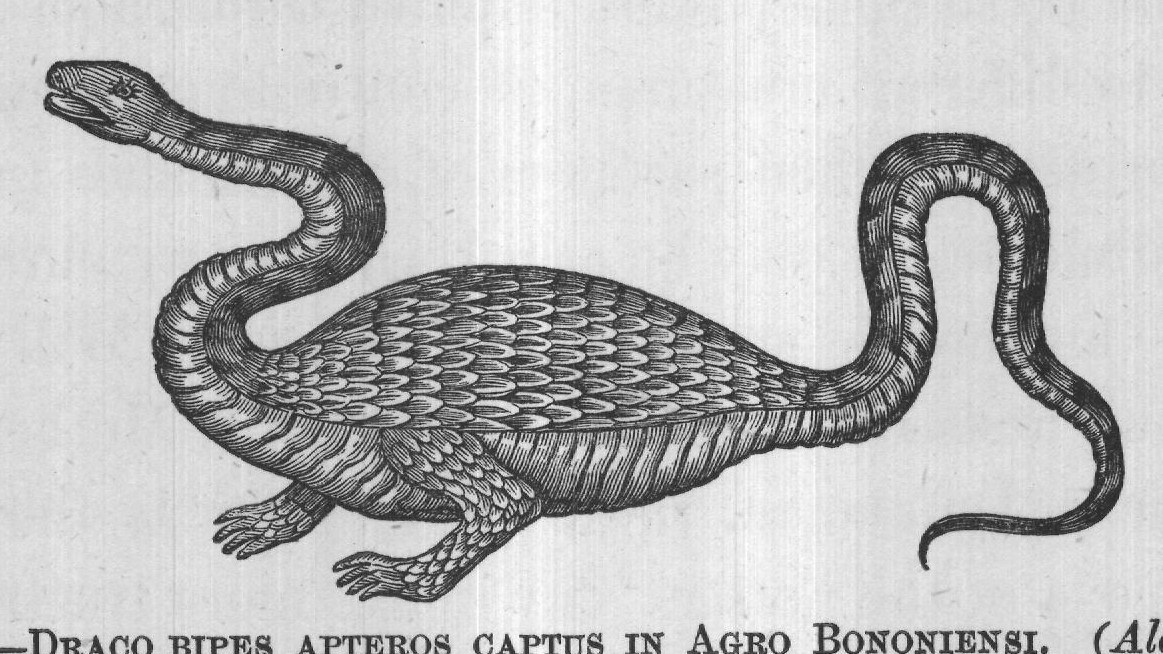
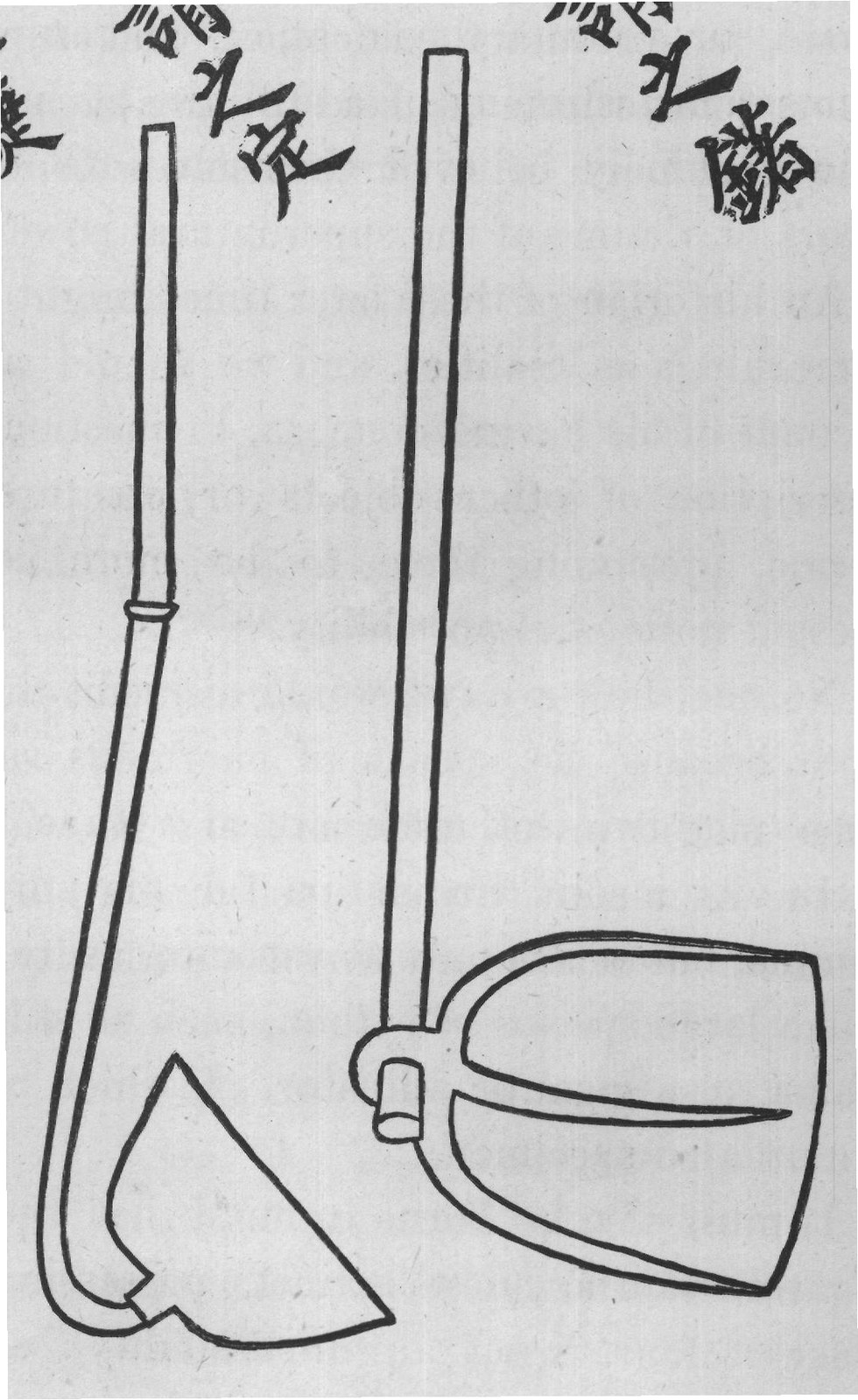
I notice that Retzoch, in his designs to illustrate Schiller's poem, "The Fight with the Dragon," makes the monster have only two fore-legs, and this appears to have been a common mediæval conception of it. Aldrovandus and Gesner 料謂之鍵 所斷謂之定 所謂之錯 FIG. 50.-TOOLS OF HUSBANDRY. (From the 'Rh Ya.) both give figures of biped dragons. There is also a curious drawing in the Gentleman's Magazine for 1749-which is transferred into the pages of the Encyclopædia of Philadelphia, apparently a piracy of an English Cyclopædia, of what is styled a sea-dragon, four feet long, which stands bolt upright on two legs, and, like Barnum's mermaid, was probably a triumph of art.
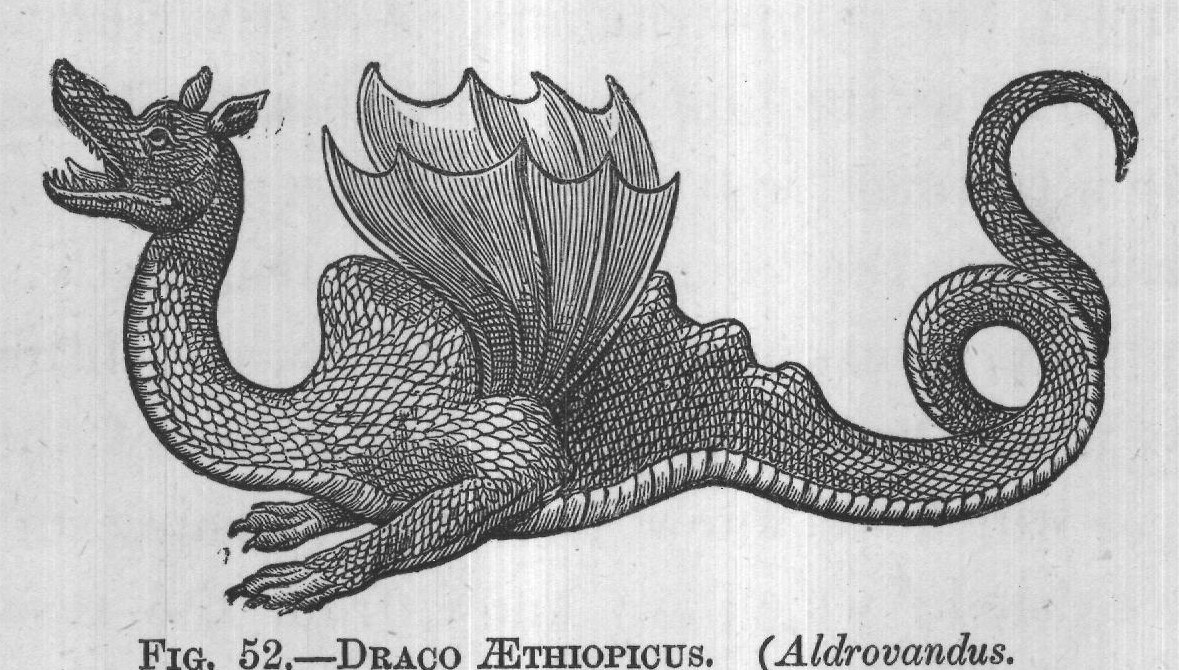
Aldrovandus was probably imposed on by some waggish friend, in reference to the biped dragon without wings, two cubits long, which was said to have been killed by a countryman near Bonn in 1572 A.D., and which he first figured and FIG. 51. DRACO BIPES APTEROS CAPTUS IN AGRO BONONIENSI. (Aldrovandus). then placed in his museum; and he evidently fully believed in the Ethiopian winged biped dragon, of which he gives two figures, but without quoting his authority. 7 FIG. 52. DRACO ETHIOPICUS. (Aldrovandus.
Gesner gives a similar figure, after Belon, of the winged dragon of Mount Sinai; but Athanasius Kircher is more liberal, and gives his dragon not only wings but four legs. FIG. 53. THE FOUR-FOOTED WINGED DRAGON. (Kircher.) In poetry we find Ashtaroth described as appearing to Faust in the form of a serpent with two little feet. As to the mysterious powers imputed throughout the Shan Hai King to different creatures, of controlling drought, rain, and fire, or acting, when partaken of, as remedies for sundry ills and ailments, it may be asked whether we ourselves are free from analogous superstitious beliefs? Will a sailor view without uneasiness the destruction of a Mother Carey's chicken, or a Dutchman, of a stork? Or is the Chinese pharmacopeia of the present day much more trustworthy as to many of its items?
As to the human-visaged creatures, both snakes and fourfooted beasts, may we not perhaps put them on a par with other fancied resemblances, which hold to the present day, of (for example) the hippopotamus, to a river-horse, of the pipe-fish, known as the hippocampus, to a sea-horse; of the manatee to a merman, and the like ?
And, lastly, are the composite creatures, partly bird and partly reptilian, occasionally referred to, so entirely incredible? Is it not barely possible that some of those intervening types which we know from the teaching of Darwin, must have existed; which we know, from the researches of palæontology have existed; types intermediate to the Stru thionide, the most reptilian of birds, and the Chlamydæ, the most avian of reptiles---is it not possible that some of these may have continued their existence down to a late date, and that the tradition of these existing as the descendants or the analogues of the Archæopteryx, and the toothed birds of America, may be embalmed in the pages in question? Is it impossible? Do not the Trigonias, the Terebratulas, the Marsupials, and, in part, the vegetation of Australia, form the spare surviving descendants of the forms which characterised the oolitic period on our own shores? Why, then, may not a few cretaceous and early tertiary forms have struggled on, through a happy combination of circumstances, to an aged and late existence in other lands.
After long, repeated, and careful examination of the Shan Hai King, I arrive at a very different conclusion from M. Bazin. I hold it to be an authentic and precious memorial which has been handed down to us from remote antiquity, the value of which has been unrecognised owing to the book being unfortunately a fusion of two and perhaps three distinct works.
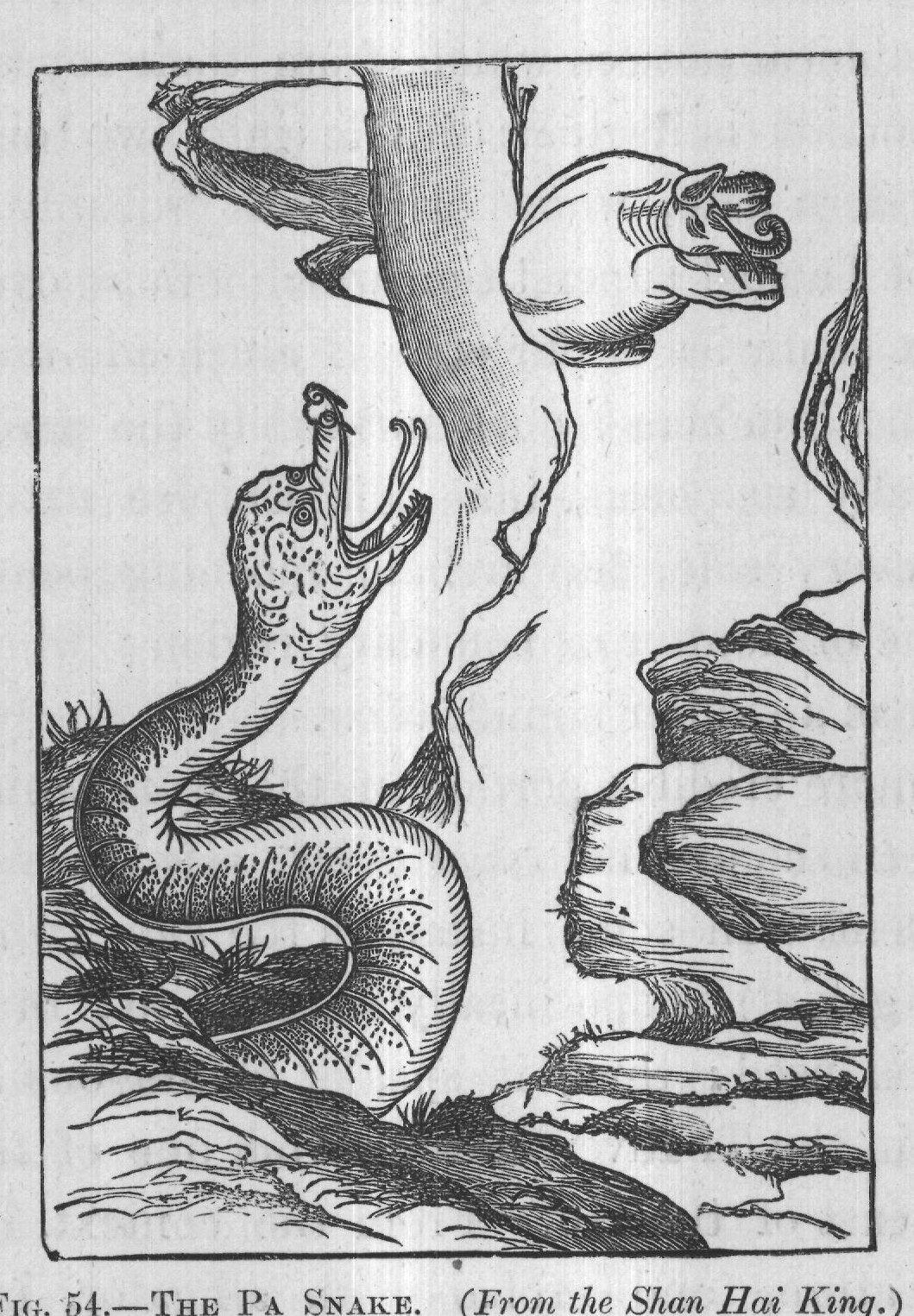
FIG. 54. THE PA SNAKE. (From the Shan Hai King.) The oldest was the Shan King, and consists of five volumes, devoted respectively to the northern, southern, eastern, western, and central mountain ranges. This is devoid of all reference to persons and habited places. It is simply an abstract of the results of a topographical survey which may not impossibly have been, as it claims, the one conducted by Yü.
It contains lists of mountains and rivers, with valuable notes on their mineral productions, fauna and flora. It also gives lists of the divinities controlling or belonging to each mountain range, and the sacrifices suitable to them. There are few extravagances in this portion of the work.
The remainder is devoted to a history of the regions without and within the four hai or seas bounding the empire, and those constituting what is called the Great Desert. Here extravagant stories, myths, accounts of wonderful people, references to states, cities, and tribes are mingled with geographical notices which, from their repetition, show that this portion is itself resolvable into two distinct works of more modern date, whose origin was probably posterior to the wave of Taouist superstition which swept over China in the first six centuries of our era. I must add that the term, "within the four seas" does not imply the arrogant belief, as is generally supposed, that this Empire extended to the ocean on every side, the archaic meaning being the very different one of frontier or boundary region; while the word "desert" has a similar signification.
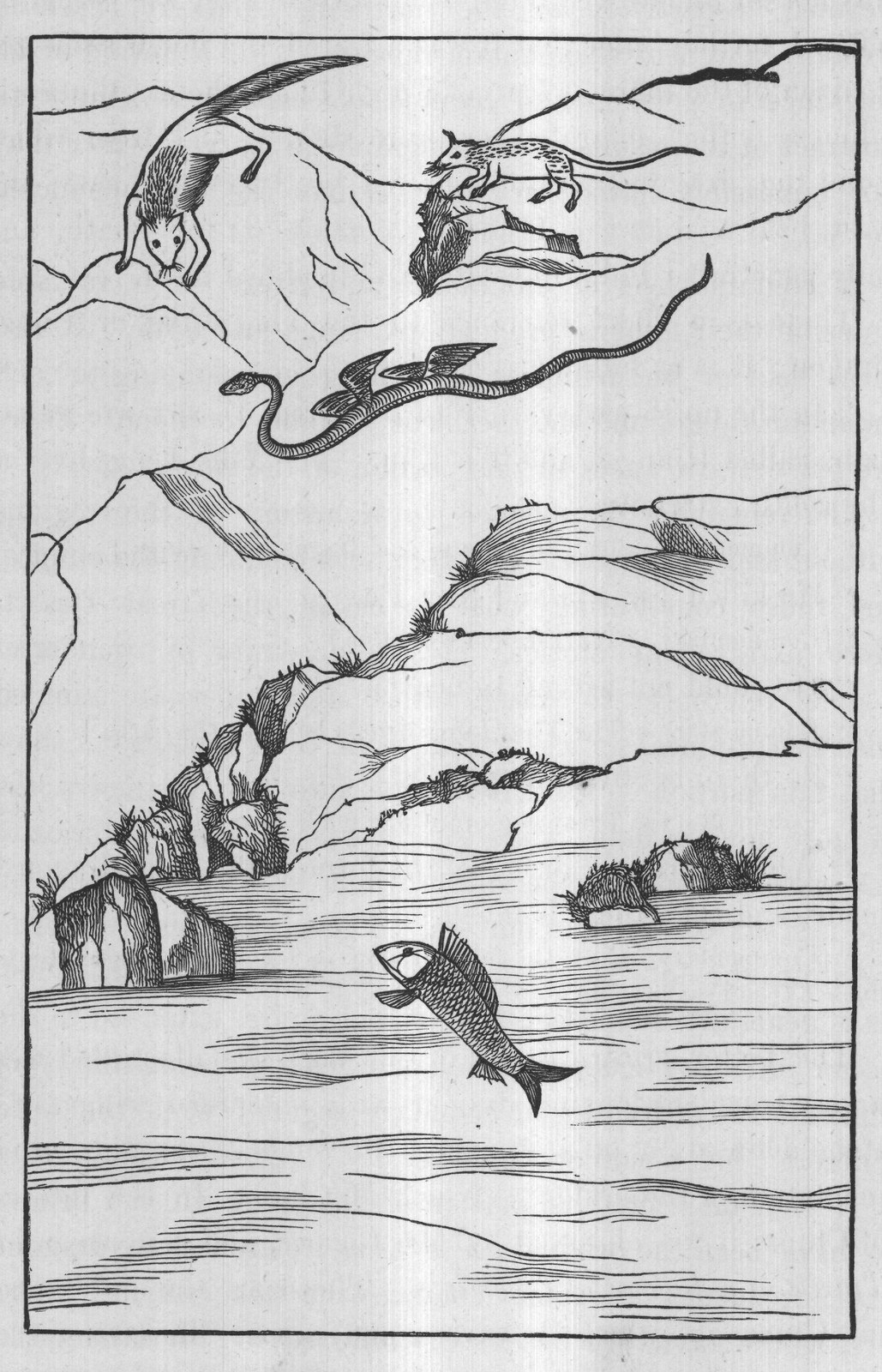
In that more credible portion of the work which I believe to have been the original Shan King, references to dragons are infrequent. In some instances the kiao (which I interpret as the gavial) is specifically referred to; in others the word lung is used; thus, it speaks of dragons and turtles abounding in the Ti River, flowing from one of the northern mountains east of the Ho. From the context, however, an aquatic creature, and probably an alligator, is indicated. FIG. 55. FLYING SNAKES FROM THE SIEN MOUNTAINS (CENTRAL MOUNTAINS). (Shan Hai King.) 1 From the entire text I gather that the true terrestrial dragon was not an inmate of China, at all events after the period of Yü. I further infer that it was a feared and much respected denizen of the more or less arid highlands, whence the early Chinese either migrated or were driven, and from which point the dragon traditions flowed pretty evenly east and west, beat against the Himalayan chain on the south, and only penetrated India in a later and modified form.