Home › The Chinese Dragon › The Chinese Dragon: Williams
The Chinese Dragon: Williams
In the former we find only incidental references to either of these, such as, "XIV. The Emperor K'ung-kea. In his first year (в.c. 1611), when he came to the throne, he dwelt on the west of the Ho. He displaced the chief of Ch'e-wei, * and appointed Lew-luyt to feed the dragons." * Williams, Shi-Wéi. † Williams, Liu-Léi.
According to the latter, Hwang Ti (в.c. 2697) had a dragon-like countenance; while the mother of Yaou (B.c. 2356) conceived him by a dragon. The legend is : "After she was grown up, whenever she looked into any of the three Ho, there was a dragon following her. One morning the dragon came with a picture and writing. The substance of the writing was the Red one has received the favour of Heaven. The red dragon made K'ing-teo pregnant."
Again, when Yaou had been on the throne seventy years, a dragon-horse appeared bearing a scheme, which he laid on the table and went away.
The Emperor Shun (B.c. 2255) is said to have had a dragon countenance.
It is also said of Yu (the first emperor of the Hia dynasty) that when the fortunes of Hia were about to rise, all vegetation was luxuriant, and green dragons lay in the borders; and that " on his way to the south, when crossing the Kiang, in the middle of the stream, two yellow dragons took the boat on their backs. The people were all afraid ; but Yu laughed, and said, 'I received my appointment from Heaven, and labour with all my strength to nourish men. To be born is the course of nature; to die is by Heaven's decree. Why be troubled by the dragons?' On this the dragons went away, dragging their tails."
From these extracts it will be seen that the dragon, although universally believed in, was already mythical and legendary, so far as the Chinese were concerned.
THE "SHU KING"* OR "SHOO KING" is, according to Dr. Legge, simply a collection of historic memorials, extending over a space of one thousand seven hundred years, but on no connected method, and with great gaps between them. * Williams, Shu King.
It opens with the reign of Yaou (B.c. 2357), and contains interesting details of the polity of those remote ages. It contains a record of the great inundation occurring during his reign, which Mr. Legge does not identify with the Deluge of Genesis, but which Dr. Gutzlaff and other missionary Sinologues consider to be the same.
It is interesting to find in this work, claiming so high an antiquity, references to an antiquity which had preceded ita bygone civilization, perhaps-as follows, in the book called Yih and Ts'ih. The emperor (Shun, B.C. 2255 to 2205) says, "I wish to see the emblematic figures of the ancients -the sun, the moon, the stars, the mountain, the dragon, and the flowery fowl, which are depicted on the upper garment ; the temple cup, the aquatic grass, the flames, the grains of rice, the hatchet, and the symbol of distinction, which are embroidered on the lower garment. I wish to see all these displayed with the five colours, so as to form the official robes ; it is yours to adjust them clearly." Here the dragon is chosen as an emblematic figure, in association with eleven others, which are objects of every-day knowledge, and this, I think, establishes a presumption that it itself was not at that date considered an object of doubtful credibility. Similarly, we find the twelve symbolical animals, representing the twelve branches of the Horary characters (dating, see Williams' Dictionary, from B.c. 2637), to be the rat, the ox, tiger, hare, dragon, serpent, horse, sheep, monkey, cock, dog, boar, where the dragon is the only one about whose existence a question can be raised. From this latter we learn that there was no confusion of meaning then between dragons and serpents; the distinction of the two creatures was clearly recognized, just as it was many centuries afterwards by Mencius (4th century B.c.), who, in writing of these early periods, says, "In the time of Yaou, the waters, * Williams, Yih and Ts'ih. flowing out of their channels, inundated the Middle Kingdom. Snakes and dragons occupied it, and the people had no place where they could settle themselves"; and again, "Yu dug open their obstructed channels, and conducted them to the sea. He drove away the snakes and dragons,* and forced them into the grassy marshes."
THE "'RH ΥΑ."
The 'Rh Ya or Urh Ya,+ also transliterated Eul Ya and El Ya, a dictionary of terms used in the Chinese classics, but more especially of those in the Shi King, or Book of Odes," a collection of ancient ballads compiled and arranged by Confucius.
There is a tradition that it was commenced by the Duke of Chow 1100 в.c., and completed or enlarged by Tsz Hia, a disciple of Confucius.
Dr. Bretschneider suggests that each heading or phrase in the original book merely represents the book names and the popular names of the plants and animals.
The bulk of the work at present extant consists of the commentary by Kwoh P'oh (about A.D. 300) and, in some editions, of additional commentaries by other authors. The illustrations selected from it for the present volume are reduced from those in a very fine folio copy, for the loan * I am under the impression that the dragons to which Mencius refers were probably alligators, of which one small species still exists, though rare, in the Yang-tsze-kiang. So also we may regard as alligators the dragons referred to above in the annals of the Bamboo Books on the passage of the Kiang by Yu. Mr. Griffis, in his work on Corea, "The creature called a-ke, or alligator, capable of devouring a says, man, is sometimes found in the largest rivers." + For a full account of this work, see an Article by E. C. Bridgman in Chinese Repository, xviii. (1849), p. 169; and Botanicon Sinicum, by Dr. E. Bretschneider, in the Journal of the North China Branch of the Royal Asiatic Society, New Series, vol. xvi. 1881. of which I am indebted to Mr. Thomas Kingsmill, of Shanghai.
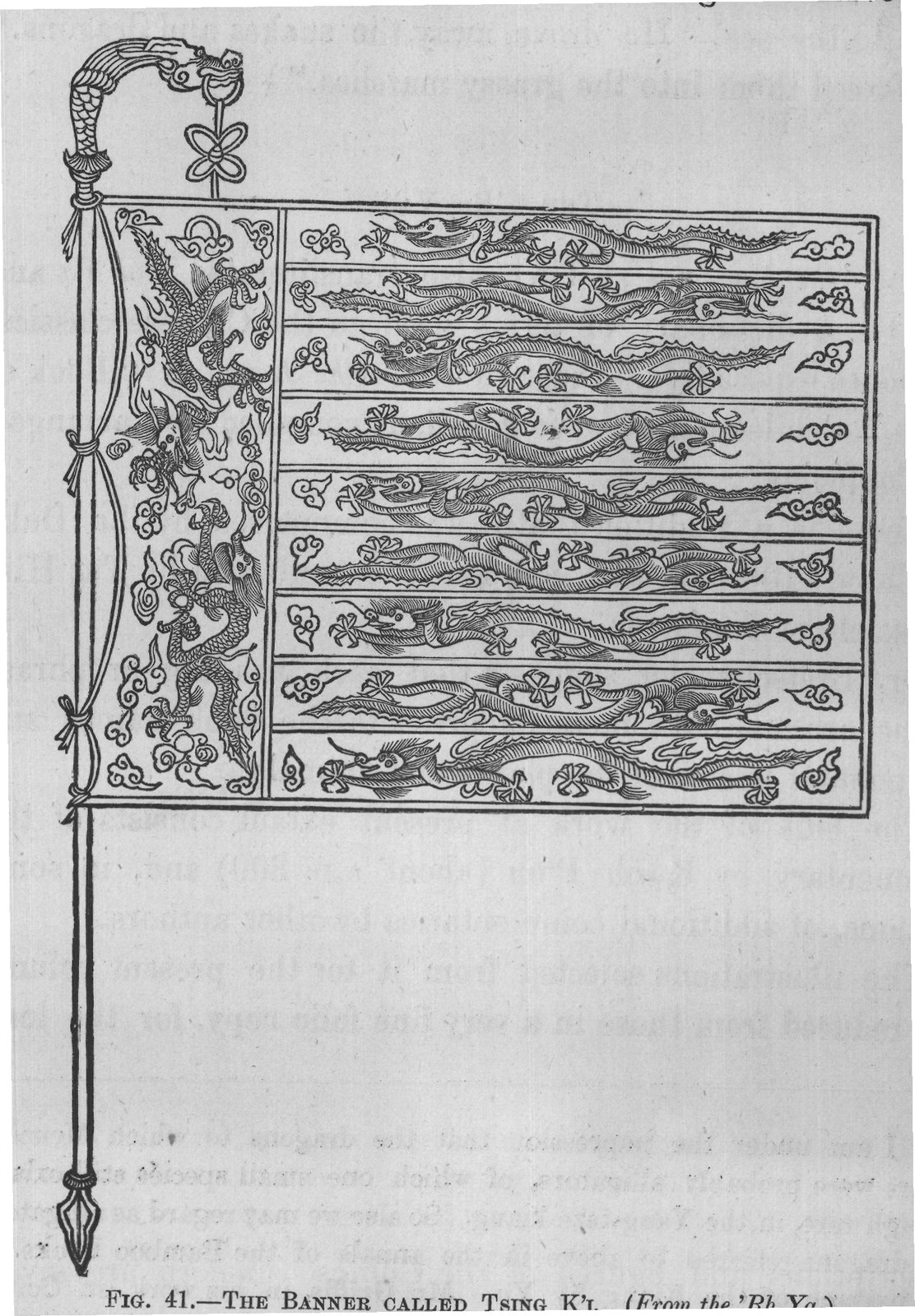
These profess to date back so far as the Sung dynasty (A.D. 960 to A.D. 1127), and it is interesting to observe that FIG. 41. THE BANNER CALLED TSING K'I. (From the 'Rh Ya.) the representations of tools of husbandry then in use (Fig. 50, p. 232), and of the methods of hawking (Fig. 46, p. 225), fishing (Fig. 47, p. 227), and the like, are such as might be taken without alteration from those of the present day. The drawings made by Kwoh P'oh appear to have been lost in the sixth century A.D.
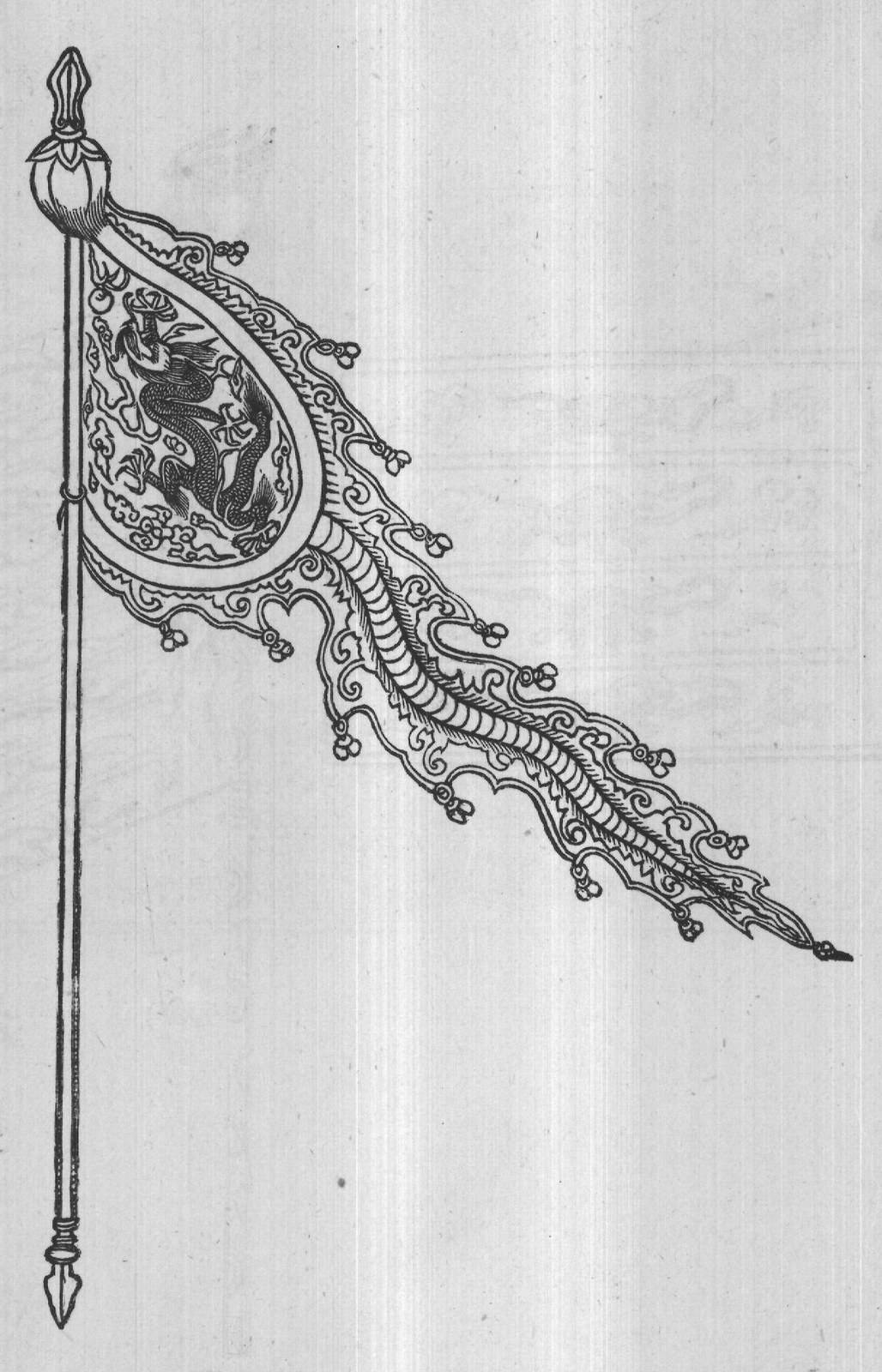
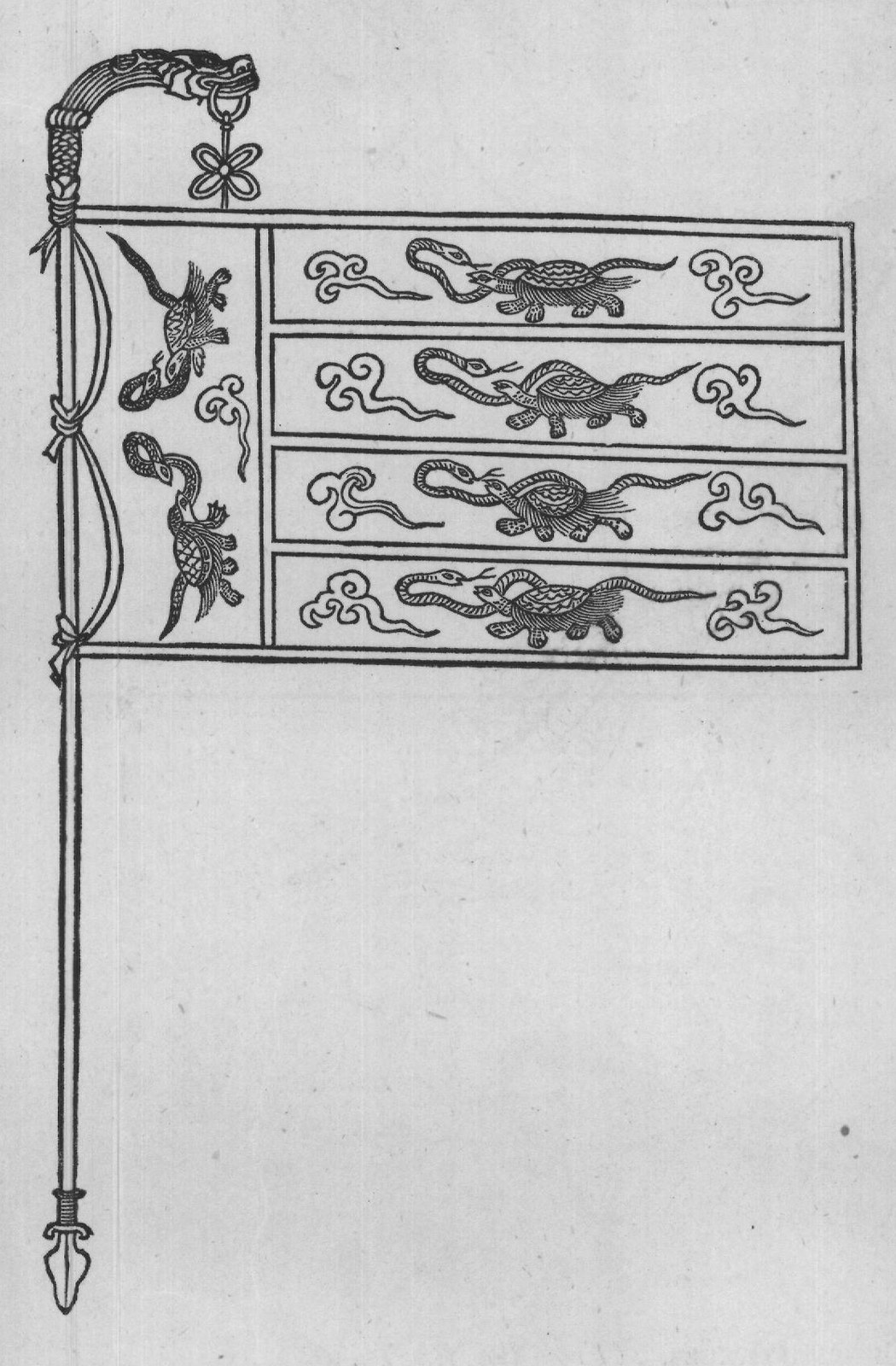
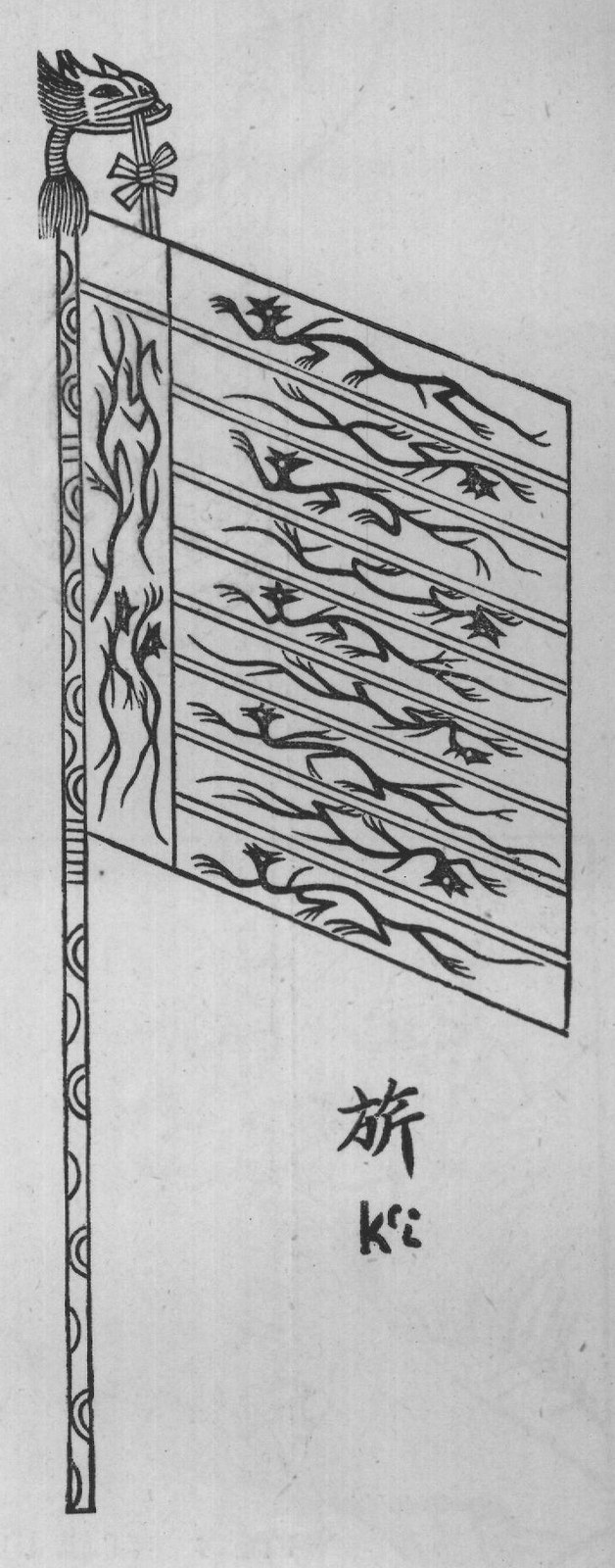
Notices of the dragon only appear incidentally in the 'Rh Ya as forming part of the decoration of banners, &c.; but FIG. 42. THE K'I WITH BELLS. (From the 'Rh Ya.) descriptions and figures of the Chinese unicorn are given, and of other remarkable animals, of which I shall eventually take notice.
These figures of dragons in the drawings of banners (Figs. 41-44) are especially interesting; as there is fair reason to suppose that they at least have been reproduced time after time from pre-existing ones with tolerable accuracy; and that they give us a good notion of the general character of the animal they purport to represent.
I have appended a few fac-similes of wood engravings from the 'Rh Ya on general subjects, in anticipation of others * 方 ki FIG. 48. THE CHAO BANNER. (From the 'Rh Ya.).
FIG. 44. THE K'I OR KIAO LUNG STANDARD. (From the San Li Tu.) dealing with specialities, which will be found in their appropriate positions; they will serve to correct the notion that the Chinese are entirely devoid of artistic power and imagination (Figs. 46-49).