Home › The Chinese Dragon › The Chinese Dragon: According
The Chinese Dragon: According
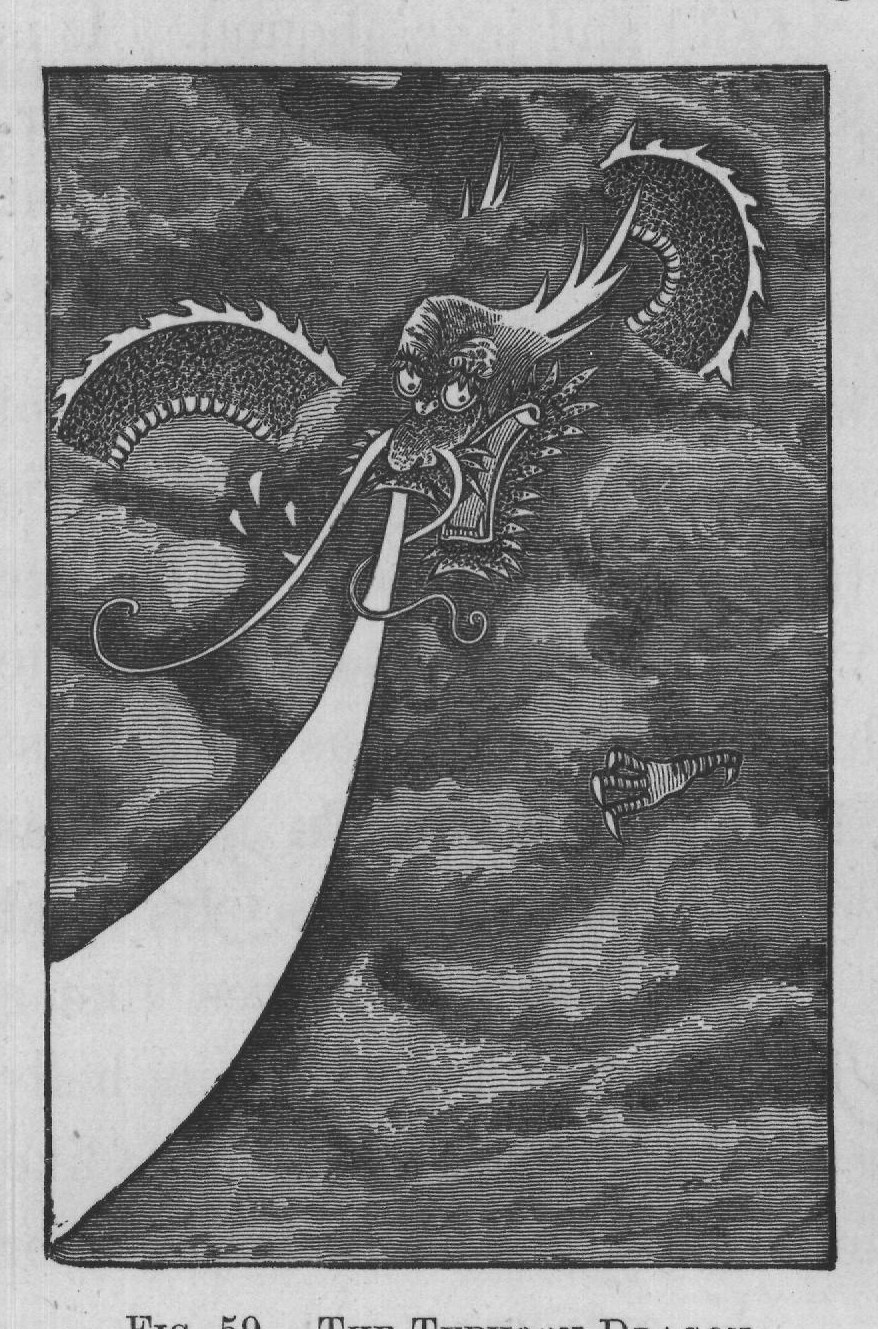
Mu, made up of extracts from upwards of eight hundred preceding authors, and including three volumes of illustrations by Li Shechin, of the Ming dynasty (probably born early in the sixteenth century A.D.). It was first printed in the Wăn-leih period (1573 to 1620). I give its article upon the dragon in extenso. "According to the dictionary of Hü Shăn, the character lung in the antique form of writing represents the shape of the animal. According to the Shang Siao Lun, the dragon is deaf, hence its name of lung (deaf). In Western books the dragon is called nake (naga). Shi-Chăn says that in the 'Rh Ya Yih of Lo-Yuen the dragon is described as the largest of scaled animals (literally, insects). Wang Fu says that the dragon has nine (characteristics) resemblances. Its head is like a camel's, its horns like a deer's, its eyes like a hare's,* its ears like a bull's, its neck like a snake's, its belly like an iguanodon's (?), its scales like a carp's, its claws like an eagle's, and its paws like a tiger's. Its scales number eighty-one, being nine by nine, the extreme (odd or) lucky number. Its voice resembles the beating of a gong. each side of its mouth are whiskers, under its chin is a bright pearl, under its throat the scales are reversed, on the top of its head is the poh shan, which others call the wooden foot-rule. A dragon without a foot-rule cannot ascend the skies. When its breath escapes it forms clouds, sometimes changing into rain, at other times into fire. Luh Tien in the P'i Ya remarks, when dragon-breath meets with damp it becomes bright, when it gets wet it goes on fire. It is extinguished by ordinary fire. On "The dragon comes from an egg, it being desirable to keep it folded up. When the male calls out there is a breeze above, when the female calls out there is a breeze below, in * The character for a hare is very like the character for a devil. The Japanese, in quoting this passage, have fallen into this error. consequence of which there is conception. The Shih Tien states, when the dragons come together they are changed into two small serpents. In the Siao Shwoh it is said that the disposition of the dragon is very fierce, and it is fond of beautiful gems and jade (?). It is extremely fond of swallow's flesh; it dreads iron, the mong plant, the centipede, the leaves of the Pride of India, and silk dyed of different (five) colours. A man, therefore, who eats swallow's flesh should fear to cross the water. When rain is wanted a swallow should be offered (used); when floods are to be restrained, then iron; to stir up the dragon, the mong plant should be employed; to sacrifice to Küh Yuen, the leaves of the Pride of India bound with coloured silk should be used (see Mayers, p. 107, § 326) and thrown into the river. Physicians who use dragons' bones ought to know the likes and dislikes of dragons as given above." " Dragons' Bones. * In the Pieh luh it is said that these are found in the watercourses in Tsin (Southern Shansi) and in the earth-holes which exist along the banks of the streams running in the caves of the T'ai Shan (Great Hill), Shantung. For seeking dead dragons' graves there is no fixed time. Hung King says that now they are largely found in Leung-yih (in Shansi?) and Pa-chung (in Szchuen). Of all the bones, dragon's spine is the best; the brains make the white earth striæ, which when applied to the tongue is of great virtue. The small teeth are hard, and of the usual appearance of teeth. The horns are hard and solid. All the dragons cast off their bodies without really dying. Han says the dragon-bones from Yea-cheu, Ts'ang- * The dragons' bones sold by apothecaries in China consist of the fossilized teeth and bones of a variety of species, generally in a fragmentary condition. The white earth striæ, or dragons' brains, here referred to, are probably asbestos. The asbestos sold in Chefoo market, under the name of Lung Ku or dragons' bones, is procured at O-tzu-kung. cheu and T'ai-yuen (all in Shansi) are the best. The smaller bones marked with wider lines are the female dragon's; the rougher bones with narrower lines are those of the male dragon; those which are marked with variegated colours are esteemed the best. Those that are either yellow or white are of medium value; the black are inferior. If any of the bones are impure, or are gathered by women, they should not be used. "P'u says dragons' bones of a light white colour possess great virtue. Kung says the bones found in Tsin (South Shansi) that are hard are not good; the variegated ones possess virtue. The light, the yellow, the flesh-coloured, the white, and the black, are efficacious in curing diseases in the internal organs having their respective colours, just as the five varieties of the chi* plant, the five kinds of limestone, and the five kinds of mineral oil (literally, fat), which remain still for discussion in this work. "Su-chung states: 'In the prefecture of Cheu kiün, to the "East of the River" (Shansi), dragons' bones are still found in large quantities.' "Li-chao, in the Kwoh-shi-pu, says: 'In the spring floods the fish leap into the Dragon's Gate, and the number of castoff bones there is very numerous. These men seek for medicinal purposes. They are of the five colours. This Dragon's Gate is in Tsin (Shansi), where this work (Kwoh-shi-pu) is published. Are not, then, these so-called dragons' bones the bones of fish?' "Again, quoting from Sun Kwang-hien in the Poh-mung Legends: 'In the time of the five dynasties there was a contest between two dragons; when one was slain, a village hero, Kw'an, got both its horns. In the front of the horns was an object of a bluish colour, marked with confused lines, * The boletus, supposed to possess mystic efficacy. which no one knew anything about, as the dragon was completely dead.' "Tsung Shih says: 'All statements [concerning dragons' bones] disagree; they are merely speculations, for when a mountain cavern has disclosed to view a skeleton head, horns and all, who is to know whether they are exuvia or that the dragon has been killed? Those who say they are exuvie, or that the dragon is dead, then have the form of the animal, but have never seen it alive. Now, how can one see the thing (as it really is) when it is dead? Some also say that it is a transformation, but how is it only in its appearance that it cannot be transformed ?' "Ki, in the present work, says that they are really dead dragons' bones; for one to say that they are exuvicæ is a mere speculation. "Shi Chăn says: The present work considers that these are really dead dragons' bones, but To Shi thinks they are exuvie. Su and Kan doubt both these statements.
They submit that dragons are divine beings, and resemble the principle of immortality (never-in-themselves-dying principle); but there is the statement of the dragon fighting and getting killed; and further, in the Tso-chw'en, in which it is stated that there was a certain rearer of dragons who pickled dragons for food [for the imperial table?].' "The I-ki says: In the time of the Emperor Hwo, of the Han dynasty, during a heavy shower a dragon fell in the palace grounds, which the Emperor ordered to be made into soup and given to his Ministers.' "The Poh-wuh-chi states that a certain Chang Hwa 'got dragon's flesh to dry, for it is said that when seasoning was applied the five colours appeared, &c. These facts prove that the dragon does die, an opinion which is considered correct by [the writers of] the present work.'" THE YUEN KIEN LEI HAN.
This is an encyclopædia in four hundred and fifty books or volumes, completed in 1710. More than eighty pages are devoted to the dragon. These, with all similar publications in China, consist entirely of extracts from old works, many of which have perished, and of which fragments alone remain preserved as above.
I have had the whole of this carefully translated, but think it unnecessary to trouble the reader, in the present volume, with more than the first chapter, which I give in the Appendix. There is also a description of the Kiao, of which I give extracts in the Appendix, together with others relating to the same creature, and to the T'o lung, from the Păn Tsao Kang Mu.
FIG. 60.-VIGNETTE. (After Hokusai.)