Home › The Chinese Dragon › The Chinese Dragon: Wylie
The Chinese Dragon: Wylie
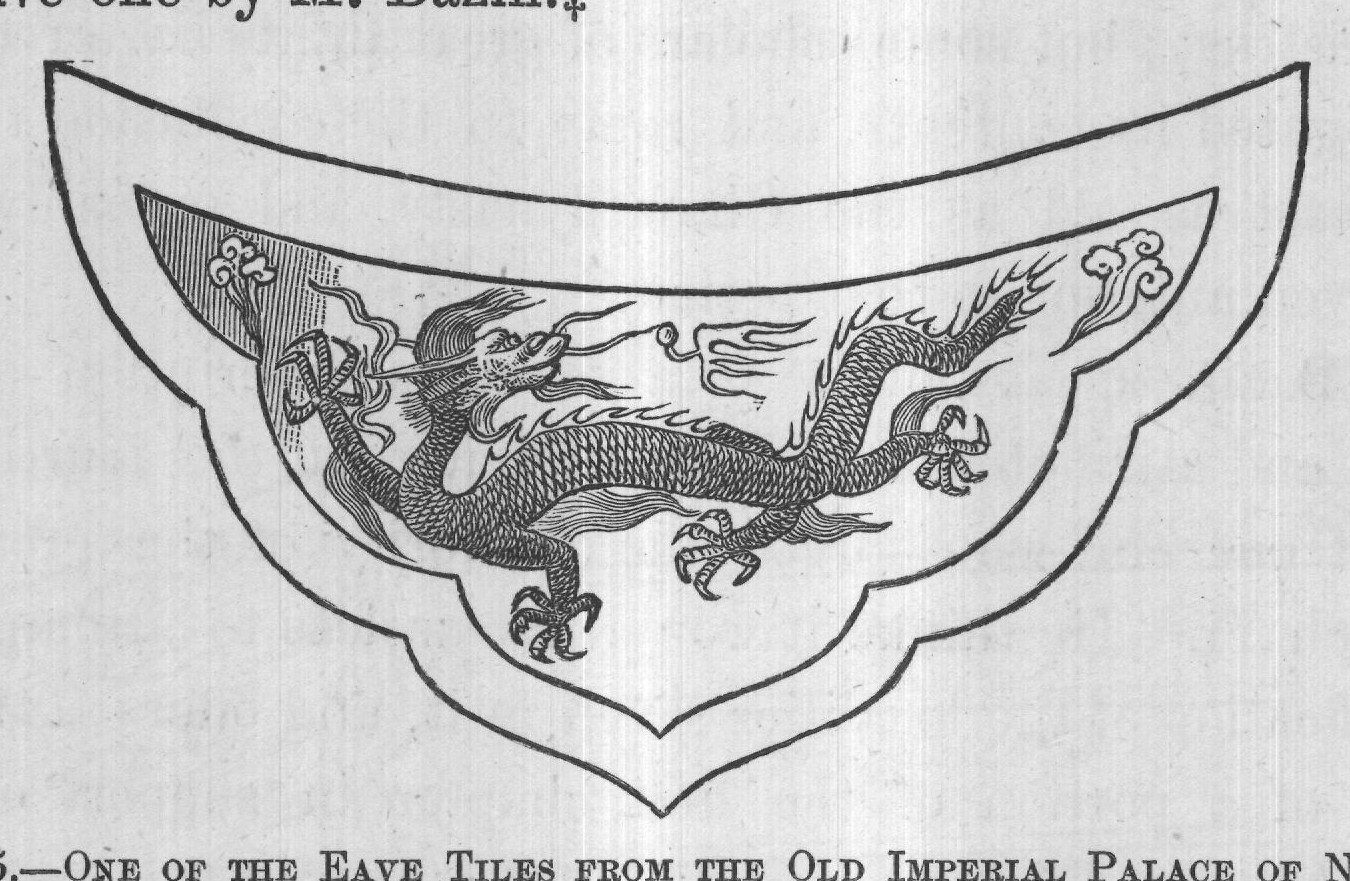
THE "SHAN HAI KING" OR CLASSIC OF MOUNTAIN AND SEAS. Short notices of this remarkable work are given by Mr. Alexander Wylie* and Dr. Bretschneider, † and a more exhaustive one by M. Bazin.‡ FIG. 45. ONE OF THE EAVE TILES FROM THE OLD IMPERIAL PALACE OF NANKIN, showing the Five-clawed or Imperial Dragon, an emblem which cannot be borne by any outside of the Imperial service, under the penalty of death. Commoners have to be satisfied with a four-clawed dragon.
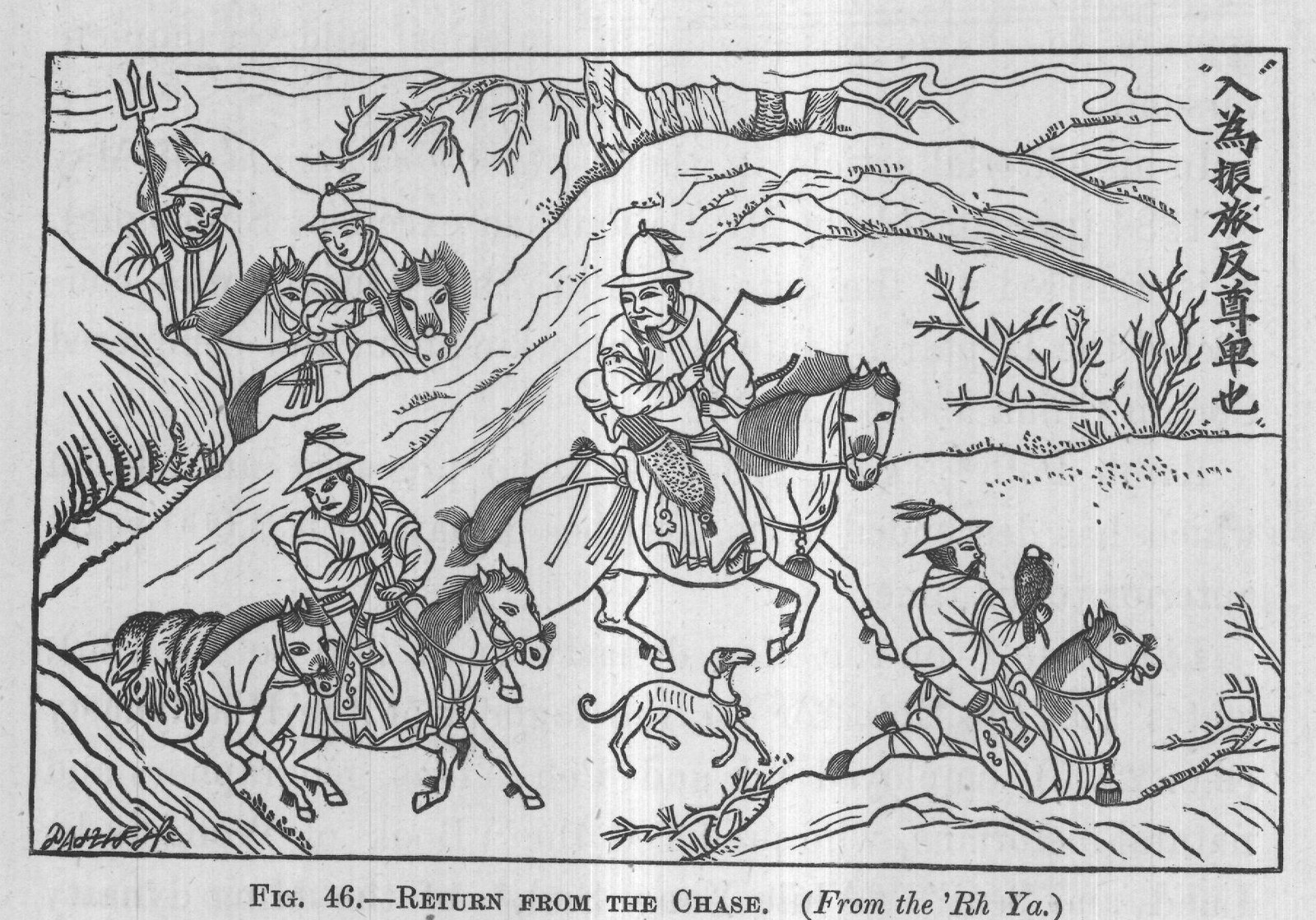
DALZHE A 入為振旅反尊卑也 FIG. 46. RETURN FROM THE CHASE. (From the 'Rh Ya.) * Notes on Chinese Literature, A. Wylie, Shanghai and London, 1867. † "Bot. Sin." in Journal of N. China Branch R. A. S., 1881. ‡ Journal Asiatique, Extr. No. 17 (1839).
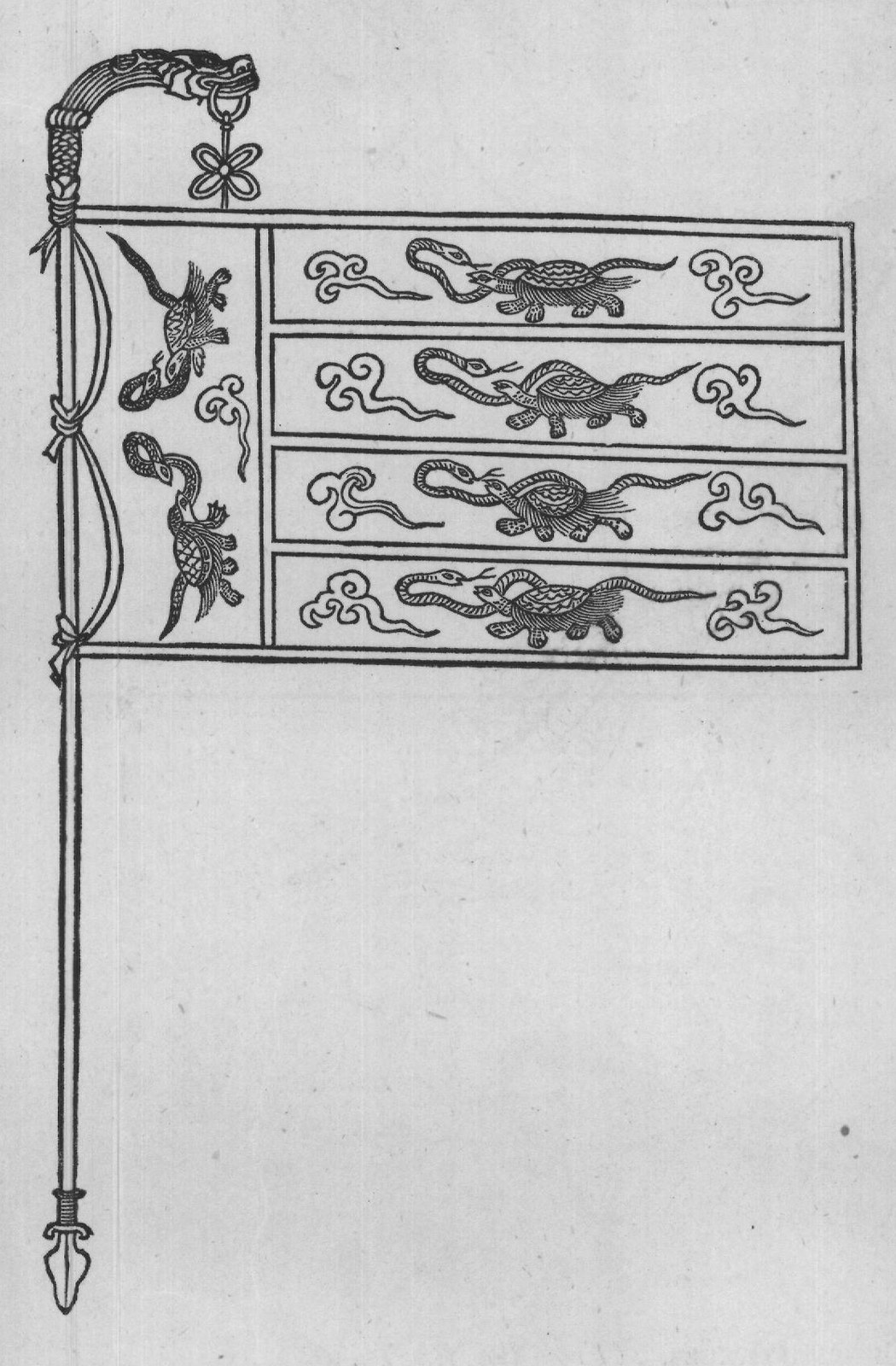
It is also largely quoted by Williams in his valuable Chinese dictionary. Otherwise Sinologues appear to have entirely ignored it.
Mr. Wylie remarks that "it has long been looked upon with distrust; but some scholars of great ability have recently investigated its contents, and come to the conclusion that it is at least as old as the Chow dynasty, and probably of a date even anterior to that period."
M. Bazin speaks of it as a fabulous description of the world, and attributes it to Taouist writers in the fourth century of our era, who forged the authority of the great Yü and Peh Yi. He thinks it would be useless to attempt the identification of the localities given in it, and offers a translation of a portion of the first chapter in support of his views.
The value of his translation is impaired by his making no distinction between the text and the commentary, and he appears to have possessed an inferior and incomplete version.
In an editorial article in the North China Herald of May 9, 1884 (presumably by Mr. Balfour, an excellent Sinologue), it is referred to the date of Ch'in Shih Huang, who connected the Heptarchy into a single kingdom, and conquered Cochin China about в.c. 222.
Kwoh Po'h* (A.D. 276-324), who prepared an edition which has descended to us, ascribes a date to it 3,000 years anterior to his time.
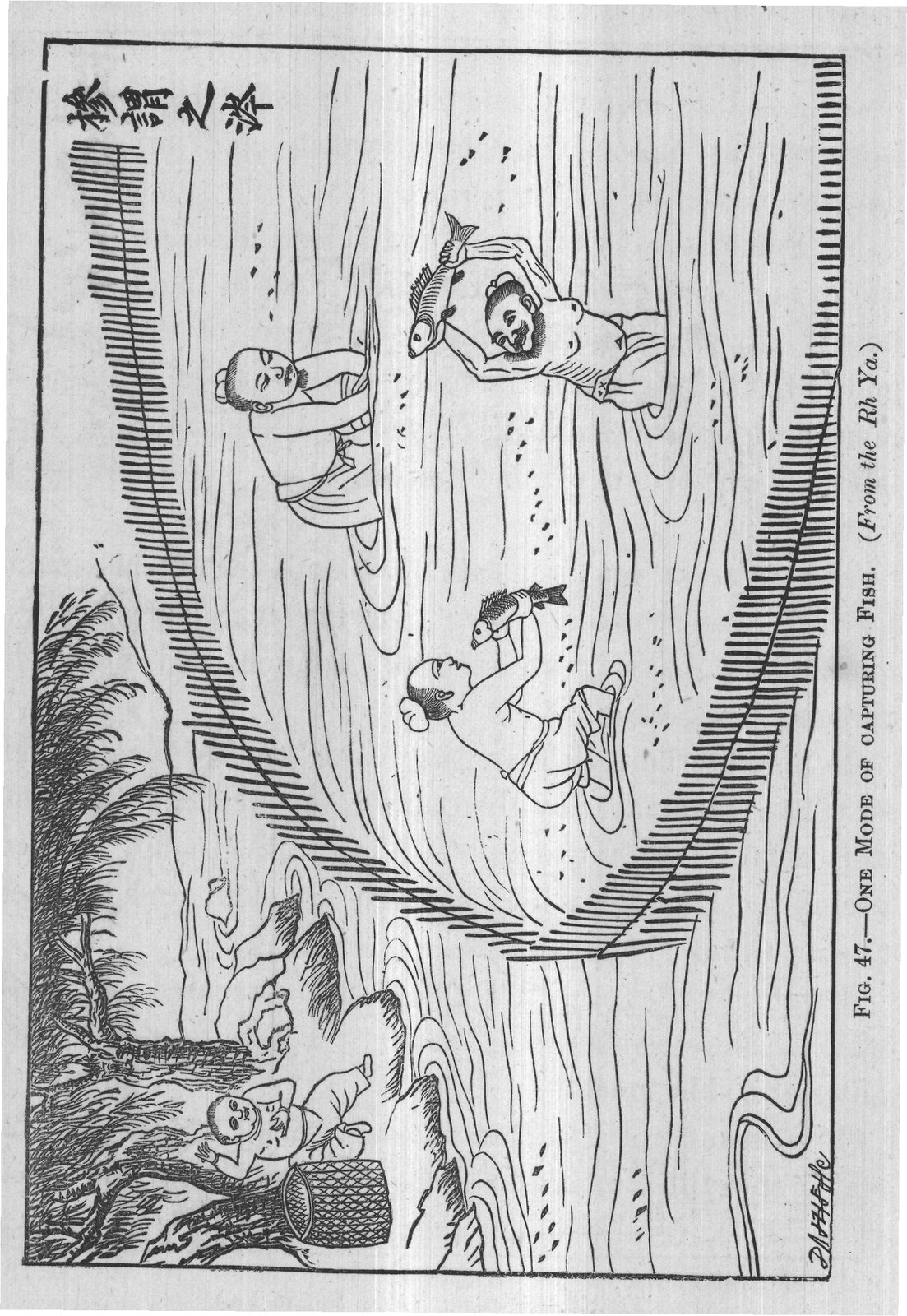
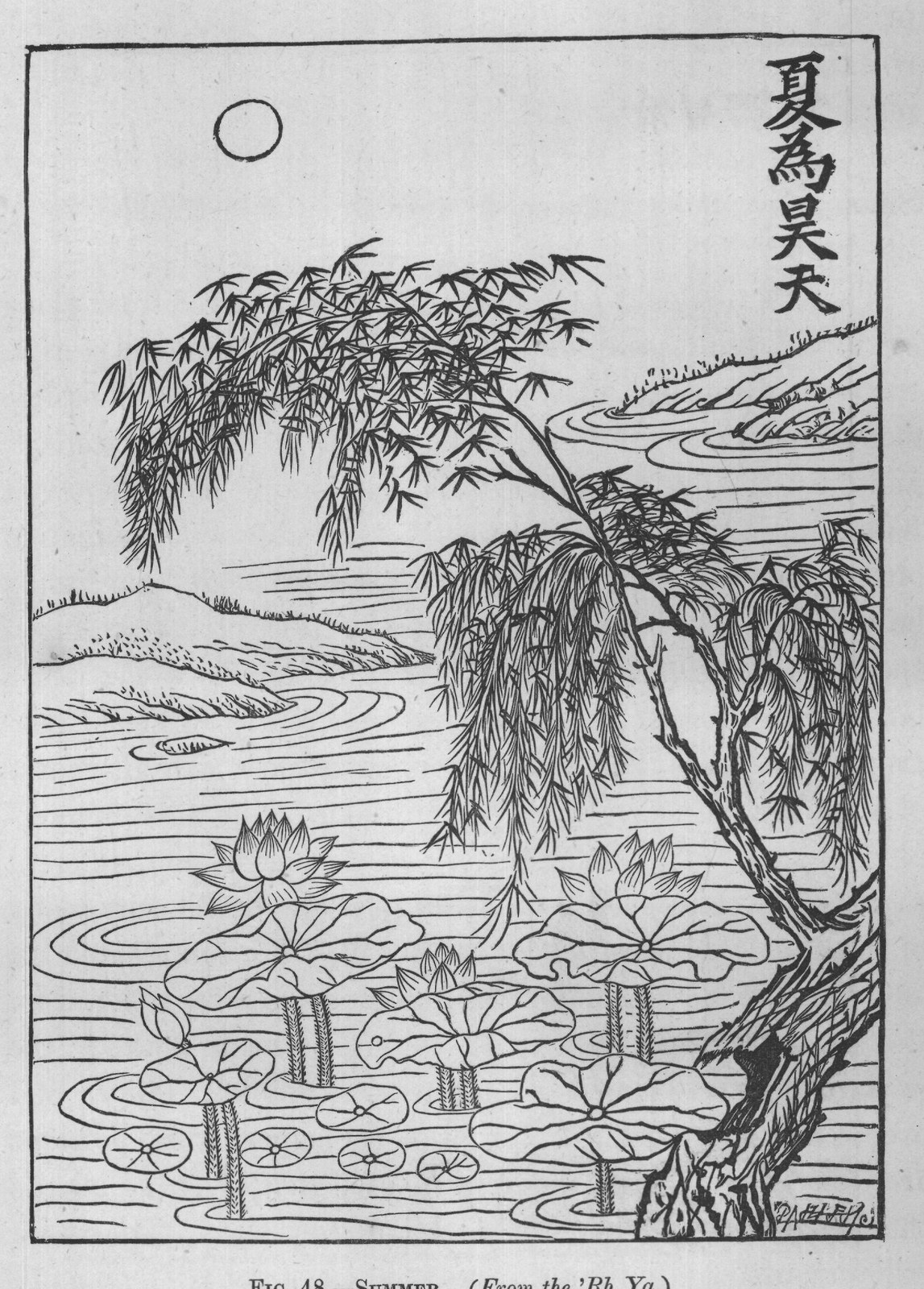
Liu Hsiu,* of the Han dynasty (B.C. 206 to A.D. 25), states that the Emperor Yü, the founder of the Hia dynasty (в.c. 2205), employed Yih and Peh Yi as geographers and natural historians, who produced the "Book of Wonders by Land and Sea." While Yang Sun, * of the Ming dynasty * The three prefaces by these authors are given in extenso in the Appendix to this Chapter, 摻謂之涔 0000 FIG. 47. ONE MODE OF CAPTURING FISH. (From the Rh Ya.) HAHAVE 15 * 夏為昊天 FIG. 48. SUMMER. (From the 'Rh Ya.) (commencing A.D. 1368), states in his after-preface that the Emperor Yü had nine metal vases cast, on which all wonderful or rare animals were engraved, the commoner ones being recorded in the annals of Yü; and that K'ung Kiah (of the Hia dynasty, в.c. 1879), included this varied information in the present work. It is to be hoped that at no distant date some competent Sinologue will be induced to furnish a full translation of this remarkable work, with an adequate commentary.
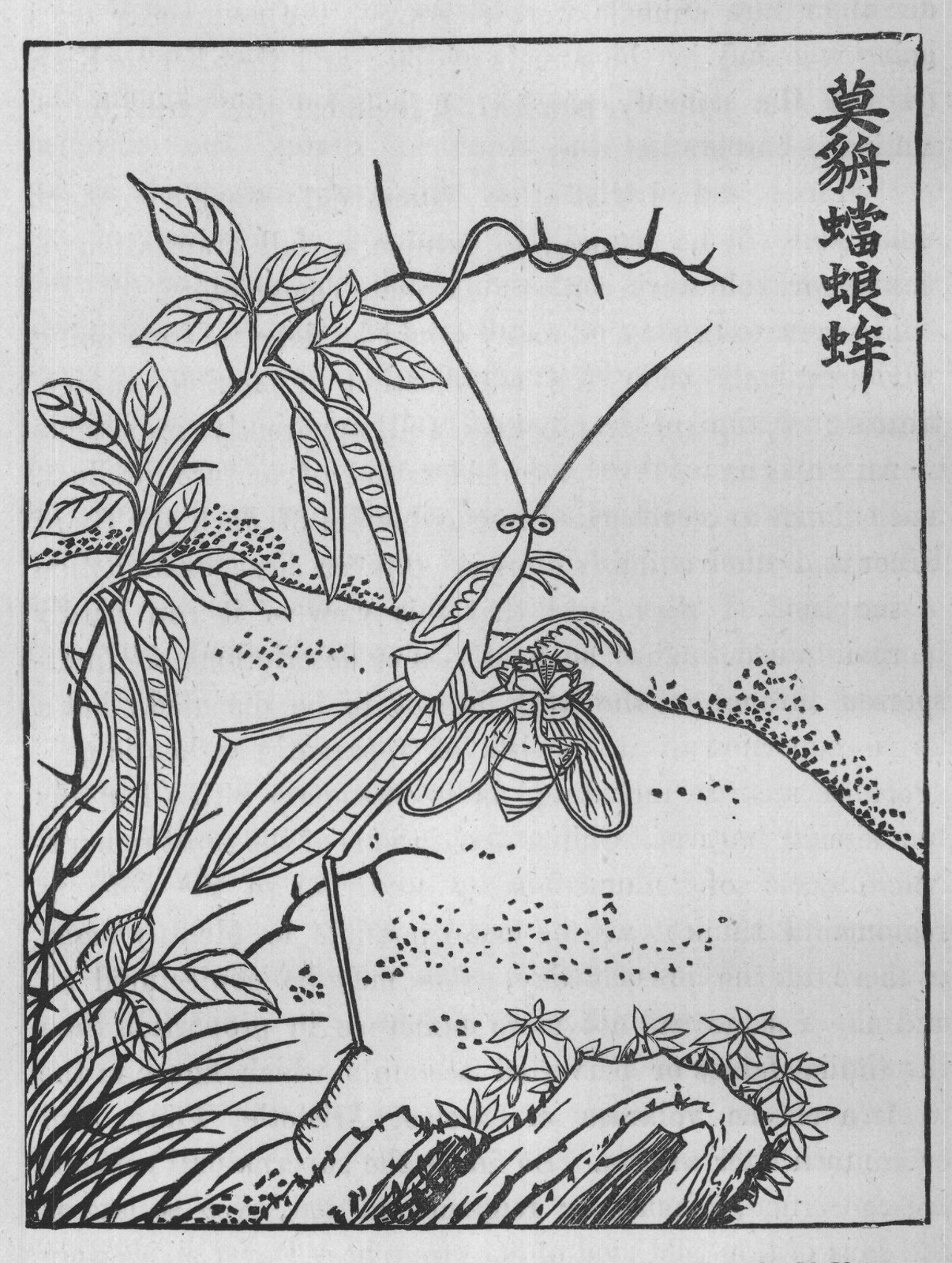
There is no doubt that many would be deterred from doing so by an impression that a collection of fabulous stories, treating of supernatural beings and apparently impossible monsters, is unworthy the consideration of mature intellect, and only fit to be relegated to the domain of Jack the Giant Killer and other childish stories. After a close examination of the book, I apprehend that this view of it can hardly be maintained. That such stories or descriptions are interspersed throughout the work is not to be disputed; but a large proportion of it consists of apparently authentic geographical records, including, as is customary with all works of a similar nature in China, descriptions of the most remarkable objects of natural history occurring in the different regions. I think it will be found possible to identify many of these at the present day, some may be conjectured at, and the residue are not more numerous in proportion than the similar fables or perverted accounts which figure in the western classic volumes of Ctesias, Aristotle, Pliny, and even much later writers. So far as the supernatural portions are concerned, it must be remembered that, even so late as the days of the childhood of Sir Humphrey Davy, pixies were still supposed by the lower classes to trace the fairy rings in Cornwall; that quite lately, and perhaps among certain classes to the present day, the existence of the banshee in Ireland, of the kelpie in Scotland, and of persons gifted with the mysterious and awe-inspiring power of second sight, 莫掰燴蝮蜂 FIG. 49. MANTIS (A VERY CHARACTERISTIC FIGURE). (From the 'Rh Ya.) was religiously believed in. There are few important houses in England whose ancestral walls have not concealed an apparition connected with the destinies of the family, appearing only on fatal or eventful occasions; and in the days of the sapient James I. in England, and among the Pilgrim Fathers in the American States, the existence of wizards and witches was universally accepted as an undeniable fact, proved by hundreds of instances of extorted or voluntary confession, and supplemented by the concurrent testimony of a still greater number of witnesses who genuinely believed themselves to have been the spectators or victims of the supernatural powers of the accused. An historian of these later times might well have described such things as realities, and we should not be disposed, on account of his having done so, to question the validity of his description of other objects or creatures existing at the period, presuming them to be more consistent with our present notions of possibility.
No one, now-a-days, would discredit the veracity of Marco Polo because he speaks of enormous serpents in Carajan, possessing two feet, each armed with a single claw. That there was a solid foundation for his story is admitted, and commentators are only at variance as to whether the basis was a large species of python, such as still exists in Southern China, or a gigantic alligator, of which he might have seen a mutilated specimen.
It must also be borne in mind that the existence of some gigantic saurian, now extinct, possessing two limbs only, in place of four, is not an impossibility; as the small lizard, Chirotes, is in that condition, and also the North American genus Siren, belonging to the Newts.