Home › The Japanese Dragon › The Japanese Dragon: China
The Japanese Dragon: China
The third story runs as follows :- The White Dragon. "There is a very large pond at the eastern part of Fu-simi-shi-ro-yama, at Yama-shiro (near Kioto); it is called * The idea of the eight heads probably originated in China; thus, in the caves in Shantung, near Chi-ning Chou, among carvings of mythological figures and divinities, dating from A.D. 147, we find a tiger's body with eight heads, all human. † Mourakoumo means "clouds of clouds"; ama means "heaven"; tsurogi means "sword."
Ukisima. In the fine weather little waves rise up on account of its size. There are many turtles in it. In the summertime many boys go to the pond to swim, but never go out into the middle or far from the shore. No one is aware how deep the centre of the pond is, and it is said that a white dragon lives in that pond, and can transform itself into a bird, which the people of the district call O-gon-cho, i.e. golden bird, because, when it becomes a bird, it has a yellow plumage. The bird flies once in fifty years, and its voice is like the howling of a wolf. In that year there is famine and pestilence, and many people die. Just one hundred years ago, when this bird flew and uttered its cry, there was a famine and drought and disease, and many people died. Again, at Tempo-go-nen (i.e. in the fifth year of Tempo), fifty years back from the present time, the bird flew as before, and there was once again disease and famine. Hence the people in that district were much alarmed, as it is now just fifty years again. They hoped, however, that the bird would not fly and cry. But at 2 A.M. of the 19th April it is said that it was seen to do so. The people, therefore, were surprised, and now are worshipping God in order to avert the famine and disease. The old farmers say, in the fine weather the white dragon may occasionally be seen floating on the water, but that if it sees people it sinks down beneath the surface." * As a pendant to this I now quote a memorial from the Pekin Gazette of April 3rd, 1884, of which a translation is given in the North China Herald for May 16th, 1884. "A Postscript Memorial of P'an Yü requests that an additional title of rank, and a tablet written by His Majesty's * White snakes are occasionally, although rarely, seen in Japan. They are supposed to be messengers from the gods, and are never killed by the people, but always taken and carried to some temple. The white snake is worshipped in Nagasaki at a temple called Miyo-ken, at Nishi-yama, which is the northern part of the city of Nagasaki. own hand, may be conferred on a dragon spirit, who has manifested himself and answered the prayers made to him. "In the Ang-shan mountains, a hundred li from the town of Kuei-hai, there are three wells, of which one is on the mountain top, in a spot seldom visited. It has long been handed down that a dragon inhabits this well. If pieces of metal are thrown into the well they float, but light things, as silk or paper, will sink. If the offerings are accepted, fruits come floating up in exchange. Anything not perfectly pure and clean is rejected and sent whirling up again. The spirit dwells in the blackest depths of the water, in form like a strange fish, with golden scales and four paws, red eyes and long body. He ordinarily remains deep in the water without stirring. But in times of great drought, if the local authorities purify themselves, and sincerely worship him, he rises to the top. He is then solemnly conveyed to the city, and prayers for rain are offered to him, which are immediately answered. His temple is in the district city, on the To'ang-hai Ling. The provincial and local histories record that tablets to him have been erected from the times of the Mongol and the Ming dynasties. During the present dynasty, on several occasions, as, for instance, in the years 1845 and 1863, he has been carried into the city, and rain has fallen immediately. Last year a dreadful drought occurred, in which the ponds and tanks dried up, to the great terror of the people. On the 15th day of the eighth month, the magistrate conducted the spirit into the city, and, with the assembled multitude, prayed to him fervently; thereupon a gentle rain, falling throughout the country, brought plenty in the place of scarcity, and gladdened the hearts of all. At about the same time, the people of a district in the vicinity, called Chin-yü, also had recourse to the spirit, with equally favourable results. These are well-known events, which have happened quite recently. "It is the desire of the people of the district that some mark of distinction should be conferred on the spirit; and the memorialist finds such a proceeding to be sanctioned both by law and precedent; he therefore humbly lays the wishes of the people before His Majesty, who, perhaps, will be pleased to confer a title and an autograph tablet as above suggested. The Rescript has already been recorded. "No. 6 of Memorial."
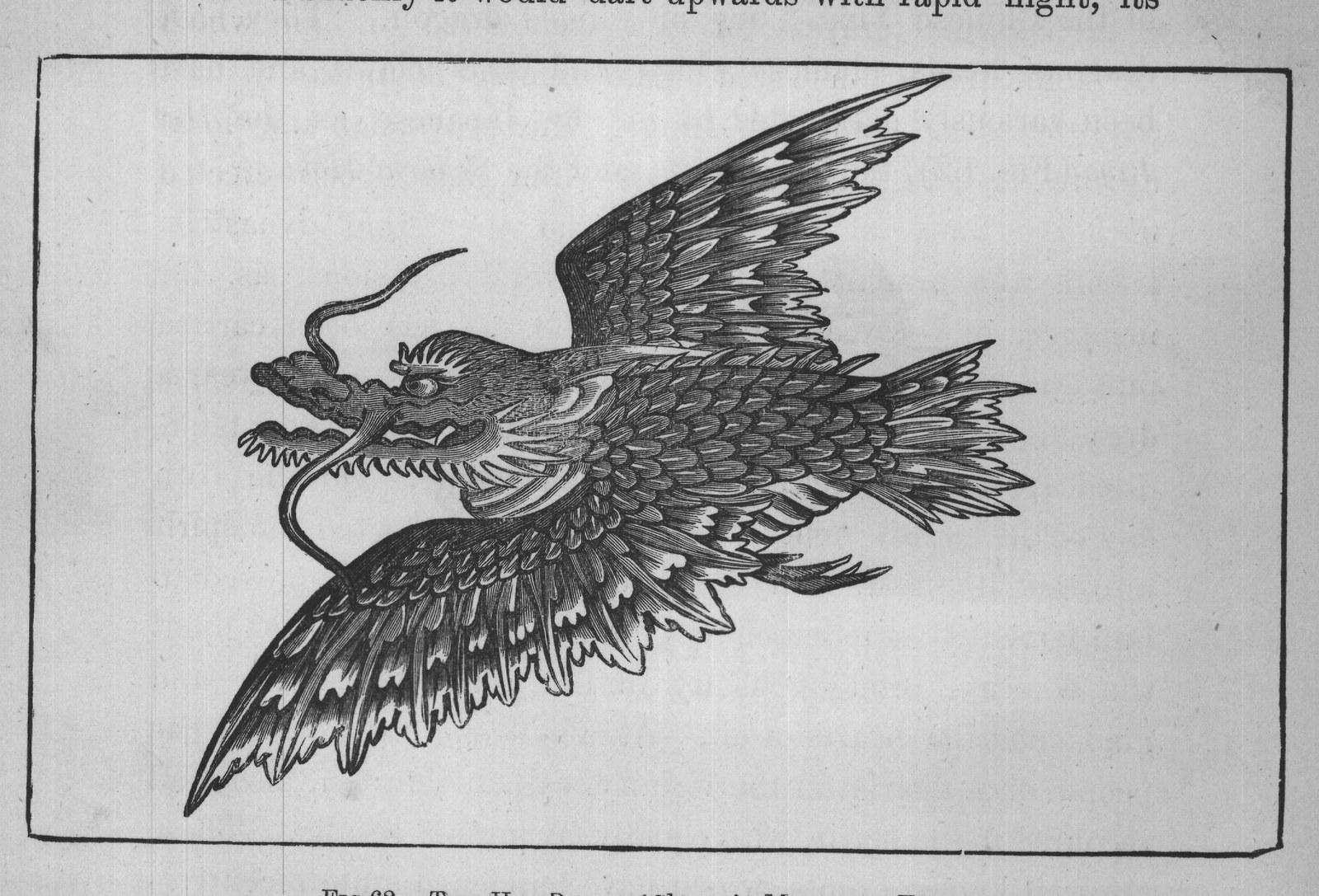
The idea of the transformation of a sea-monster or dragon into a bird is common both to China and Japan; for instance, in The Works of Chuang Tsze, ch. i. p. 1, by F. H. Balfour, F.R.G.S., we read that- "In the Northern Sea there was a fish, whose name was kwʻên. It is not known how many thousand li this fish was in length. It was afterwards transformed into a bird called p'êng, the size of whose back is uncertain by some thousands of li. Suddenly it would dart upwards with rapid flight, its FIG.62. THE HAI RIYO. (Chi-on-in Monastery, Kioto.) wings overspreading the sky like clouds. When the waters were agitated [in the sixth moon] the bird moved its abode to the Southern Sea, the Pool of Heaven. In the book called Ts'i Hich, which treats of strange and marvellous things, it is said that when the pêng flew south, it first rushed over three thousand li of water, and then mounted to the height of ninety thousand li, riding upon the wind that blows in the sixth moon. The wild horses, i.e. the clouds and dust of heaven, were driven along by the zephyrs. The colour of the sky was blue; yet, is that the real colour of the sky, or only the appearance produced by infinite, illimitable depths? For the bird, as it looked downwards, the view was just the same as it is to us when we look upwards."
On the screens decorating the Chi-on-in monastery in Kioto, are depicted several composite creatures, half-dragon, half-bird, which appear to represent the Japanese rendering of the Chinese Ying Lung or winged dragon. They have dragons' heads, plumose wings, and birds' claws, and have been variously designated to me by Japanese as the Hai Riyo (Fig. 62), the Tobi Tatsu, and the Schachi Hoko. FIG. 63.-JAPANESE DRAGON (BRONZE) うどんんろ少男 夢 にて取 ろろ で男 坐 五にかけず劣 瓦氏生 以罗里 あと五羽 も