Home › Conclusion of Dragon Chapters › Conclusion of Dragon Chapters
Conclusion of Dragon Chapters
The numerous quotations given in the above pages, or in the Appendix, are merely a selection, and by no means profess to be so extensive as they should be were this work a monograph on the dragon alone. Having a special object in view, I have forborne to diverge into those interesting speculations which relate to its religious significance; these I leave to those who deal specially with this portion of its history. I therefore pass over the many traditions and legends regarding it contained in the pages of the Memoirs of Hiouen-Thsang,* of Foě Kouě Ki,† and similar narratives, and * Mémoires sur les Contrées occidentales, traduits du Sanscrit en Chinois en l'an 648; et du Chinois en Francais, par M. Stanislas Julien. 2 vols., Paris, 1857. † Foě Kouě Ki, ou Relation des Royaumes Bouddhiques, par Che Fa omit quoting folk-lore from the pages of Dennys, Eitel, and others who have written on the subject.
For my purpose it would be profitless to collate legends such as that given in the Apocrypha, in the story of Bel and the Dragon, and reappearing in the pages of El Edrisi as an Arab legend, with Alexander the Great as the hero, and the Canaries as the scene, or to dwell on the Corean and Japanese versions of dragon stories, which are merely borrowed, and corrupted in borrowing, from the Chinese. Nor shall I do more than allude to the fact that dragons are represented in the Brahminical caves at Ellora, and among the sculptures of Ancoar Wat in Cambodia.
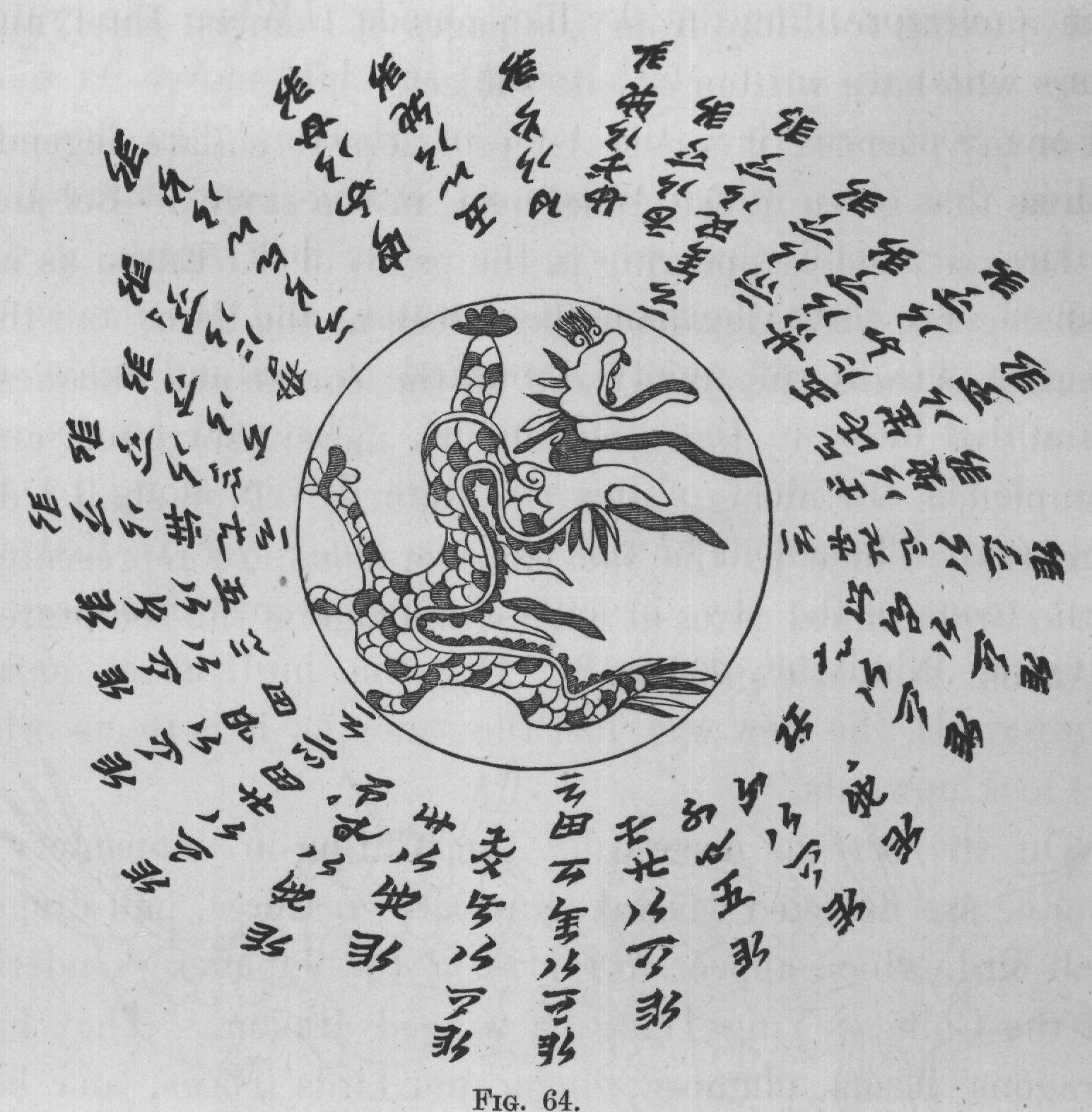
FIG. 65.
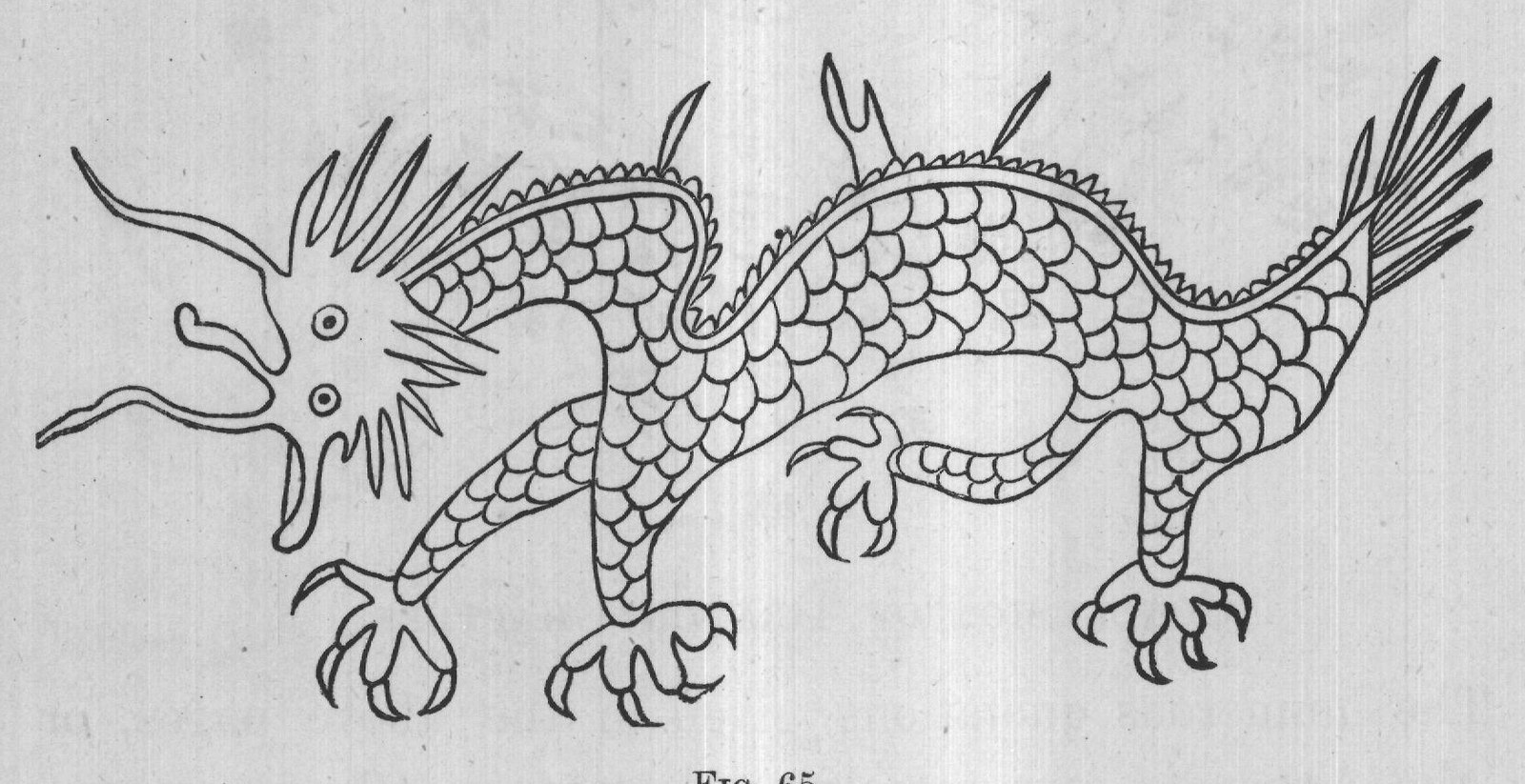
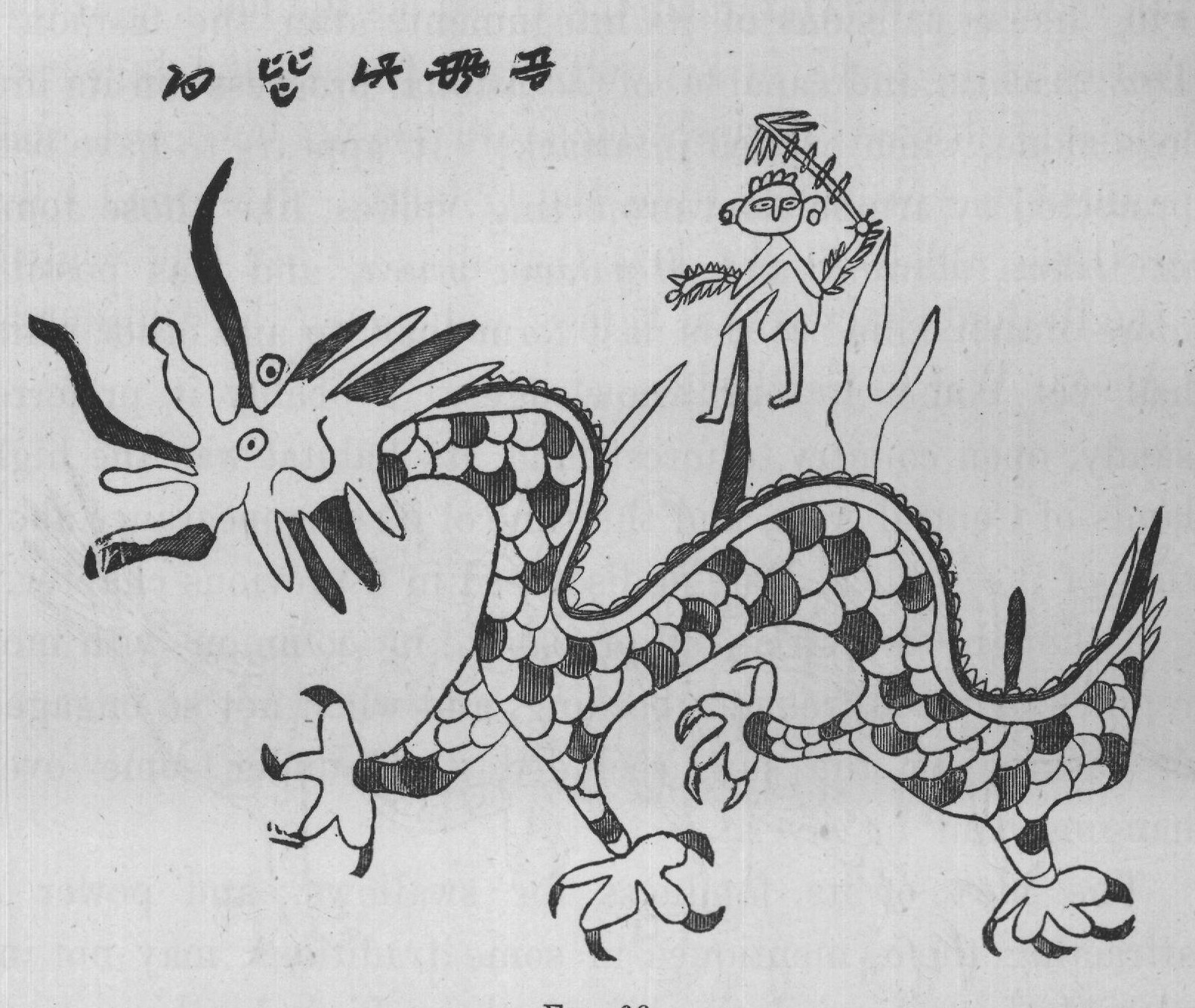
The rude diagrams, Figs. 64, 65, 66, are facsimiles from a manuscript of folio size in the possession of J. Haas, Esq., Imperial Austro-Hungarian Vice-Consul for Shanghai, which he kindly placed at my disposal. This unique volume is at present, unfortunately, unintelligible. It comes from the western confines of China, and is believed to be an example of the written Lolo language, that is, of Hien. Translated from the Chinese by M. Abel Remusat; Paris, 1836. This volume contains a number of very interesting dragon legends, and quaint conceits about them; but I find nothing in it to supplement my materialistic argument, the language of the aboriginal tribes of China. They suffice to show that the same respect for the dragon is shown among these people as in China; but no opinion can be offered as to whether this belief and respect is original or imported, until their literature has been examined.
FIG. 66.
I regret that I am unable to give in this volume, as I had wished, an account of the Persian dragon, which, I am informed, is contained in a rare Persian work.
In conclusion, I must hope that the reader who has had the patience to wade through the medley of extracts which I have selected, and to analyse the suggestive reasoning of the introductory chapters, will agree with me that there is nothing impossible in the ordinary notion of the traditional dragon; that such being the case, it is more likely to have once had a real existence than to be a mere offspring of fancy; and that from the accident of direct transmission of delineations of it on robes and standards, we have probably a not very incorrect notion of it in the depicted dragon of the Chinese.
We may infer that it was a long terrestrial lizard, hibernating, and carnivorous, with the power of constricting with its snake-like body and tail; possibly furnished with wing-like expansions of its integument, after the fashion of Draco volans, and capable of occasional progress on its hind legs alone, when excited in attack. It appears to have been protected by armour and projecting spikes, like those found in Moloch horridus and Megalania prisca, and was possibly more nearly allied to this last form than to any other which has yet come to our knowledge. Probably it preferred sandy, open country to forest land, its habitat was the highlands of Central Asia, and the time of its disappearance about that of the Biblical Deluge discussed in a previous chapter. Although terrestrial, it probably, in common with most reptiles, enjoyed frequent bathing, and when not so engaged, or basking in the sun, secluded itself under some overhanging bank or cavern. The idea of its fondness for swallows, and power of attracting them, mentioned in some traditions, may not impossibly have been derived from these birds hawking round and through its open jaws in the pursuit of the flies attracted by the viscid humours of its mouth. We know that at the present day a bird, the trochilus of the ancients, freely enters the open mouth of the crocodile, and rids it of the parasites affecting its teeth and jaws.