Home › The Dragon › The Dragon: Celtic
The Dragon: Celtic
The dragon plays an important part in Celtic mythology. Among the Celts, as with the Romans, it was the national standard.
While Cymri's dragon, from the Roman's hold Spread with calm wing o'er Carduel's domes of gold.* The fables of Merllin, Nennius, and Geoffry describe it as red in colour, and so differing from the Saxon dragon which was white. The hero Arthur carried a dragon on his helm, and the tradition of it is moulded into imperishable form in the Faerie Queen. A dragon infested Lludd's dominion, and made every heath in England resound with shrieks on each May-day eve. A dragon of vast size and pestiferous breath lay hidden in a cavern in Wales, and destroyed two districts with its venom, before the holy St. Samson seized and threw it into the sea.
In Celtic chivalry, the word dragon came to be used for chief, a Pendragon being a sort of dictator created in times of danger; and as the knights who slew a chief in battle were said to slay a dragon, this doubtless helped to keep alive the popular tradition regarding the monster which had * Lord Lytton, King Arthur, Book i. Stanza 4. been carried with them westward in their migration from the common Aryan centre.
The Teutonic tribes who invaded and settled in England bore the effigies of dragons on their shields and banners, and these were also depicted on the ensigns of various German tribes.* We also find that Thor himself was a slayer of dragons, and both Siegfried and Beowulf were similarly engaged in the Niebelungen-lied and the epic bearing the name of the latter. The Berserkers not only named their boats after the dragon, but also had the prow ornamented with a dragon figure-head; a fashion which obtains to the present day among the Chinese, who have an annual dragonboat festival, in which long snaky boats with a ferocious dragon prow run races for prizes, and paddle in processions. So deeply associated was the dragon with the popular legends, that we find stories of encounters with it passing down into the literature of the Middle Ages; and, like the heroes of old, the Christian saints won their principal renown by dragon achievements. Thus among the dragon-slayers§ we find that- 1. St. Phillip the Apostle destroyed a huge dragon at Hierapolis in Phrygia. 2. St. Martha killed the terrible dragon called Tarasque at Aix (la Chapelle). 3. St. Florent killed a similar dragon which haunted the Loire. 4. St. Cado, St. Maudet, and St. Paul did similar feats in Brittany. * Chamber's Cyclopædia, 1881. † J. Grimm, Deutsche Mythologie, vol. ii. p. 653. † A dragon without wings is called a lintworm or lindworm, which Grimm explains to mean a beautiful or shining worm (here again we have a corroboration of the idea of the gold and silver dragon given ante.) § Brewer's Dictionary of Phrase and Fable. 5. St. Keyne of Cornwall slew a dragon. 6. St. Michael, St. George, St. Margaret, Pope Sylvester, St. Samson, Archbishop of Dol, Donatus (fourth century), St. Clement of Metz, killed dragons. 7. St. Romain of Rouen destroyed the huge dragon called La Gargouille, which ravaged the Seine.
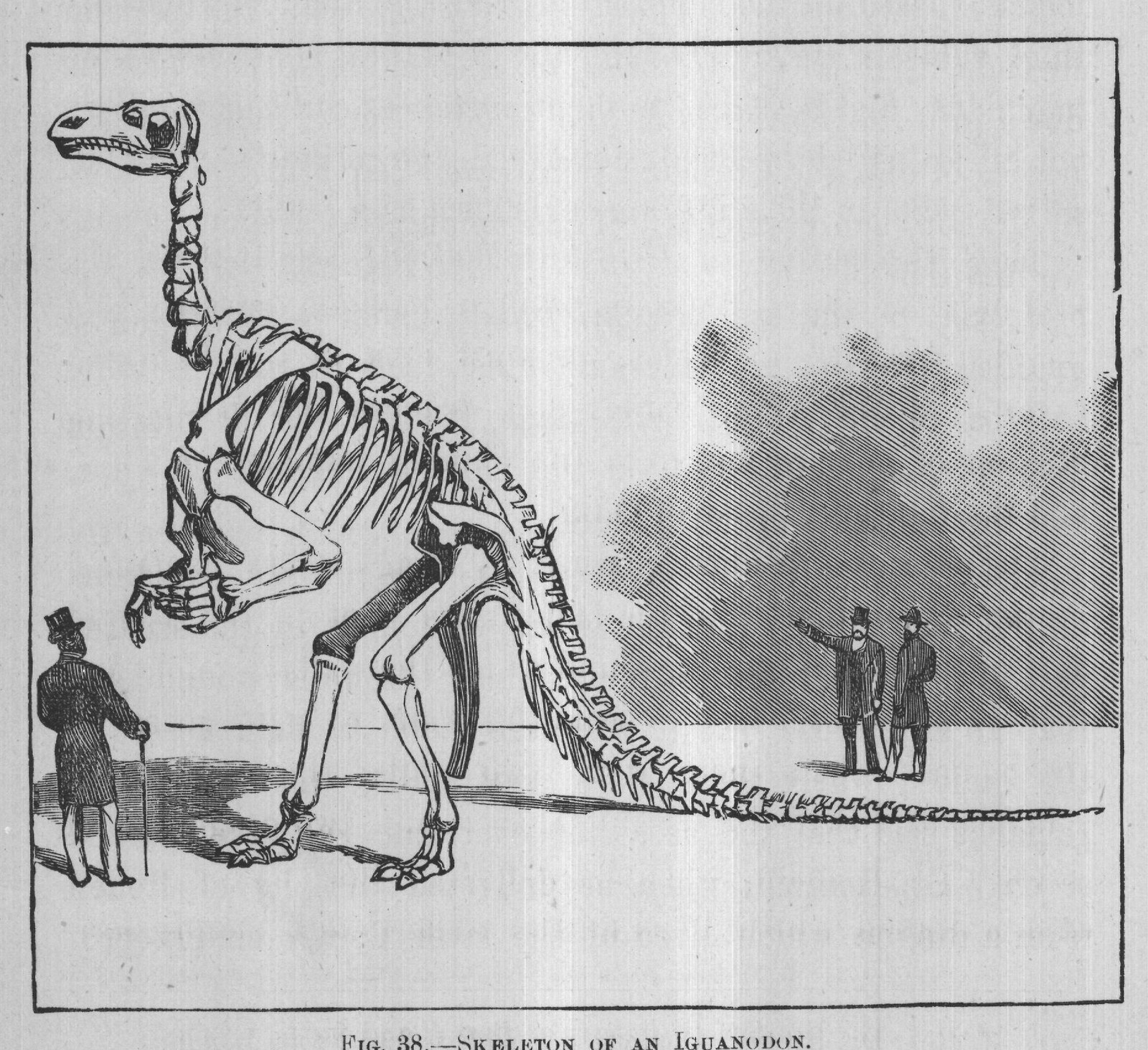
Moreover, the fossil remains of animals discovered from time to time, and now relegated to their true position in the zoological series, were supposed to be the genuine remains of either dragons or giants, according to the bent of the mind of the individual who stumbled on them: much as in the present day large fossil bones of extinct animals of all kinds are in China ascribed to dragons, and form an important item in the Chinese pharmacopeia. (Vide extract on FIG. 38. SKELETON OF AN IGUANODON.
Dragon bones from the Pen-tsaou-kang-mu, given on pp. 244 -246.) The annexed wood-cut of the skeleton of an Iguanodon, found in a coal-mine at Bernissant, exactly illustrates the semi-erect position which the dragon of fable is reported to have assumed.