Home › The Whooping-Crane › The Whooping-Crane: Flamingoesthat
The Whooping-Crane: Flamingoesthat
There are two kinds of Flamingoesthat of America is of a deep red, while the In the summer the flock of the Flam- one in Asia and Africa is rose-colored, ingoes will take a journey northward as with black wings. In old times the flesh far as the Rhine. When they are on the of the Flamingo was considered a dainty, wing they have a very splendid appear- and even now the young bird is thought ance. They look like a great fiery triangle. by some people to taste like partridge. All at once they slacken their speed, hover But the people in these days, who have for a moment, and then alight on the tasted it, say it is very disagreeable. banks of the river. They range them- There was a tame Flamingo that lived selves in the usual line, place their guards, a little time in our latitude. It used to and begin at once to fish. dip its bread in water, and to eat more in the night than in the day. It was very impatient of cold, and would go so near to the fire as to burn its toes. One of its legs was hurt by an accident, and it could not use it. But it contrived to walk all the same, for it put its head to the ground and used its long neck as a crutch.
A. Singular Nest.
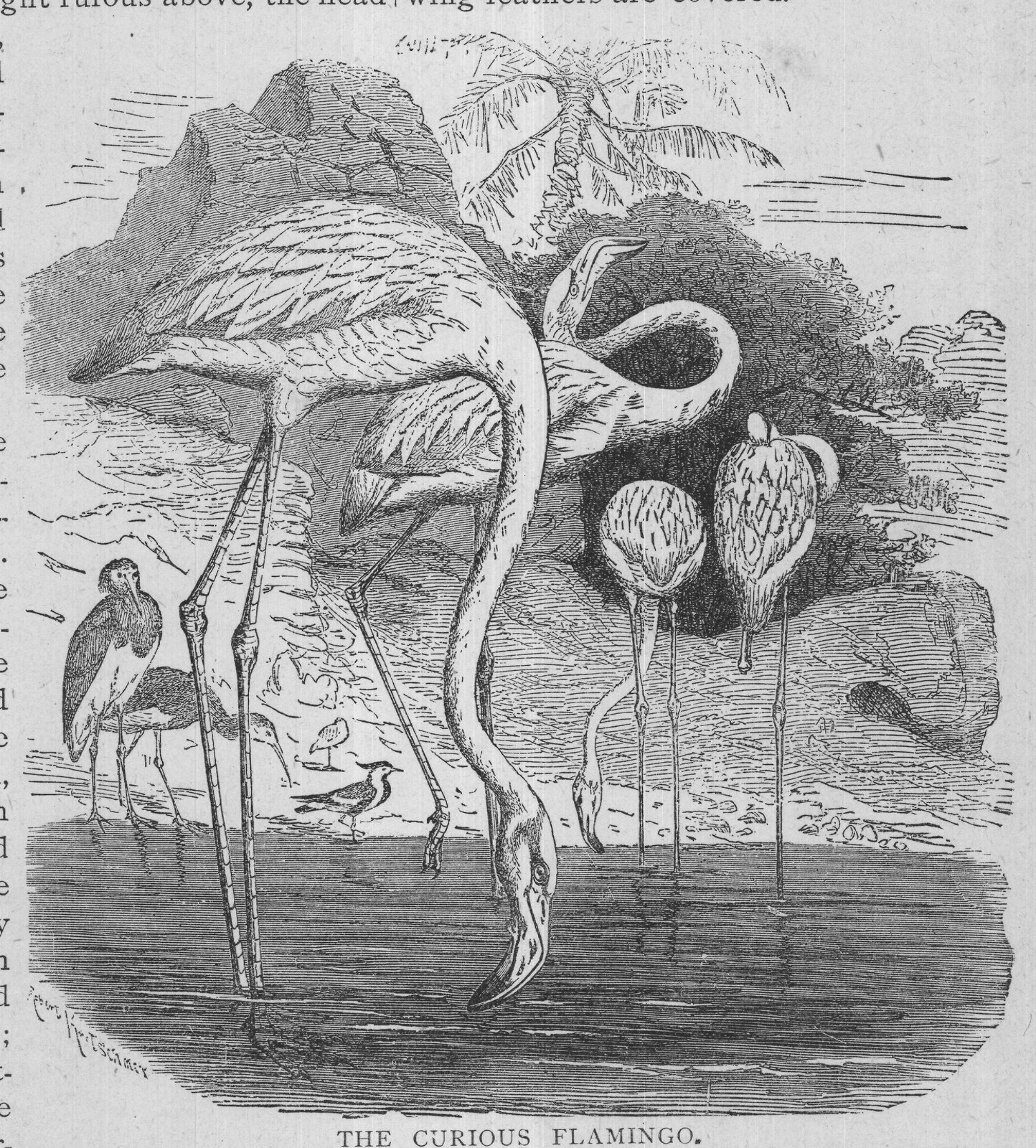
Considering the enormous length of its legs, you would wonder how the bird contrives to hatch its eggs, or what kind of a nest it builds. It is a mason bird, and forms its nest of mud, in the shape of a hillock, with a hole at the top. Here the mother bird lays two eggs about the size As the Flamingo frequents the sea-coast of those of the goose. The nest is high and the adjacent marshes, it has the power enough to allow her to throw her legs of swimming, and its toes are partially across it and sit upon the eggs, in an atti- webbed; and thus it may fearlessly ventude as if she were riding. The Flam-ture even beyond its depth, nor apprehend ingo sitting on its nest in this manner has being carried away by the retiring tide. been compared to a man on a high stool, Its food consists of small fish, shells, and with his legs hanging down. The nest water insects, for the capture of which its itself is very curious, and is solid nearly beak is most singularly constructed. to the top, and then hollow like a basin.
The bottom of the nest is in the water, The Pheasants have a short, convex, and the bird usually has its feet in the and strong bill, the head more or less water. In some parts of the tropics, the covered with carunculated bare flesh on birds are tamed for the sake of their skin, the sides, which, in some species, is conwhich is used in swans'-down. They are tinued upwards to the crown, and beneath, caught in snares, or else decoyed by tame so as to hang under each jaw, and the Flamingoes that are used on purpose. legs, in most of the species, are furnished The Argus Pheasant. with spurs. The females produce many the development of the tail feathers and young ones at a brood. These they take secondaries. It is found in the forests of care of for some time. The nests of the Sumatra and the other large East Indian The whole tribe are formed on the ground. islands, where it lives in pairs. The common Pheasant is about three feet name Argus Pheasant is derived from the long, of which the tail forms one-half; number of eye-like spots with which its the male is bright rufous above, the head wing feathers are covered. and neck blue, with green and golden reflections, and variegated with, black and white. Its habits are much like those of the common fowl.
One of the prettiest species is the Argus Pheasant.
It is about the size of a common fowl; the under part and lower neck are reddish brown, spotted with yellow and black; the back ochrey yellow with black and brown spots; tail deep chestnut with white spots, sur-