Home › Contents › Charles Johns
Charles Johns
The Humming-Bird.
How sweetly has Mary Howitt sung:
T HE Humming-bird! the Humming-bird!
So fairy-like and bright; It lives among the sunny flowers, A creature of delight!
In the radiant islands of the East, Where fragrant spices grow, A thousand, thousand Humming-birds Are glancing to and fro.
Like living fires they flit about, Scarce larger than a bee, Among the dusk palmetto leaves, And through the fan-palm tree.
And in the wild and verdant woods, Where stately moras tower.
Where hangs from branching tree to tree The scarlet passion flower.
Where, on the mighty river banks, La Plate or Amazon, The cayman, like a forest tree, Lies basking in the sun.
There builds her nest the Humming-bird Within the ancient wood, Her nest of silky cotton down, And rears her tiny brood.
She hangs it to a slender twig, Where waves it light and free, As the campanero tolls his song, And rocks the mighty tree.
All crimson is her shining breast, Like to the red, red rose; Her wing the changeful green and blue That the neck of the peacock shows.
Thou happy, happy Humming-bird, No winter round thee lowers, Thou never saw'st a leafless tree, Nor land without sweet flowers!
A reign of summer joyfulness To thee for life is given ; Thy food, the honey in the flower, Thy drink, the dew from heaven.
How glad the heart of Eve would be, In Eden's glorious bowers, When she saw the first, first Humming-bird Among the spicy flowers; Among the rainbow butterflies, Before the rainbow shone, One moment glancing in her sight, Another moment gone!
Thou little shining creature, God saved thee from the flood, ✓ With eagle of the mountain land, And tiger of the wood!
Who cared to save the elephant, He also cared for thee, And gave those broad lands for thy home, Where grows the cedar-tree! "Of all animated beings," says Buffon, "the Humming-bird is the most elegant in form and most splendid in coloring. Precious stones and metals artificially polished, can never be compared to this jewel of Nature, which has placed it in the order of birds at the bottom of the scale of magnitude, while all the gifts which are only shared among others-nimbleness, rapidity, sprightliness, grace and rich decoration-have been profusely bestowed upon this little favorite. The emerald, the ruby, the topaz, sparkle in its plumage, which is never soiled by the dust of the ground, for its whole life being aërial, it rarely lights on the turf. It dwells in the air, and flitting from flower to flower, it seems to be itself a flower in freshness and splendor; it feeds on their nectar, and resides in climates where they glow in perpetual succession; for the few which migrate out of the tropics during the summer make but a transitory stay in the temperate zones. They follow the course of the sun, advancing or retiring with him, and flying on the wings of zephyrs, wanton in eternal spring."
The Humming-bird has indeed been universally beloved and admired by every lover of Nature. Audubon compares it to the glittering fragment of a rainbow; the American Indians give it a name signifying a sunbeam, expressive of its brilliancy and rapidity of motion, and frequently wear it in their ears as a pendant; and the enthusiastic Alexander Wilson, in his history of its habits, makes it the subject of a poem, from which we cannot refrain extracting a few lines: When the morning dawns, and the blest sun again Lifts his red glories from the eastern main, Then through our woodbines, wet with glittering dews, The flower-fed Humming-bird his round pursues; Slips, with inserted tube, the honey'd blooms, And chirps his gratitude as round he roams; While richest roses, though in crimson drest, Shrink from the splendor of his gorgeous breast.
What heavenly tints in mingling radiance fly!
Each rapid movement gives a different dye; Like scales of burnished gold they dazzling show, Now sink to shade-now like a furnace glow.
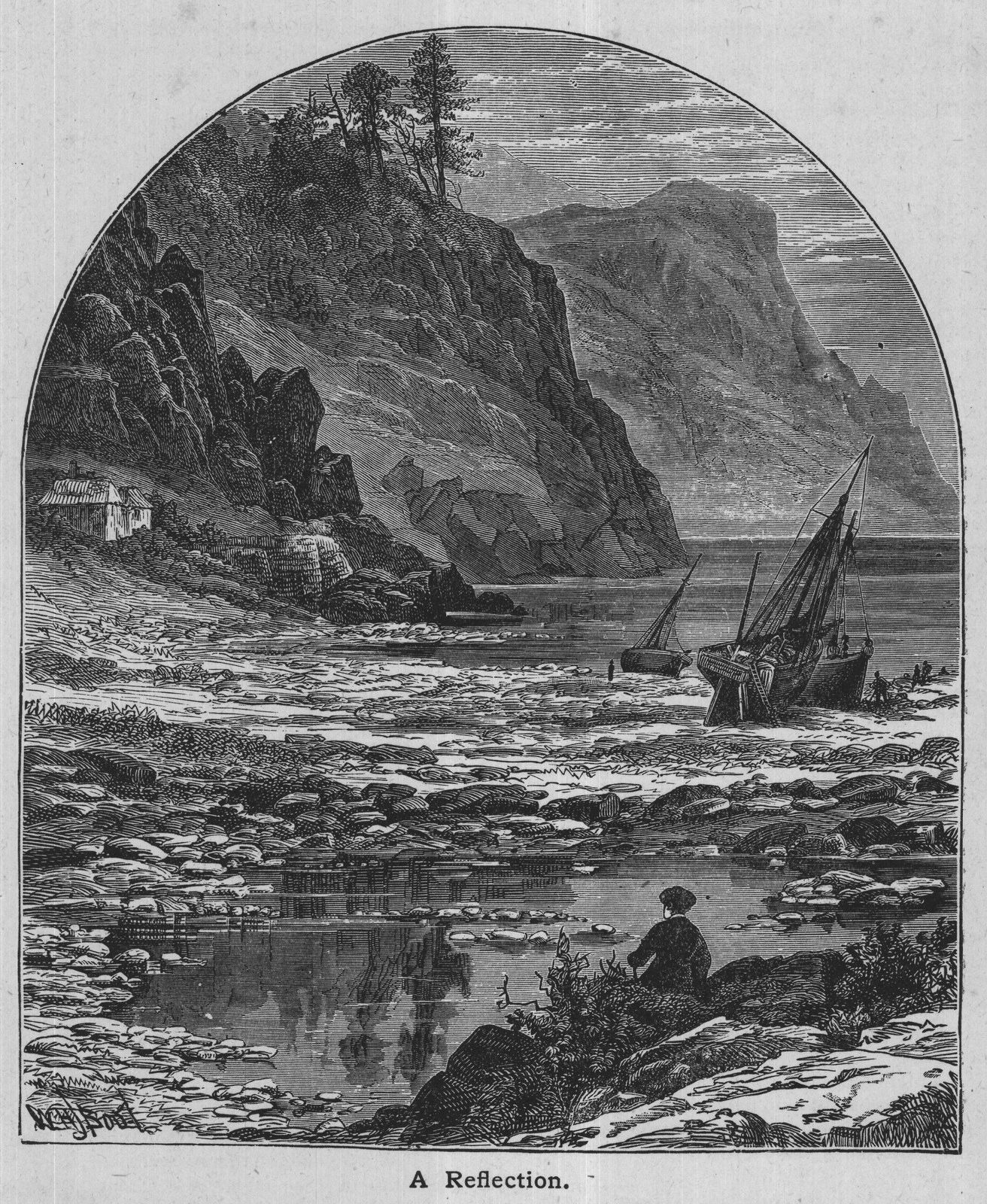
A Reflection.
Sidelong the gentle sea-wind bends, and plays Under its listening leafy ears, and soon Returns with some fresh fancy, which the rays Upon the simple surface mirror below; Until the western chasm grows blank, and slow From the sad sea-line, murmurous with the flow Of the night's rising tide, comes the calm moon.