Home › Contents › The Curious Flamingo
The Curious Flamingo
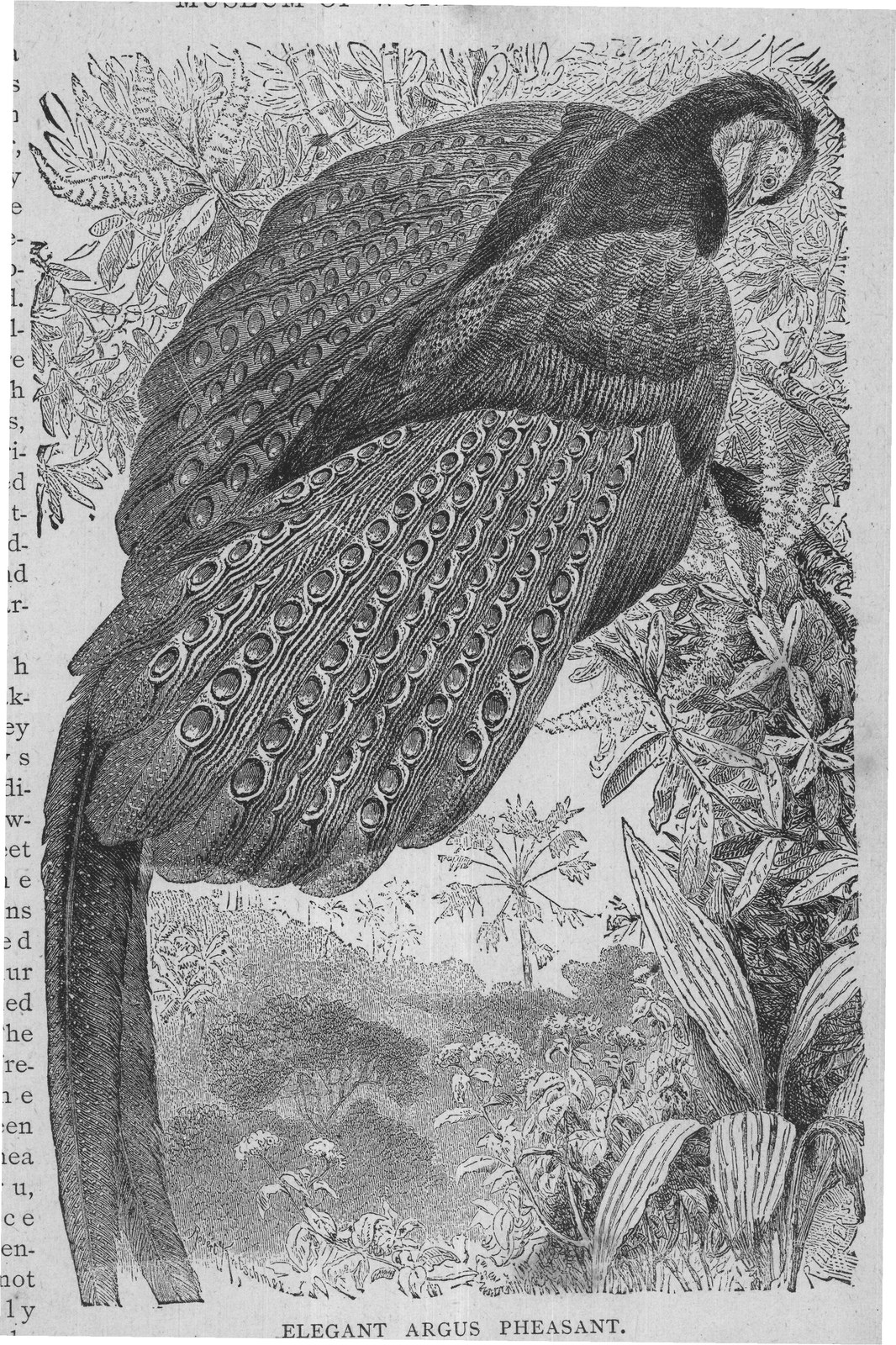
rounded by a black ring; secondaries These birds are extremely shy, and very about three feet long and brownish, but difficult to be kept alive for any length of when spread adorned with beautiful os- time after they have been taken from the cillated spots, like those in the peacock's woods. In a strong light they appear to tail. be dazzled, and when exposed to such, The female is dull chestnut red, varied they seem to be melancholy and inaniwith yellowish brown and black without mate, but in the dark they recover all their animation. They have a cry not plantation or the tangled wood, and durunlike that of a peacock, and their wings ing the summer and autumn has the and tail feathers are in considerable habit of sleeping on the ground, though request for female head-dresses. in the winter a tree is chosen on which to roost..
Other Pheasants are the Horned Pheasant and Impeyan Pheasant (so-called in Early in the morning he visits the open honor of Lady Impey), an inhabitant of fields, and searches for the tender shoots Nepaul and the Himalaya Mountains, of the grass, and of many of the meadow both very beautiful birds. plants, and will pick up worms and insects.
It is a curious fact that the hen bird, Later in the season, acorns and beech when she is getting old, will often assume nuts, and wild berries form articles of the beautiful colors and gay plumage of diet. But during a severe winter the her mate, and become a sort of natural birds require to be fed or they would sufcuriosity. Next to the peacock, the fer from hunger. Then they become very Pheasant carries away the palm in beauty, tame, and come when they are called. both for the lovely colors of his plumes, and the happy manner in which they are blended.
Story of Solon.
There is an old story. told about the famous king of Lydia, Crœsus, who was said to be the richest monarch in the world. He was one day seated on his The Golden Pheasant is derived from China. Its name there is said by Latham to be "kinki," or "kinker," which signifies "golden flower fowl." It is a favorite in that country, as may be seen by its frequent occurrence in Chinese paintings. In our country this bird has hitherto been preserved only in aviaries, where it is throne, in his royal robes, and in all his shielded from the cold of winter and supmagnificence, and asked Solon, the Greek plied with food. In captivity it breeds philosopher, if he had ever seen anything freely. It is one of a race remarkable for so fine. It was rather a foolish question. beauty.
And Solon replied, that having seen the beautiful plumage of the Pheasant, he could not be surprised by any other grandeur that might be displayed.
The Superb Bird of Paradise.
The true residence, or breeding-place, of these birds seems to be Papua, or New Guinea, whence they make occasional The Pheasant, thus grandly attired, is excursions to some smaller neighboring no less admired when served up at the islands. They fly in flocks of about thirty table. His flesh is so delicate that its or forty, led, it is alleged, by a single bird, delicacy once became a proverb, and when which the natives call their king, but a doctor in those days wished to recom- which is said to be of a different species. mend an article of diet, he used to say it It is further pretended, that when this was as nice and as wholesome as the flesh bird settles the whole flock settle also, in of the Pheasant. consequence of which they sometimes There are many varieties of the Pheas- perish, being unable to rise again, owing ant, such as the spotted Pheasants of to the peculiar structure of their wings. China, and the gold and silver Pheasants, They also always fly against the wind, also brought from that country. The lest their plumage should be discomposed. daily life of the Pheasant is very much While flying they make a noise like starlike that of the grouse; he loves the thick lings, but their common cry rather resembles that of a raven, and is very audible in windy weather, when they dread the chance of being thrown upon the ground.
In the Arru Islands they are seen to perch on lofty trees, and are variously captured by the inhabitants, with birdlime snares and blunted arrows.
Though many are taken alive, they are always killed immediately, embowelled, the feet cut off, the plumed skins fumigated with sulphur and then dried for sale. The Dutch ships frequenting the sea between New Guinea and Arru, a.distance of about twenty miles, not unfrequently observe flocks