Home › Contents › The Giant Cactus-Antibes, France
The Giant Cactus-Antibes, France
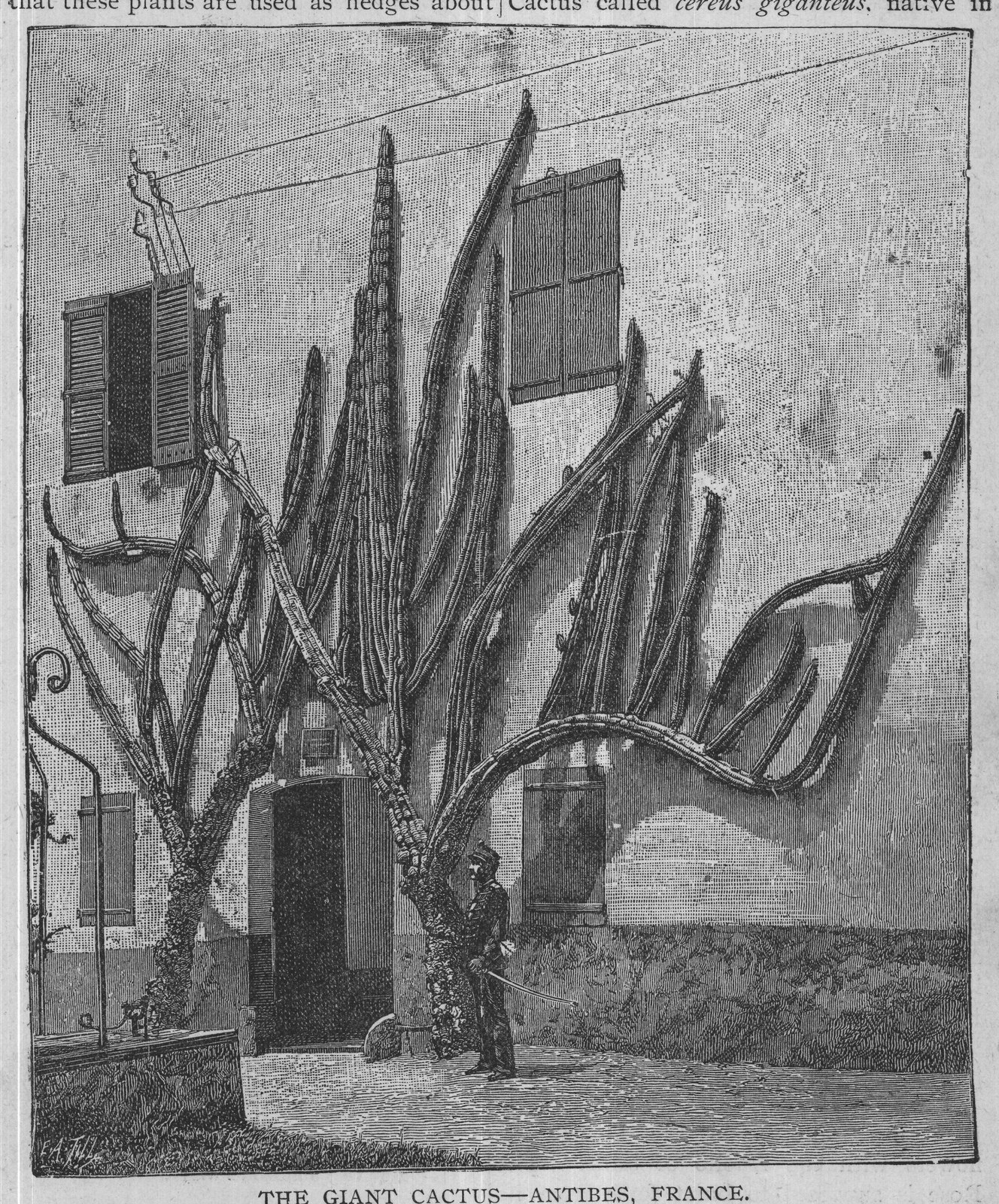
gardens and fields. Even in southern | New Mexico. In Sicily it grows most Europe several species of Cactus under wonderfully, and produces an edible, fig. favorable circumstances grow to an like fruit, the nearly branchless Cactus, which gives to the arid, treeless plains of Turkey in Europe. There, Roses grow New Mexico a most curious appearance, in great profusion, and are gathered in and sometimes grows to a height of sixty large quantities by the peasants. The feet, grows vine-fashion along the walls oil of Roses has long been used in comof the houses. pounding perfumery, and, as the flowers Even on the European Continent this bring a good price in the market, the species, under favorable circumstances, peasants make a business of gathering attains to colossal proportions. For in- them. stance, there is one of these species in This beautiful flower has received many Antibes, Southern France, which for the tributes from the poet's pen. Thus, last thirty years has grown along the Anster writes : wall of a house, and is still strong and hardy, never needing any fertilization or care. Our illustration faithfully represents this wonderful plant. The Queen of Flowers.
The different kinds of Roses are quite numerous, and botanists find it very difficult to determine with accuracy which are species and which are varieties. On this account, Linnæus and some other eminent authors are inclined to think that there is only one real species of Rose, which is the Rosa Canina, or Dog-Rose of the hedges, and that all the other sorts are accidental varieties of it.
Poetry is lavish of Roses; it heaps them into beds; weaves them into crowns, twines them into arbors, forges them into chains, and plants them in the bosom of beauty. It not only delights to bring in the Rose itself upon every occasion, but seizes each particular beauty it possesses as an object of comparison with the loveliest works of Nature; as soft as a Rose-leaf, as sweet as a Rose, Rosy clouds, Rosy dawn, and a thousand other expressions which cannot be mentioned here. The Eastern poets have united the Rose with the nightingale-the Venus of flowers with the Apollo of birds. The Rose is supposed to burst forth from its bud at the song of the nightingale.
Our engraving shows a beautiful country scene in Roumelia, a province of AIL to thy hues! thou lovely flower; Still shed around thy soft perfume, Still smile amid the wintry hour, And boast even now a spring-tide bloom.
Thine is, methinks, a pleasing dream, Lone lingerer in the icy vale, Of smiles that hailed the morning beam, And sighs more sweet for evening's gale.
Still are thy green leaves whispering Low sounds to fancy's ear, that tell Of mornings, when the wild bee's wing Shook dew-drops from thy sparkling cell In April's bower thy sweets are breathed, And June beholds thy blossoms fair; In autumn's chaplet thou art wreathed, And round December's forehead bare.
With thee the graceful lily vied, As summer breezes waved her head, And now the snow-drop at thy side Meekly contrasts thy cheerful red. 'Tis thine to hear each varying voice, That marks the seasons sad or gay; The summer thrush bids thee rejoice, And wintry robin's dearer lay.
Sweet flower! how happy dost thou seem 'Mid parching heat, 'mid nipping frost- While gathering beauty from each beam, No hue, no grace of thine is lost!
Thus hope, 'mid life's severest days, Still smiles, still triumphs o'er despair:
Alike she lives in pleasure's rays, And cold affliction's winter air.
Charmer alike in lordly bower, And in the hermit's cell, she glows; The poet and the lover's flower, The bosom's everlasting Rose!