Home › Contents › The Goliath Beetle
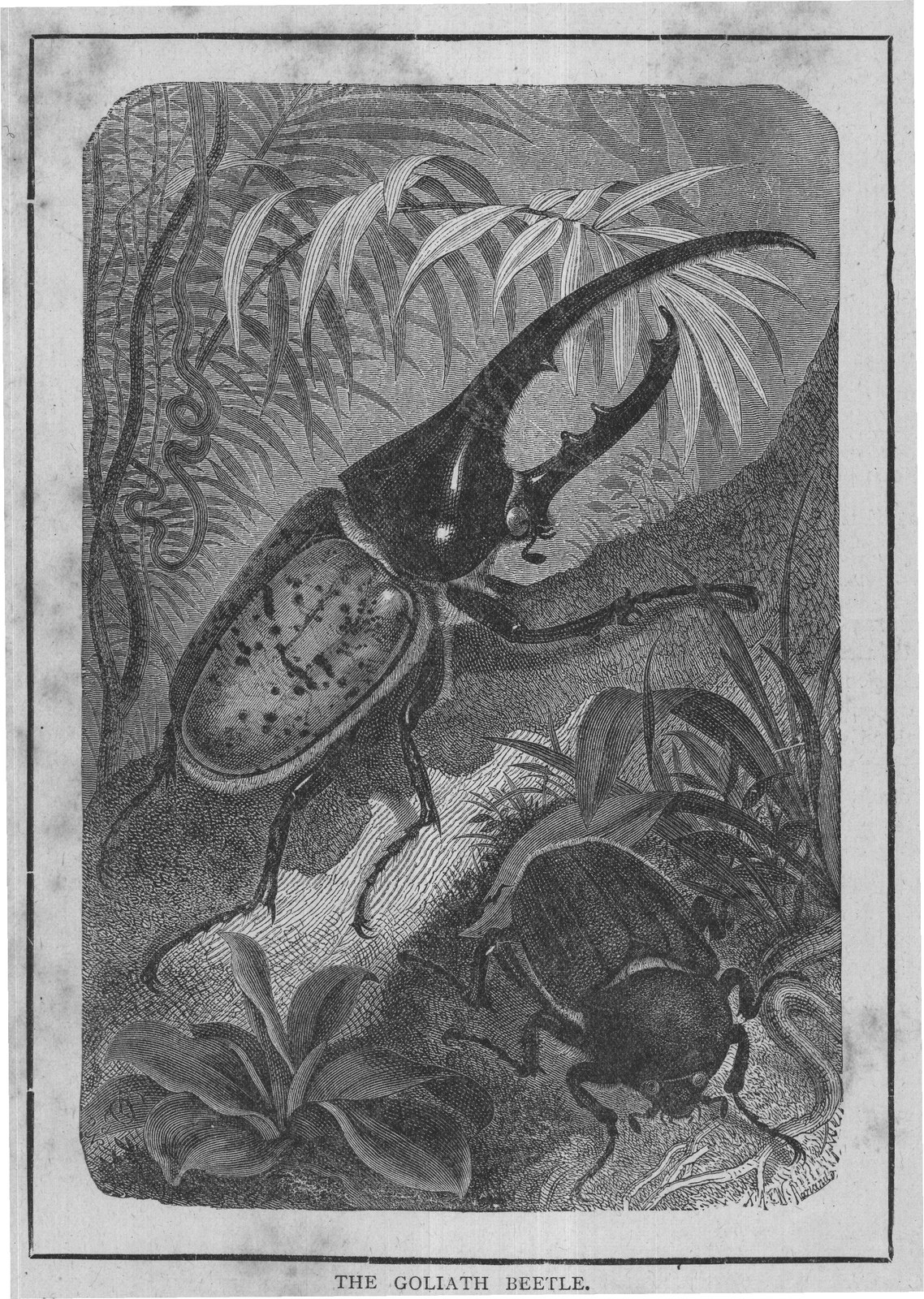
The Goliath Beetle
22 (337) spicuous, both for size and song, of our which serves for breaking up the ground native Grasshoppers; he has rather a for the reception of its eggs. The male sharp head, large prominent eyes, ample produces a sharp screeching sound, by wings, and slender antennæ as long as the rubbing the cases of its wings-which are body. This noble of his tribe is not an furnished with plates like cymbals-cne unfrequent resorter to hedges and marshy against another. Habits of Grasshoppers. places; and though his green armor may easily escape notice, his loud chirping The song of the Grasshopper, known by can hardly fail to attract attention, espe- every one, is a monotonous "zic-zic-zic," cially in the songster's months of August which can be heard during the day in and September. Many kinds of Grass-grassy places. Grasshoppers are spread hoppers are the brethren of this grandee. over the whole surface of the earth, but Wordsworth has not passed unheeded are to be met with chiefly in South the 66 - jocund voice Of insects chirping out their careless lives On these soft beds of thyme-besprinkled turf."
But of the Grasshopper it is said- "He is an evening reveller, who makes His life an infancy, and sings his fill."
America, which contains nearly threefourths of the species known. The Euro. pean species, on the contrary, are few.
They live in meadows, on trees, devouring the leaves and stalks of plants; but they are never found in such great numbers as to cause damage at all to be com. pared to that caused by the Locust. They Some Grasshoppers were great favorites appear in the month of July and disappear with the ancients, who often kept them at the beginning of the cold weather, in cages for the sake of their song. They Towards the end of summer their song is were supposed to be perfectly harmless, heard in the meadows and wheat fields. and to live on dew. One poet calls the Grass- The females lay their eggs in the ground, hopper "the nightingale of the nymphs;" which do not hatch until the following and another styles it "the sweet prophet spring. After four months the larvæ of the summer." So attached were the change into pupæ, which already show Athenians to some of these insects, that rudimentary wings, and which by a fifth they fastened golden images of them in their hair; and addressed them in the most endearing terms; and from this we may gather that their notes were sweet.
Indeed, the sounds of them and of the harp were called by one and the same name.
The Grasshoppers and Locusts take long month pass into the perfect state.
The Great Green Grasshopper is very common in Europe. It remains during the day on trees, and in the evening disports itself in the fields. There is a shorter and more thick-set species, whose distinctive feature is a very broad head. leaps, owing to the conformation of their Its color is gray of various shades, and it hind-legs, and they often make use of is to be heard singing during the day in their wings also, which are very fully fields of ripe wheat. Use is made of it developed. These insects are unable to by the peasants in Sweden and Germany walk, on account of the disproportion as a cure for warts. which exists between their different pairs "The peasants," says Charles de Geer, of legs. The female is provided with a "make these Locusts bite the warts curved egg-depositor, with two valves, which they often have on their hands and the liquid, which at the same time flows from the insect's mouth into the wound, causes the warts to dry up and disappear. is for this reason they have given them the name of Wart-bit or Wartbiter."
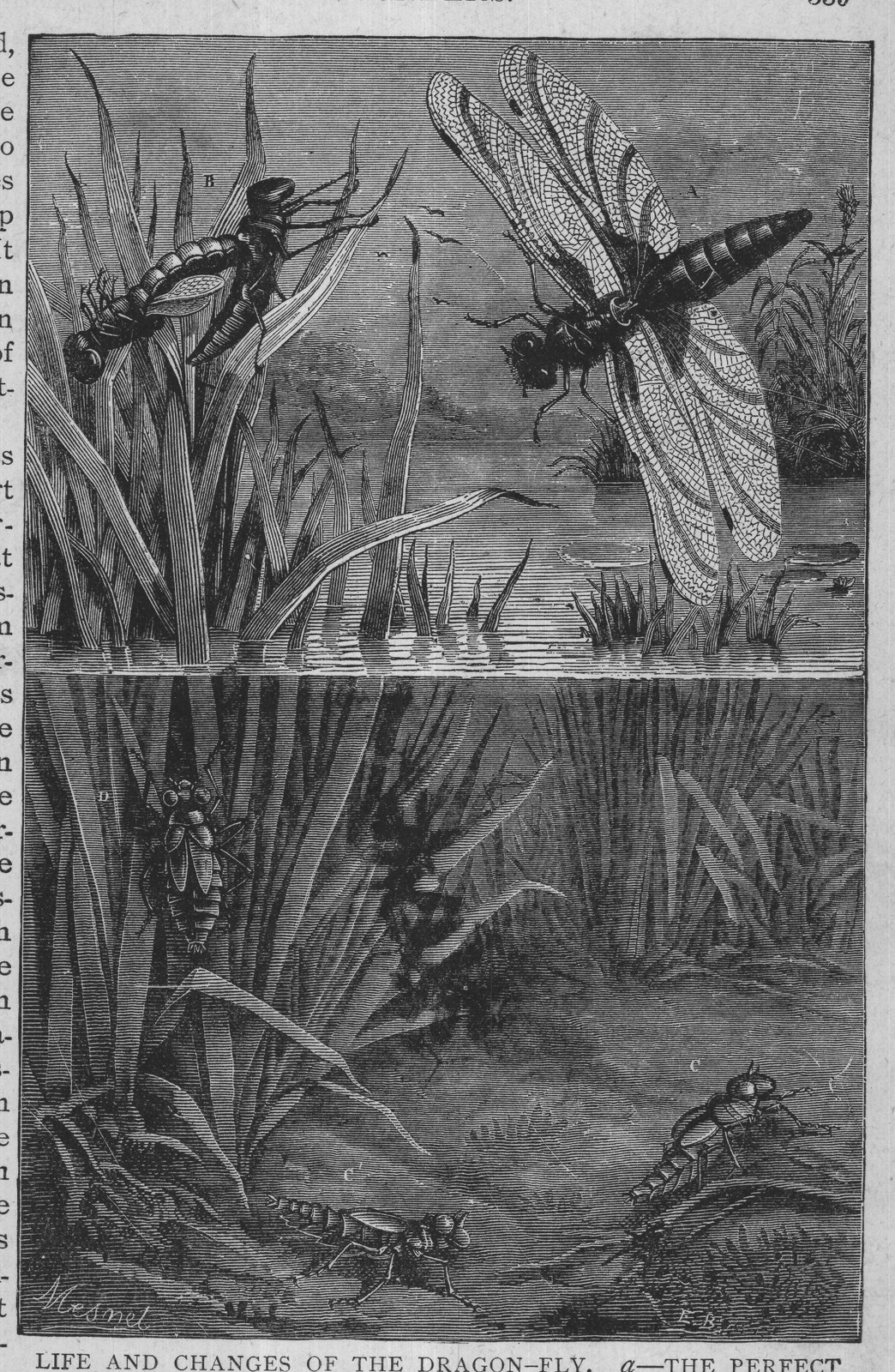
It The insect class shows in every part a harmonious organization, which at the first glance distinguishes it from all others. Nevertheless, it is perhaps the section of the animal kingdom in which we observe the greatest diversity of form; some insects indeed display at times such anomalies that we can only make them out by their fundamental characteristics. There are even D frequently extreme differences between the male and the female. Others possess such a singular exterior that ent esnel they exactly resemble leaves of trees, having the same veins and coloring; LIFE AND CHANGES OF THE DRAGON-FLY. -THE PERFECT INSECT. b - THE INSECT CASTING OFF ITS WORN-OUT NYMPH'S SKIN. c, d-LARVÆ AND NYMPHS. when they are at rest we might take them are transformed into green membranes, for leaves, and even the greedy bird is which give the animal the appearance of deceived by them. It is the wings that an animated leaf. As the great Linnæus said, Nature from the young, that one cannot in the takes no leaps, and among insects she pro- least recognize the one in the other. The ceeds as elsewhere, by insensible transi- scarabæus, or sacred beetle, with its tion. We are accustomed to recognize a emerald sheath, which was worshipped butterfly only by its ample wings; never- in ancient Egypt, does not in the least theless naturalists have discovered many resemble the hideous subterranean worm species of this order which are wingless. which produces it; a singular metamor- But although we see some individuals of phosis, in which, according to Goury, the this group deprived of these organs, nations on the banks of the Nile only others exhibit the vestiges of them to beheld the symbol of the transmigration show the gradation. . of souls.
The Animal with a Vegetable Head.
That there are more things in heaven Born in one shape the insect dies in another, and the metamorphoses which it undergoes are the most important act of and earth than are dreamed of in our its life, and the most extraordinary phe- philosophy, is abundantly proven by a nomenon in physiology. Organism, func- study of natural history. We come upon tions, all things change; the ugly cater- surprises the further we pursue our invespillar is transformed into a butterfly tigations. Who would have believed, gleaming with azure and gold, and if this without the actual demonstration of the butterfly were restricted to the fresh fact, that there could be a union between leaves of which it devoured such quanti- a living moth, an insect, and a vegetable ties in its youth, it would die of inanition; it requires a more delicate nourishment now that it has become adorned with its brillant wings, and only lives on the nectar of flowers. The libellula, or dragon-fly, when it appears in its last dress, assumes different habits. It has passed all its life growth?
A fungus is known which never grows except on the bodies of dead spiders; another only appears on the surface of horses' hoofs in a state of putrefaction.
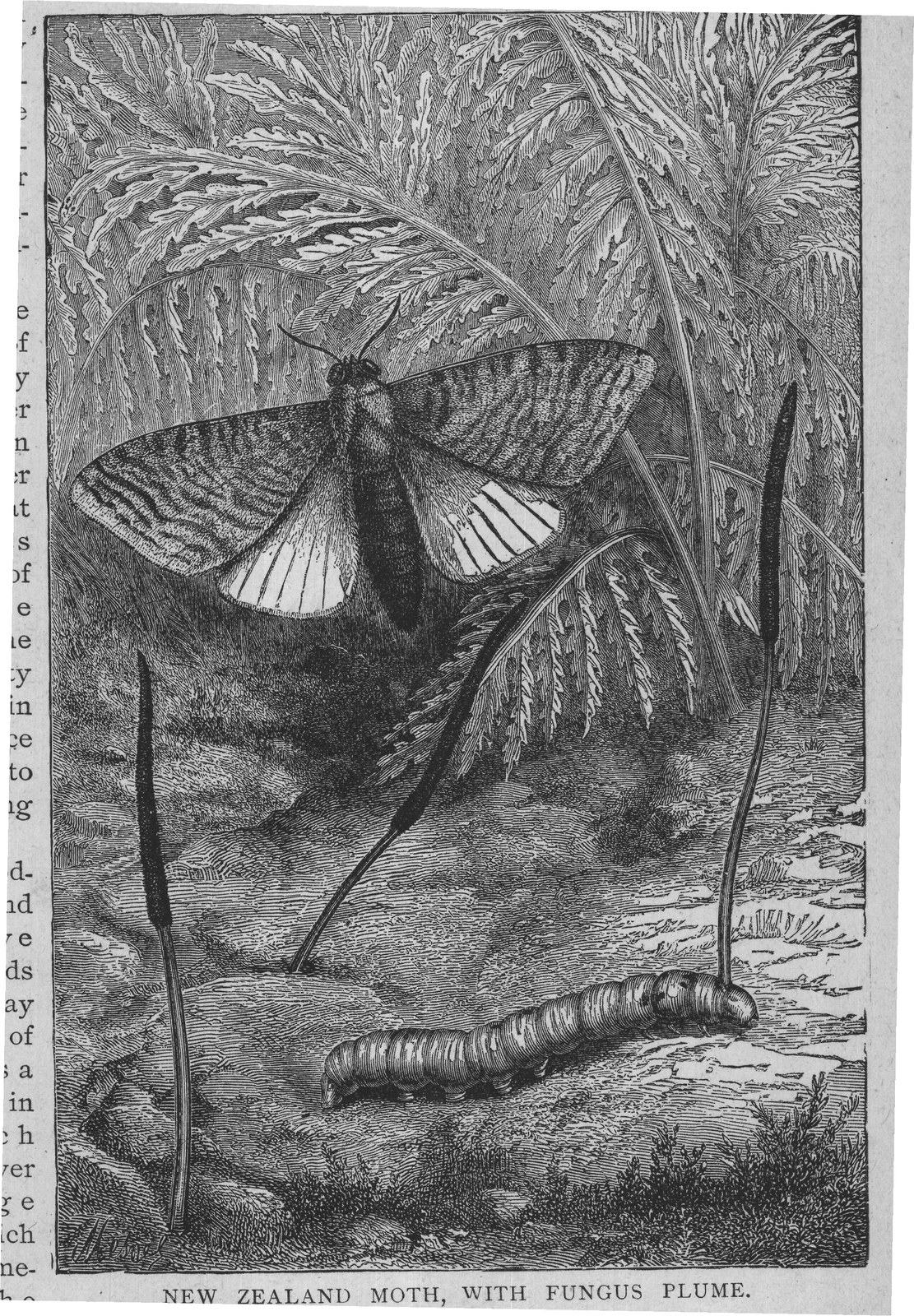
One little parasite of the same family, the isaria of the sphynx, has hitherto only been observed on certain nocturnal moths. beneath the water in the condition of an Still more curious facts are known; for ignoble larva, soiled with mud and filth; instance, that of a fungus never found but now that the time has come, it aspires only on the neck of a caterpillar of to soar into the air. Having mounted on tropical countries. It is always solitary some plant or other, it attaches its aquatic on this, and of enormous size in proporgarment to it and equips itself with bril- tion, being often four or five inches high. liant wings of gauze which bear it away. Another species of fungus is an outgrowth The metamorphosis is so radical and its from the head of the New Zealand moth new wants so imperious, that if we at- in its larvæ state, as represented in our tempt to retain the insect a single minute engraving, which conveys an accurate longer in its ancient èlement it will per- idea of one of the most astounding disish on the spot. It has lived till now in coveries in the insect world. shaded and tainted water; henceforth it In considering those creatures which can only breathe the pure air and in a work fearful destruction on vegetable life, glowing light. we naturally expect to see animals on the The grown insect differs so widely stage, the bulk of which must be in proportion to their formidable powers of tributed in troops commanded by experidevastation, but it is quite the contrary. lenced leaders . They are all provided It is not the auroch with its shaggy mane, nor the powerful stag, nor the wild boar that ravages or destroys our forests, but tiny insects which slaughter its aged trees. If, when the warm breath of spring drives away the rigor of winter and renews life in the fields, we enter one of the great coniferous woods of the continent of Europe, we are astonished at the tumult and activity which prevail in lieu of the silence we went there to seek. Everything is in movement.
Groups of woodmen, foresters and overseers move about by hundreds and stretch away like columns of skirmishers; it is a complete army in the field, which opens out wherever there is a large space, and of which the wings are sometimes lost in the