Home › Contents › The Fabled Man-Eating Tree
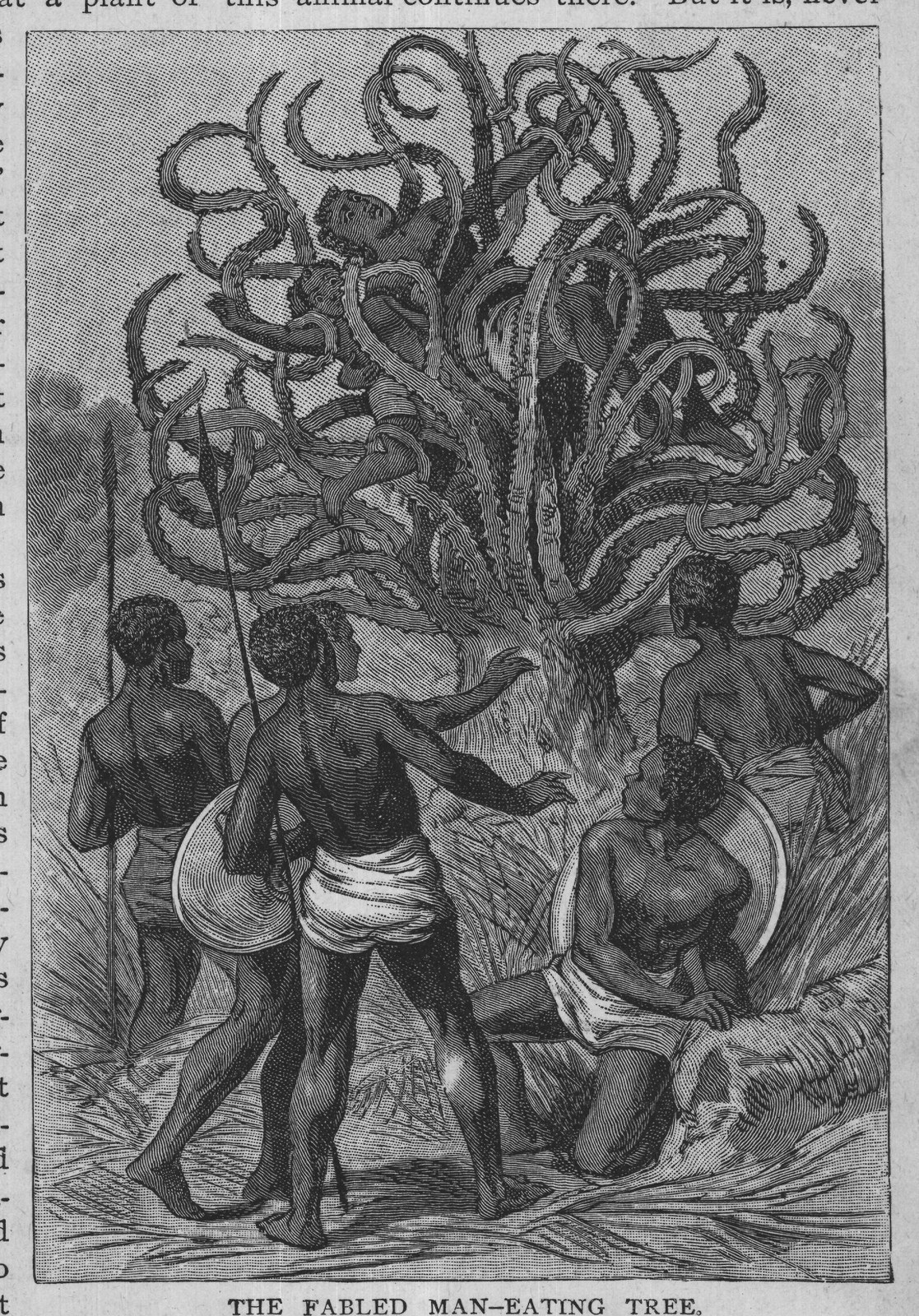
The Fabled Man-Eating Tree
fast, lock the rows of spines together, and theless, certain that the plant cannot dissqueeze it to death. And further, lest the tinguish an animal from a vegetable or strong effort for life in the creature just mineral substance, for, if we introduce a taken should serve to disengage it, these straw or pin between the lobes, it will small erect spines are fixed near the middle grasp it as fast as if it were an insect." This description, though written long cate hairs, moving slowly but surely on before any very careful study of this class the victim, fix their little points like fangs of plants had been made, is in the main and suck its juices, leaving only a dry correct, in spite of the failure to under- carcase. This accomplished, they leistand clearly that there was a well-defined surely relax their hold, return to their provision of Nature for supplying the natural position, and wait for fresh vicplant with food. Each half of the leaf of tims. Unlike the Venus's-Flytrap, the a Venus's-Flytrap is a little concave on the Sundew takes no notice of the touch of inner side, where are placed these delicate anything unsuitable for its food. The hair-like organs, in such an order that an sensitive fibres refuse to respond if they insect can hardly traverse it without are touched by a straw or bit of paper, interfering with one of them, when the and it is only when their natural prey is two sides suddenly collapse and inclose felt that they show signs of life. The the prey with a force defying all attempts Sundews are native to the temperate parts at escape. The insect, however, does not of both hemispheres. Enticing Bait. appear to be crushed by the pressure, but is retained in the leafy cell until it Another plant of kindred character is becomes enveloped in a sort of sticky that known as the Cephalotus, which is a fluid, which appears to be a solvent, like native of New Holland. It is an almost gastric juice, the fly being consumed and stemless herb, the upper part of which is then absorbed into the tissues of the plant. divided into two or three short stems, that bear clusters of purplish leaves.
One group of plants which live on ani- Among these leaves principally occupymal food is known under the name of ing the surface are several beautiful and Sundew. The plant may be described curious pitcher-shaped appendages, atas consisting of a tuft of diminutive orb- tached by stout stems. Caught in the Trap. shaped leaves, from the centre of which The form of the insect trap is slipperthere shoots up, in midsummer, a slender shaped, the color green, tinged with stem of inconspicuous flowers. As in the purple, and it is furnished with two latcase of the Venus's-Flytrap, the leaves of eral oblique wings and a central one this plant are its distinguishing feature. dilated at the margin. These wings are These are covered with shining scarlet fringed with hairs, and over the top is a hairs which secrete at their tips drops of cap-shaped formation, which acts as a lid a clear viscid fluid resembling dew, which to the trap beneath. This trap is, as it increase in size and number with the heat were, baited with a sweet watery fluid, of the sun, while real dew would be which attracts the insects, especially ants. quickly dried up under the same condi- The inner walls are clouded with dark tions. It is from this fact that the popu- purple. The main stalk rises about two lar name of Sundew is derived. feet above the cluster of leaves, and is But the design of this novel secretion crowned in June and July with a cluster is more strange than the fact of its pro- of small white flowers. duction. Instantly that insects, attracted Turning from these so-called sensitive by the fatal sweetness, touch and taste, plants, in which there appears to be an they are lost. The adhesive quality of intelligent movement, something more the liquid holds them fast while the deli- than a merely automatic and involuntary action of the leaves, let us consider edge, the fly, ant or beetle becomes enanother carnivorous plant, which may be tangled in the mesh of bristles within. grouped as a pitcher plant. It is a marked Each struggle makes the end more certype, and is found in the Eastern and tain, as the prey is continually forced Southern States of North America widely distributed.
The whole inner surface of this tubeshaped flower is covered with fine bristles, projecting inward and inclining downward. This natural abatis extends to within a short distance of the bottom. Below this line of bristles the tube contains an astringent sticky fluid, which acts the part of both a narcotic and digester of the ill-fated creature that lights on its treacherous surface.
That there may be no lack of food, Nature has provided this hypocritical plant with a cup of sweets which is distributed in the form of drops of crystal honey. This secretion, which extends along the outer ridge of the plant to the ground, is sweet but not intoxicat- NMC