Home › Contents › Fishes with Wings
Fishes with Wings
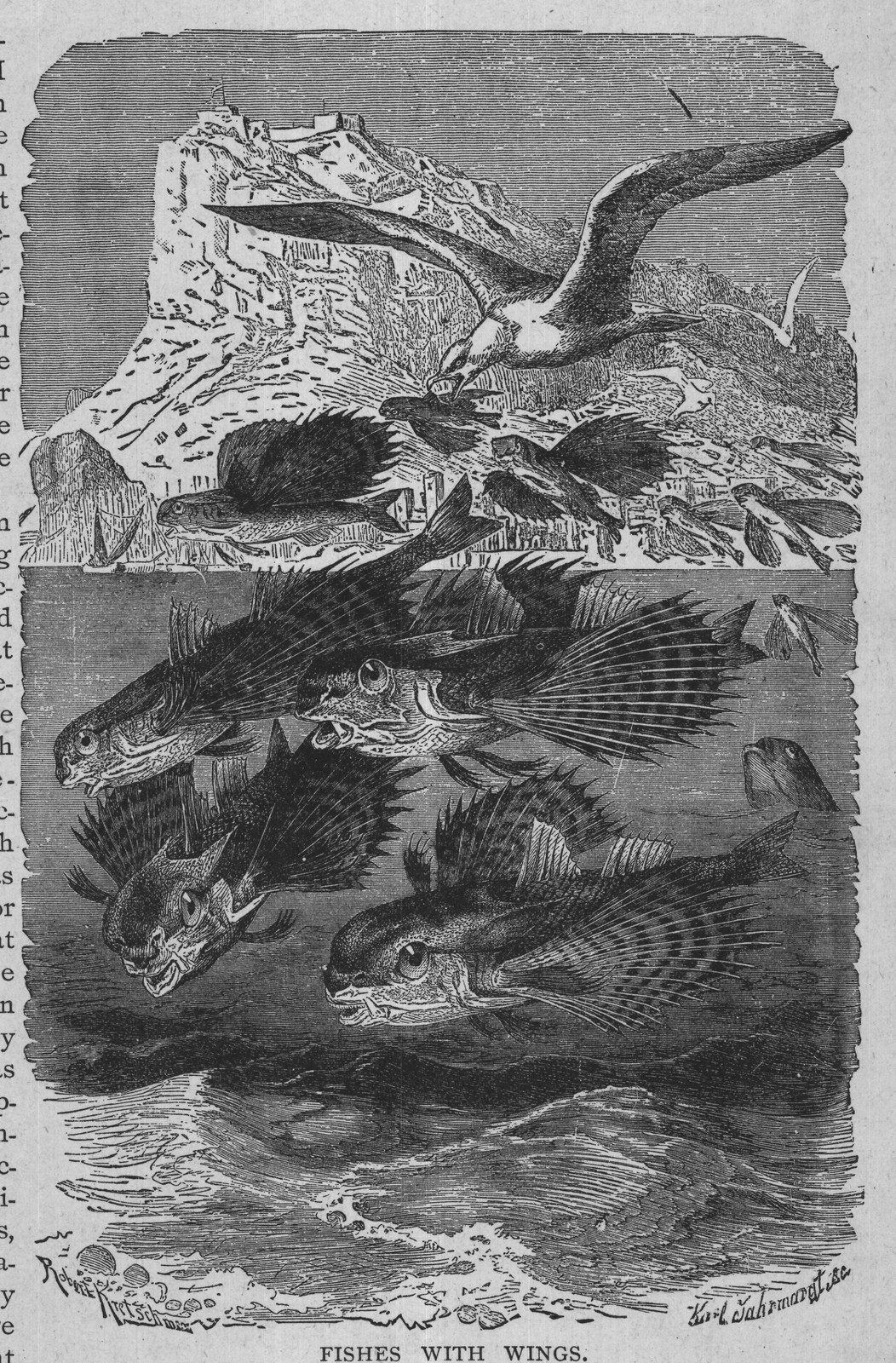
Karl Jahrmaratsi times, and so adjust their fins as to be terranean sea, and the latter in the Atlan carried upwards by it. Two species are tic Ocean. very abundant-the former in the Medi- The common Flying-fish is twelve to fourteen inches long, and has the ventral are five species on the coast of North fins placed anterior to the middle part of America. the body; it may thus be distinguished The eyes of these fish are so prominent, from the Flying Gurnard of the Mediterra- as to admit of their seeing danger from nean, which has the fins placed behind the whatever quarter it may come, but in case middle of the body. These fins are also of emergency, they are able to push them much smaller in the true Flying-fishes. somewhat beyond the sockets, so as to The species now under consideration be- considerably enlarge their usual sphere of longs to the Atlantic, and is most com- vision. They are frequently either unable mon in the tropical portions, though occa- to direct their flight out of a straight line, sionally found on the European and or they suddenly become exhausted, for North American coasts. They are often sometimes whole shoals of them fall on seen to leap by hundreds and even thou- board of ships. They have somewhat the sands from the water, chased by other manner of the swallow in the air, except fishes.
The Flying Gurnard. they fly in straight lines, and their black backs, their white bellies, and their The Flying-fishes generally inhabit the forked and expanded tails, give them seas of hot climates; but they are occa- much the same appearance as that of these sionally found within the temperate birds. regions. The Flying Gurnard inhabits The Great Sword-fish. the Mediterranean Sea. The Flying-fish No one can examine the forms of life has numerous enemies in its own element in the mighty ocean without being imand to aid its escape, it is furnished with pressed with the marked varieties and its long pectoral fins, by means of which contrasts constantly presented. Fishes of it is able to raise itself into the air, where every shape, size, and manner of existence, it is often seized by the albatross and the have engaged the attention of the natusea-gull. Its flight is short, about a hun- ralist, and here, as everywhere in the dred yards, but by touching the surface of the sea at intervals to moisten its fins and to take fresh force and vigor, it is able to greatly increase this distance. great realm of Nature, the farther he pursues his investigations the more wonderful do the discoveries become. One of the singular creatures of the sea, concerning which a volume might be written, is the Sword-fish.
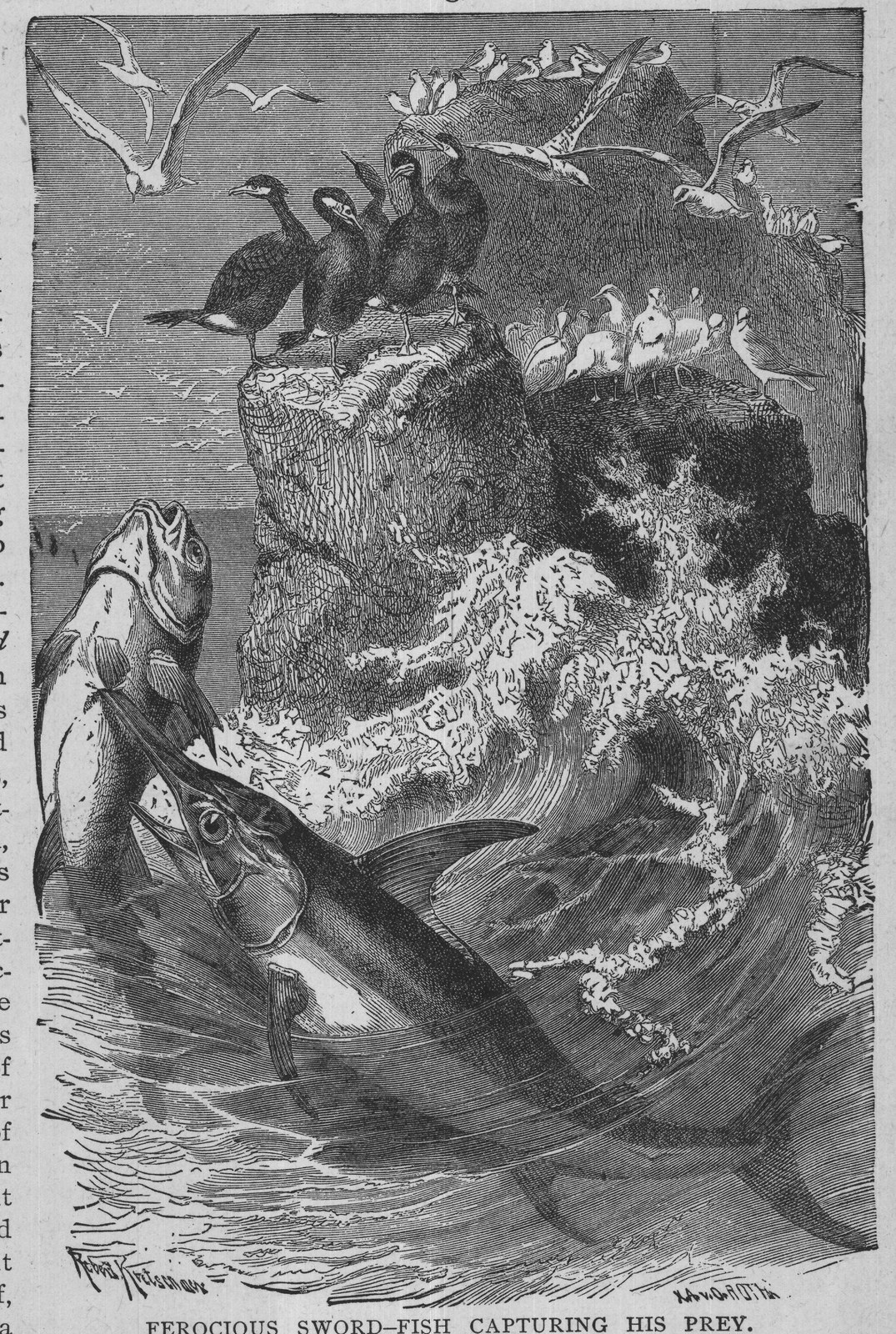
Flying-fishes are seldom seen to rise singly from the water; they generally appear in large shoals. Navigators in all Sword-fishes are very large and powertropical seas are familiar with these ful animals; they often grow to the length sprightly fishes, which relieve the mono- of twenty feet and more. They are very tony of ocean life as birds do the silence voracious and attack and destroy almost of the forest. The character of the long every living thing that comes in their pectorals, the strength of the muscles way. They belong to a family of marine which move them, and the size of the long spiny-rayed fishes, allied to the mackerels, arch, to which they are attached, are the and are so-called from the prolongation essential conditions of their flight. The of the snout into a long horizontally common Flying-fish of the Mediterranean flattened sword-like weapon. The sword is rarely more than sixteen inches long, consists of a long, strong bone, projecting and is found in all parts of the sea. There from the nasal part of the head, and is capable of doing immense damage to any sail. The sword had penetrated the animal which is so unfortunate as to sheathing, which was one inch thick, had cross the path of this savage monster of the sea.
The common Sword-fish is found in the Mediterranean and on both sides of the Atlantic; it uses its sword to destroy its enemies and sometimes strikes at vessels, burying its weapon deep in their timber.
When the British ship Leopard after her return from the coasts of Guinea and the West Indies, was being refitted and cleaned, the shipwrights found in her bottom, pointing in the direction from the stern towards the head, part of the sword or snout of one of these fishes. On the outside it was rough and the end, where it was broken off, appeared like a