Home › Contents › The Monkey and Dolphin
The Monkey and Dolphin
As Ligmy (355) The poem herewith given will show you what befell the Monkey and the Dolphin:
T was a custom with the Greeks For travellers by sea to take Monkeys and fancy dogs, whose tricks Would pastime in fair weather make.
A vessel with such things on deck, Not far from Athens, went to wreck; But for the Dolphins all had drowned.
This animal is friend to man; The fact in Pliny may be found; So must be true, say what you can.
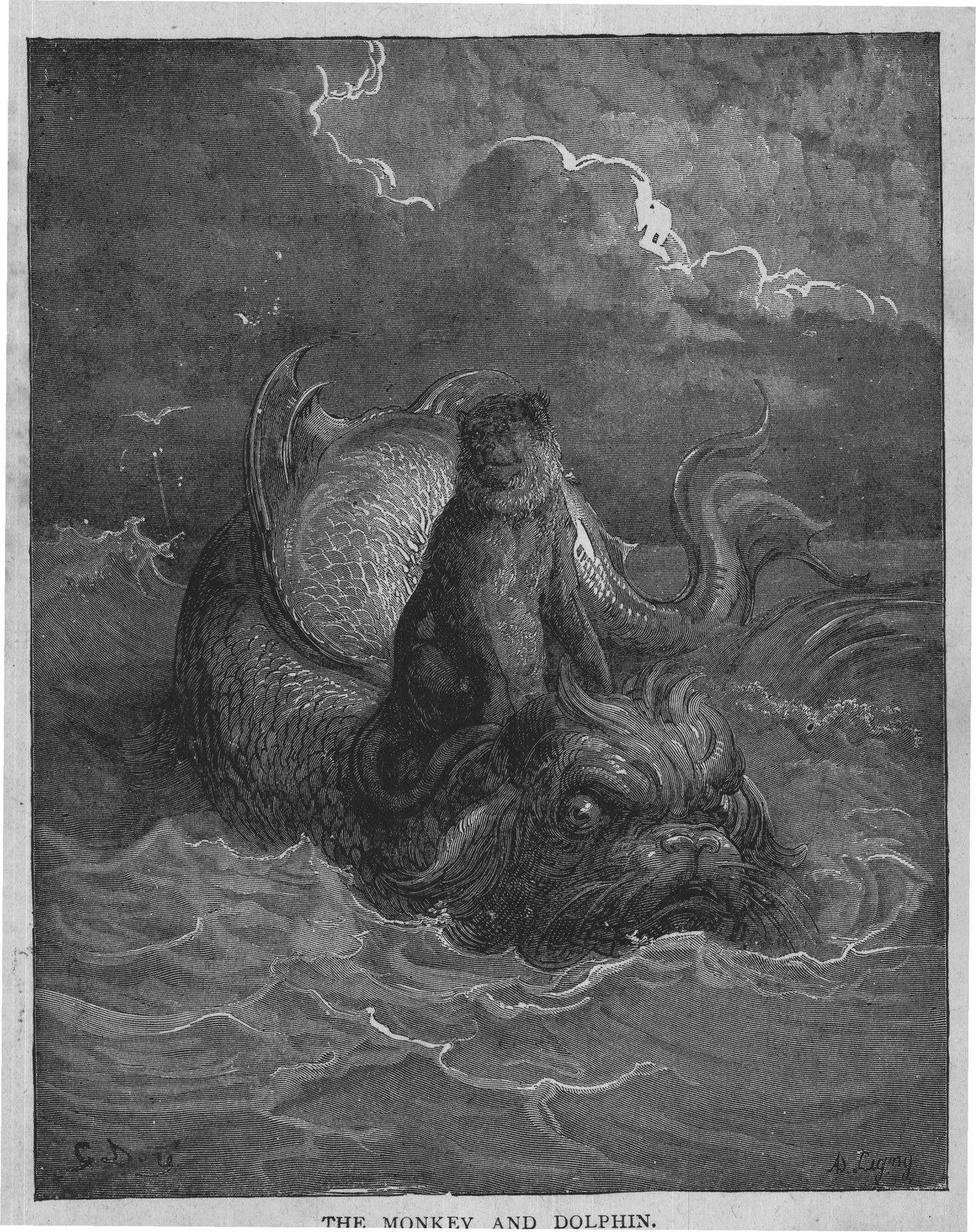
A Dolphin half the people saves, Even a Monkey, by the by, He thought a sailor, from the waves He kindly helped; the creature sly, Seated upon the Dolphin's back, Looked very grave and wise; good lack!
One would have really almost sworn "Twas old Arion, all forlorn.
The two had nearly reached the land, When just by chance, and such a pity!
Fish asks, "Are you from Athens grand?" "Yes; oh, they know me in that city; If you have any business there, Employ me, for 'tis truly where My kinsfolk hold the highest place.
My second cousin is Lord Mayor."
The Dolphin thanked him with good grace; "And the Piræus knows your face?
You see it often, I dare say?" "See him! I see him every day; An old acquaintance; that is so."
The foolish chatterer did not know Piræus was a harbor, not a man.
Such people, go where'er you can, You meet within a mile of home, Mistaking Vaugirard for Rome, People who, chattering, dogmatize Of what has never met their eyes.
The Dolphin laughed, and turning round, The Monkey saw, and straightway found He'd saved mere shadow of humanity; Then plunged again beneath the sea, And search amid the billows made For one more worthy of his aid.
The fable does not say what became of the Monkey, but evidently expects us to take it for granted he was drowned as a just punishment for his conceit.
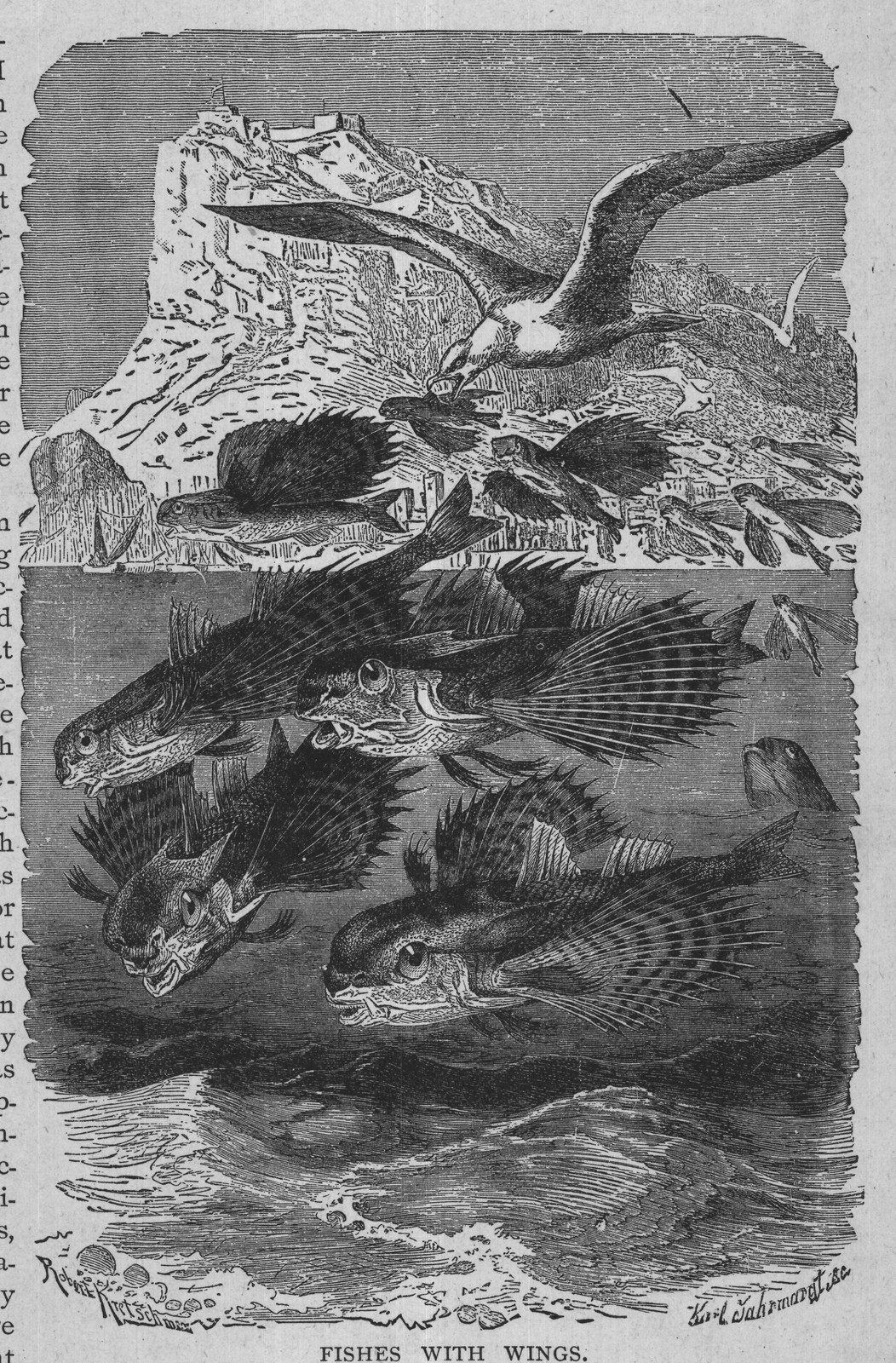
There are beautiful creatures in the great deep with colors as gorgeous as those of butterflies; moreover, like butterflies, some of them have wings and rise like birds from the surface of the sea.
The Flying-fishes, when in their own element, are constantly harassed by various fishes of prey, and it is supposed that their flights are performed for the purpose of escaping from these enemies; when in the air, however, they are subject to the attacks of various species of gulls.
How Fishes Fly.
Whether these fishes possess the power of flying, in the true sense of the termthat is, by beating the air with their members-or whether their large fins merely serve as parachutes to sustain them in the air for a time, after a leap from the water, is not yet fully ascertained, observers having given different accounts. The latter is, perhaps, the prevailing opinion of naturalists, and is that of the more recent investigators.
I have never, says Bennett, the naturalist, been able to see any percussion of the wings during flight, and the greatest length of time that I have seen this vola tile fish on the fin has been thirty seconds by the watch, and their longest flight mentioned has been a few hundred yards.
The most usual height of flight, as seen above the surface of the water, is from two to three feet; but I have known them to come on board ship at a height of fourteen feet and upwards; and they have been well ascertained to come into the channels of a line-of-battle ship, which is considered as high as twenty feet and upwards. But it must not be supposed they have the power of elevating themselves in the air after having left their native element; for on watching them, I have often seen them fall much below the elevation at which they first rose from the water, but never. in any one instance, could I observe them rise from the height at which they first sprang; for I regard the elevation they take to depend on the power of the first spring or leap they make on leaving the water.
Judging from the foregoing and similar accounts, it would appear that something beyond the mere leap of the fish would be required to account for such great heights as fourteen or twenty feet, at which these fishes have been seen. If they cannot fly, as might be supposed on examining the structure and position of their fins, it seems probable that they take advantage of the wind at