Home › Contents › Mechanical Devices for Perfom
Mechanical Devices for Perfom
ING "THE MISER'S DREAM."
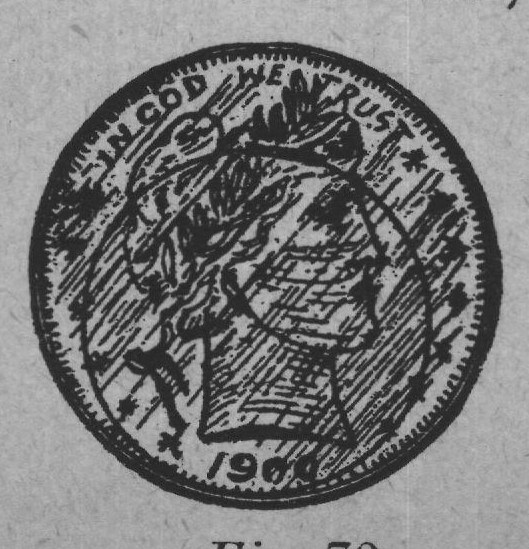
In this chapter it is proposed to describe all the latest devices invented to imitate the author's methods of palming with coins. First of all will be explained a number of mechanical coins each being so constructed that the "Continuous Back and Front Palm" can be performed with comparative ease. The author intends, in the first place, to describe what he considers to be one of the best coins of the above description, inasmuch as the performer can casually throw same in the air or from hand to hand, even at close quarters, and defy detection. Fig. 69 explains the manner in which the coin is prepared. A wire loop, large enough to easily encircle the middle finger is attached to a coin by means of a minute hinge.
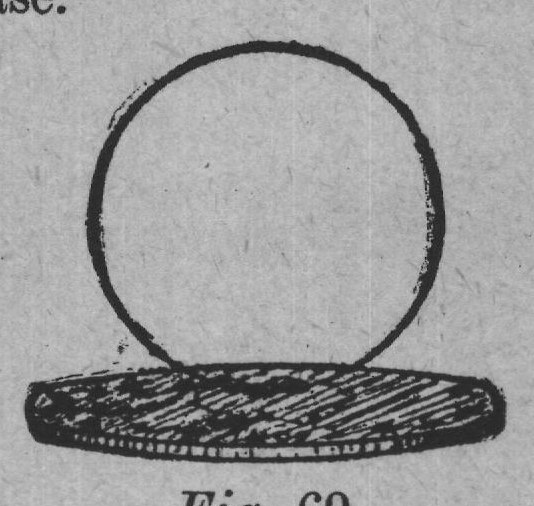
This latter arrangement admits of the loop being laid flat on the coin (Fig. 70), in which position it is absolutely invisible even at close quarters. The coin is now placed on the extended fingers of right hand, the loop being slipped over the second finger. It will be found that the coin can now be swung invisibly to the back of the hand, and again brought to the front with great ease.
Fig. 69.
The author specially recommends anyone not inclined to devote sufficient time to practicing the sleight-of-hand method to purchase one of these coins, as the back palm can then be executed in a few minutes.
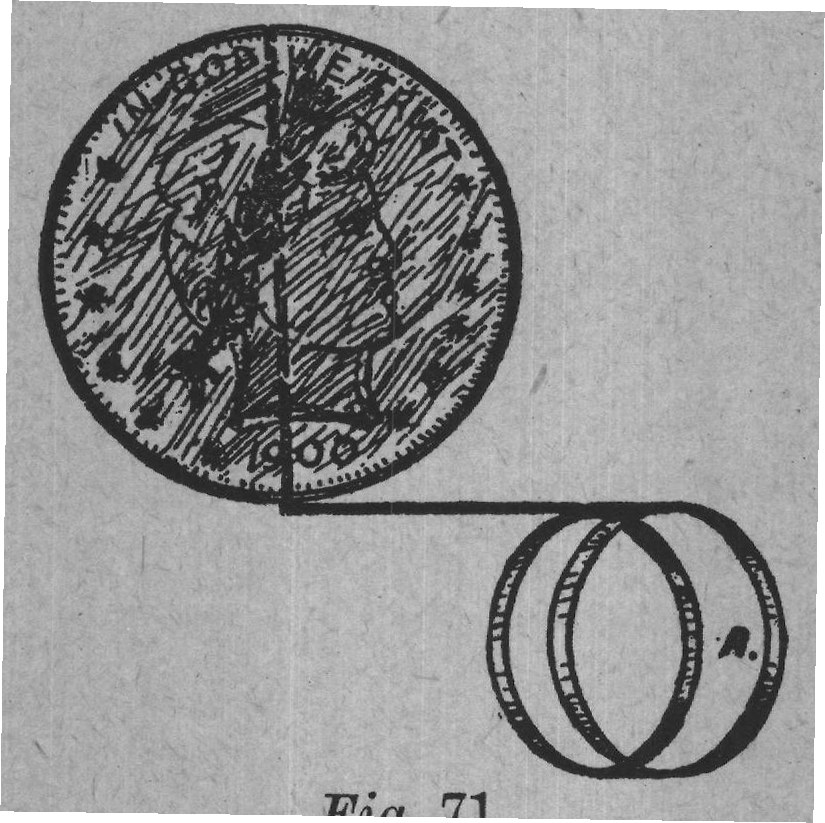
The next coin to be described, coming within Fig. 70. the above category, is that depicted in Fig. 71.
Two thin coins are first of all brazed together with a spindle, running freely through same (shown by the dotted line in the illustration).
Attached by a piece of wire to this spindle is a flesh colored arrangement which, in reality, con- Fig. 71. sists of two rings of just sufficient size to fit on the first finger. The finger is placed through the rings or loops in such a manner that the coin lies almost at the tips of the two middle fingers, which, if brought down under the coin, in a similar manner to that described in Fig. 2, cause the coin to revolve and disappear to the back of the hand. To bring it to the front again the movement is simply reversed.
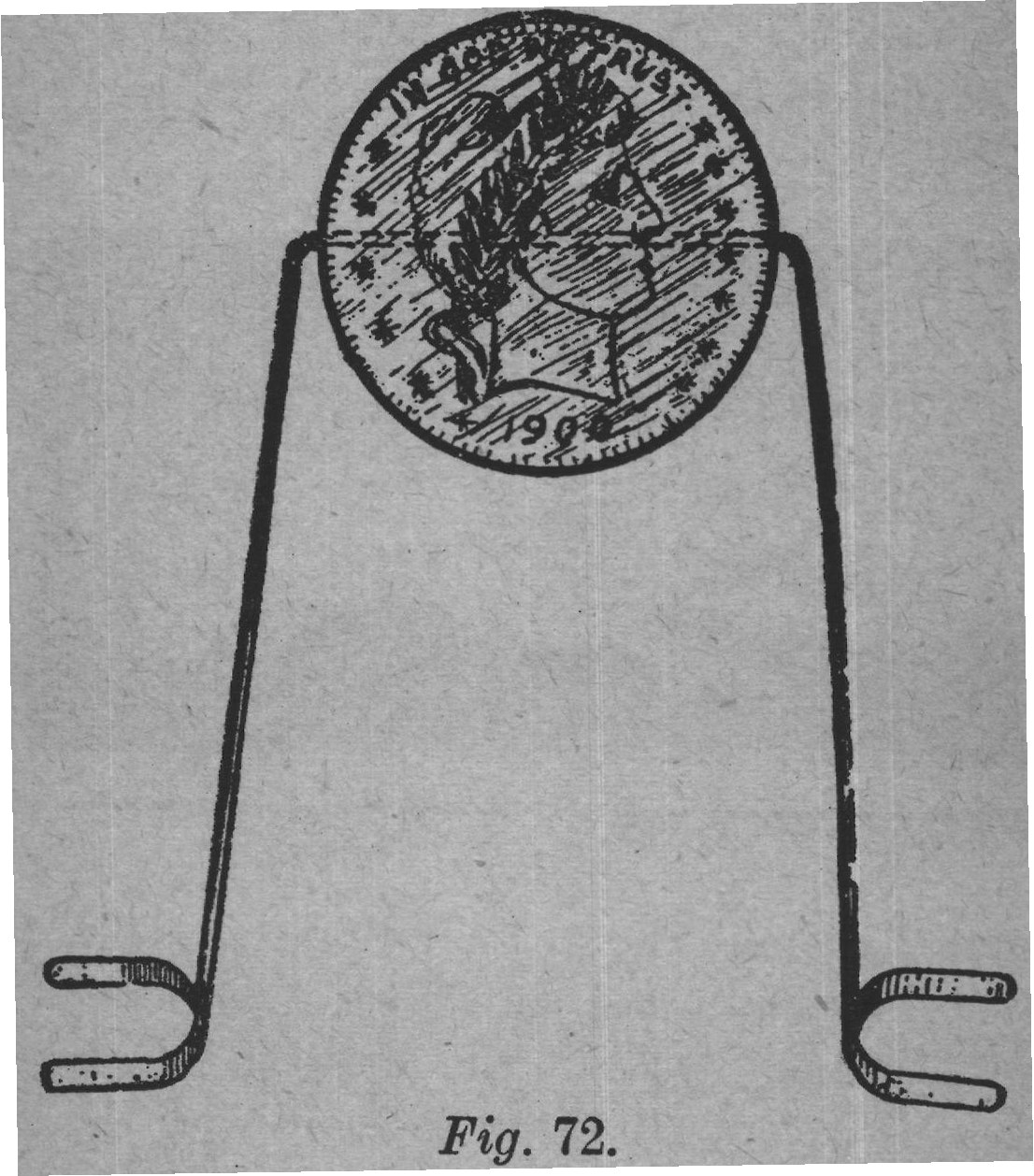
Another single coin "fake" for performing the Back and Front Palm is that depicted in Fig. 72: A A are two hooks for clipping the knuckle ends of the first and fourth fingers, at- INTERN Fig. 72. tached to which is a wire (B) running from edge to edge of the coin. When the apparatus is placed in proper position it will be found that the reverse palm can be easily executed.
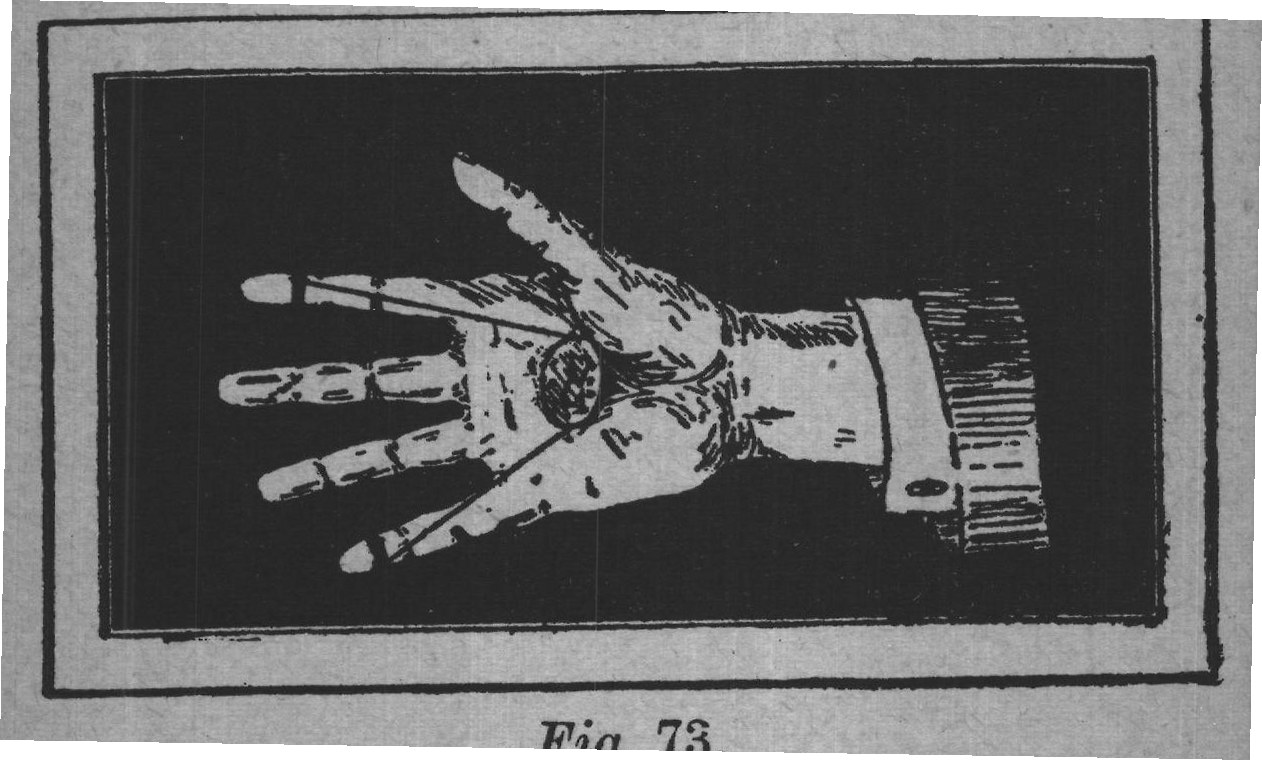
The coin next to be described is the invention of Mr. William J. Hilliar, and is an improvement on the foregoing, inasmuch as the fingers can be spread open. It consists of two thin coins, brazed together, through which runs a piece of fine elastic, which admits of great extension. The elastic terminates on either side of the coin in catgut loops, which fit over first and Fig. 73. fourth fingers. The ordinary reverse palm can now be accomplished, but when it is desired to show nothing between the fingers, all that is necessary is to push down the coin with the two middle fingers into the palm which grips it tightly, the elastic, of course, stretching sufficiently to admit of this (see Fig. 73). When the back of the hand is shown to the audience the elastic is completely hidden by the first and fourth fingers. To show the front of the hand the coin is simply released from palm when it flies to finger tips, from whence it is transferred to the back of the hand.
NOTE-A new mechanical coin by the aid of which the continuous back and front palm has recently brought out by Mr. Roterberg, and is furnished by the publisher. The coin instead of being brazed together is a single one with a hole drilled clear through it. Through this is passed a wire, to either end of which are soldered tiny flesh-colored clips. This mechanical coin, which eclipses any other coin for the purpose described, can be used by anyone with ease and without the least fear of detection.
The author specially recommends this coin, as he considers it to be the best adaptation of the "Spider" idea that he is acquainted with.
Innumerable other mechanical coins, invented for the same purpose as the foregoing, are to be obtained from the publisher, of Chicago, and of other magical dealers. The author would recommend a purchaser to obtain two, or even three different coins, as he can then use the one that suits him best, some of the devices being far more suitable for one person's hand than another.
Either of the above mentioned coins can be used for imitating the author's feat of passing a coin through the knee, but in this case, of course, one must be attached to each hand.
A great number of "coin holders" are used in different ways by magicians, enabling them to deal easily with a large number of coins. The holder now about to be described is used for the purposes of getting the first stack of coins on to the rim of the hat, and subsequently into the hat for the purpose of dropping one at a time, the sleight-of-hand method of which is explained in