Chapter II
Fig. 74 shows the appearance of the holder which is constructed on the principle of the well-known sovereign purse, the top being attached to a spiral spring which can be depressed, but immediately resumes its original position.
It is obvious, therefore, that if a coin is removed another one immediately takes its place.
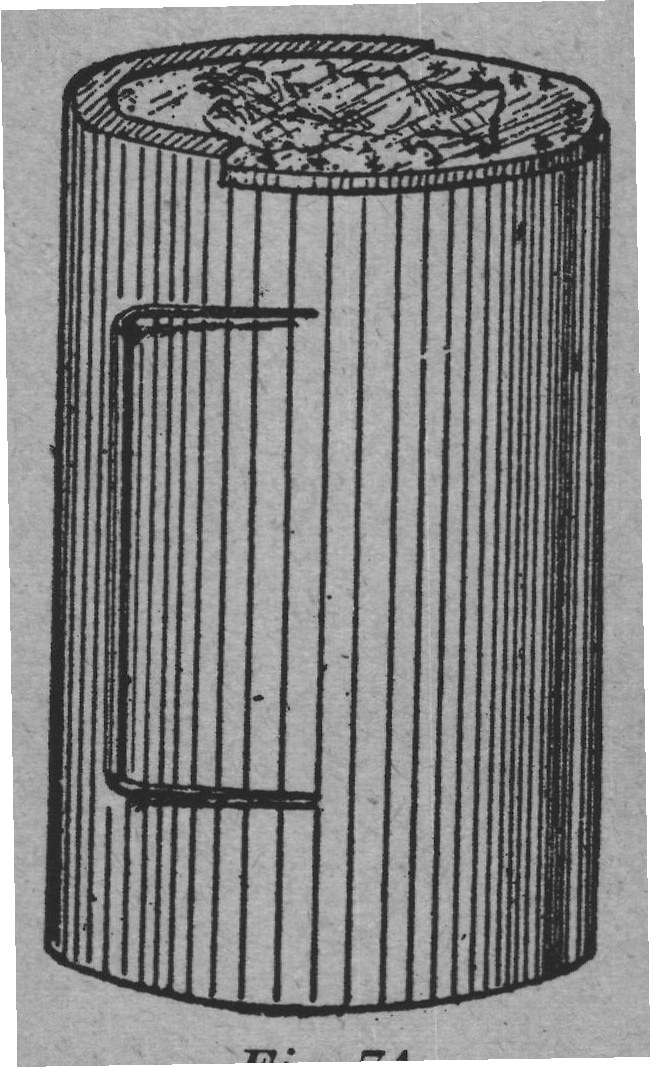
Soldered to the holder are two hooks to attach same to the lining of the hat, thereby enabling the performer to remove the left hand, if desired. In the opinion of the author the hooks are rather more bother than use, as, for instance, in the act of removing the holder from the pocket, the hooks are just as likely as not to catch in something.
The holder should be painted a dead black, thus considerably minimizing the chances of its being observed. While on the subject of hat "fakes" the author will now describe an exceedingly ingenious piece of apparatus, invented by Mr. M. M. Fig. 74.
Wood, of Chicago. It is so constructed that, during the performance of "The Miser's Dream," the artist can at any moment (by making use of this apparatus) show both hands empty, and to alleviate any suspicion that the coins drop into the hat from the left hand, the hat can be held on the palm of the hand. Notwithstanding this, coins can be caught in the air with the right hand and thrown apparently into the hat, same being distinctly heard to fall.
This can be repeated a number of times.
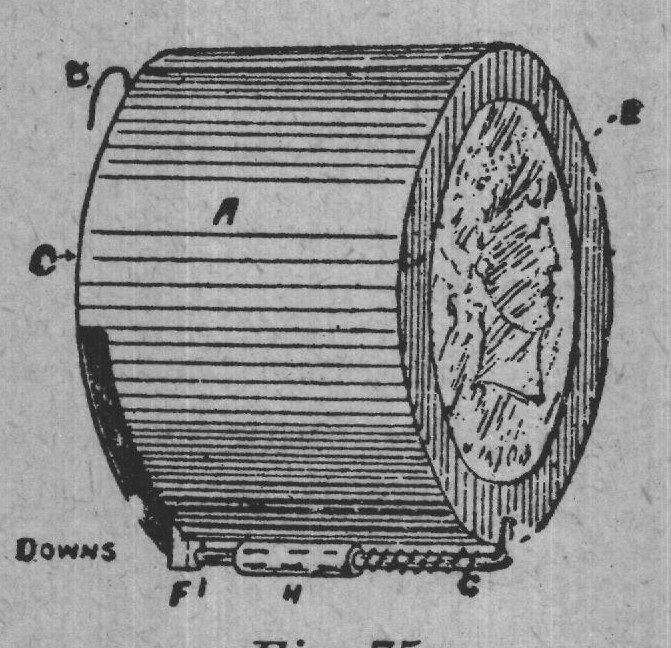
The piece of apparatus necessary for producing the above effect is that depicted in Fig. 75: A is a holder made of brass, the capacity of DOWNS Fig. 75. which is sufficient to hold easily six half-dollars. To the bottom plate (D) of same are fastened two tiny hooks (B) which enable the performer to suspend same wherever most get-at-able, for instance, behind coat tails; c is a slot extending in front of the bottom plate (D) to the middle of the holder. The slot is big enough to allow the insertion of one half-dollar at a time into the holder. Opposite to the bottom plate (D) is the bottom (E) of the holder, which is provided with a hole sufficiently large to admit the easy insertion of the tip of the middle finger.
The first coin to drop rests in front of the slot (c), and to prevent it from dropping prematurely, a lever (H) is fixed below the holder, sideways to the slot (c). The lever is pushed forward and turned round so that the little metal clip (F) of same enters the slot (c). A spiral spring fixed to the lever (H) has the effect of drawing the lever back, so that as soon as the metal clip (F) enters the slot (c) it is held in position by the spring.
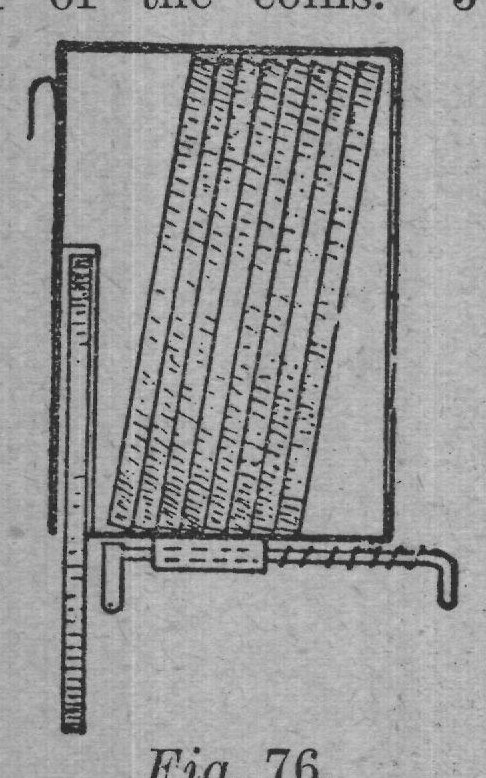
Provided with the above the performer goes hat in hand among the audience, allowing them to inspect the hat. While this is being done he indetectably obtains possession of the holder from wherever it was secreted, and as he returns to the stage he manages to fix it into the hat by hanging it on both hooks (B) to the leather rim. He now presses down the hook (G) of the lever (H), thereby opening the slot (c). To prevent the coin laying in front of the aperture (c) from falling out now the hat is slightly tilted, so that the coins rest on the bottom (E) (see Fig. 76). He now places the hat in this leaning position on his left palm, so that the coins are still retained in position. While making a grab in the air for a coin the performer slightly tilts the brim of the hat towards the audience, causing all the coins in the holder to fall against the bottom plate (D). The first coin is prevented from dropping yet by the weight of the remainder of the coins. Just when the Fig. 76. artist has apparently caught a coin and throws it into the hat, the latter is slightly tilted backwards to its former position, causing the coin nearest to D (being released from the pressure exerted by the other coins) to drop into the hat-the other coins ranging themselves against E (Fig. 76). The above movements are, of course, repeated.
Although this is a mechanical piece of apparatus, a good deal of practice is necessary to enable the performer to produce a perfect illusion. It will be found that, if the hat is tilted too far or not just far enough, the coin will not drop. Any sleight-of-hand performer, however, will find no difficulty in working this "fake" by following the foregoing instructions.
Fig. 77.
The next piece of apparatus to be described, while not invented for the purpose of imitating the author's sleights, is interesting, inasmuch as it admits of rather a novel effect in "The Miser's Dream." While performing the money catching a coin is seen suddenly to appear on the extreme rim of the hat, from whence it is removed and thrown into the hat. This can be repeated ad lib.
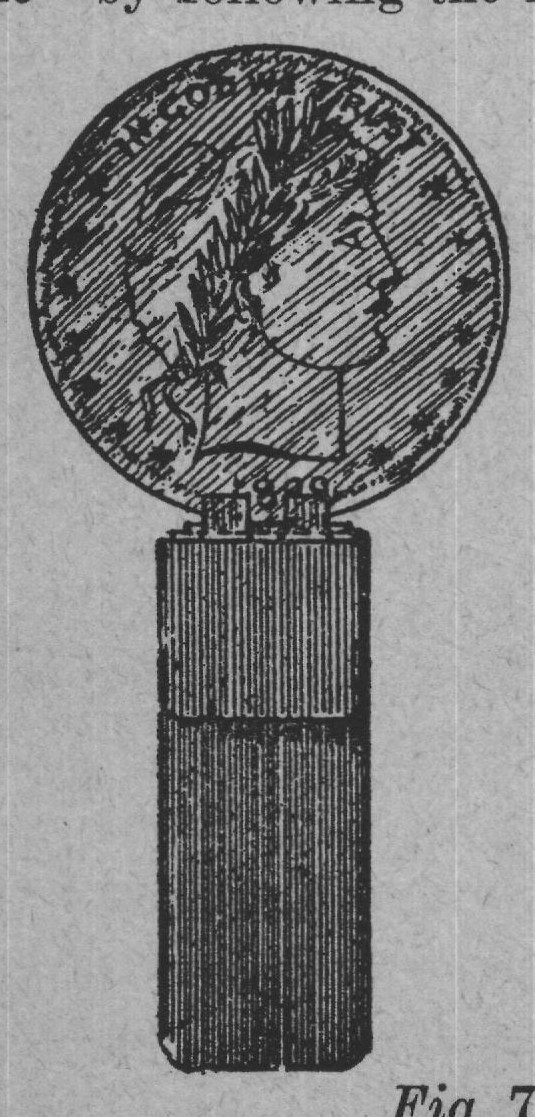
The apparatus consists of a brass hook which just fits on to the rim of a hat. Attached to the hook by means of a hinge is a steel clip, in which the coin is previously inserted (see Fig. 77).
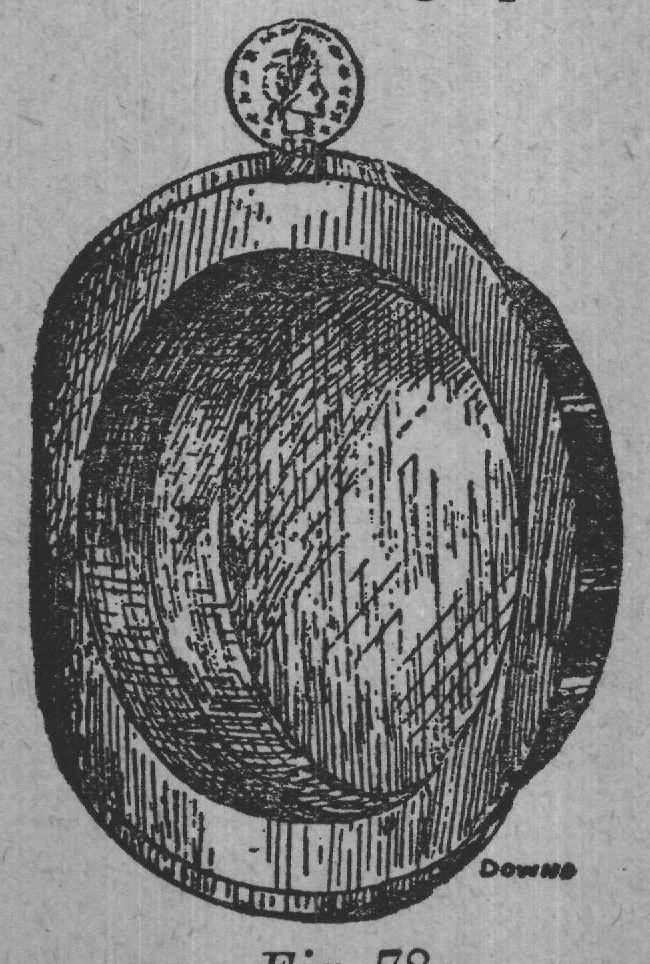
This is secretly placed in position on the hat, and by giving same a tilt in the direction of the audience, the coin is swung up into view as in Fig. 78.
DOWND Fig. 78. It is now apparently taken in the right hand (in reality folded back again) and a palmed one dropped into the hat to produce the necessary illusion.
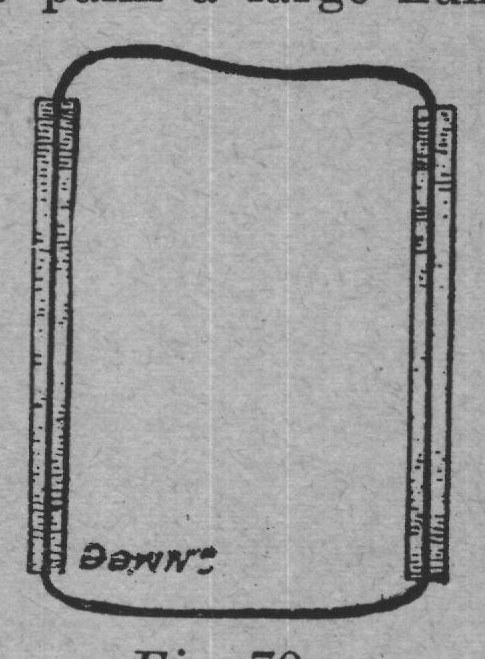
Many appliances have been invented to enable a performer to palm a large number of coins.
TH ATT DOWN Fig. 79.
The best idea consists of four coins, two at each end, brazed together, and through which runs a piece of narrow, but strong elastic. This piece of apparatus is lying amongst the coins on the table, and in the act of gathering them all up, the rest are worked in between the rubber until same is quite taut; see Fig. 80, which shows about fifty coins between the rubbers.
In this condition the stack is exhibited to the audience as an unprepared pile of coins. The pass can then be easily made, and the coins apparently vanished. When the performes desires to reproduce the coins, say from under the vest, the two ends of the "stack" are pressed tightly and the second finger exerts a pressure in the middle of same, which causes the coins to separate and fall in a shower, thereby convincing the audience that same are unprepared.
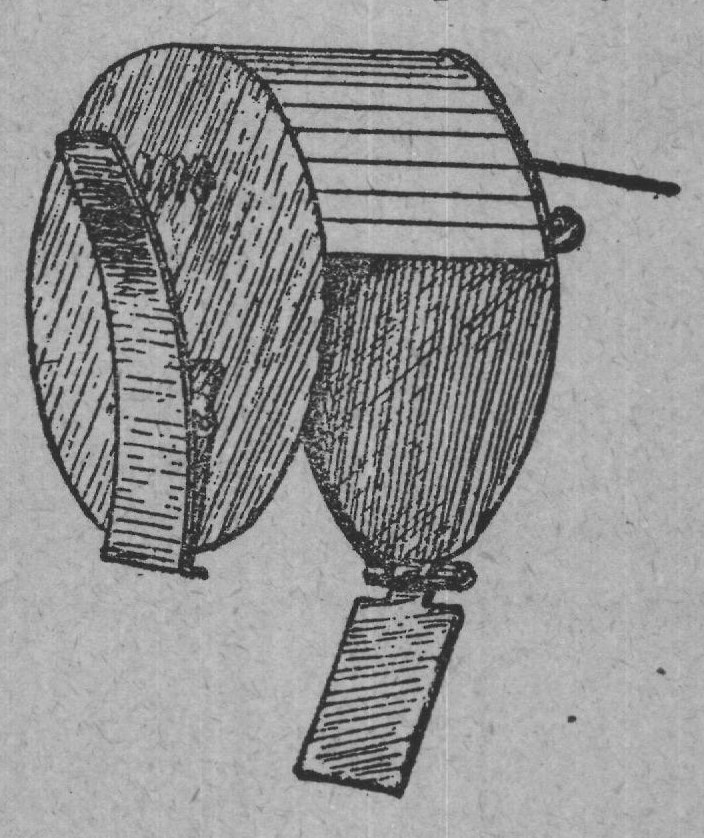
An exceedingly useful, and at the same time novel piece of apparatus, designed to enable the performer to indetectably and instantaneously obtain possession of a number of coins, is that shown in Fig. 81. It is attached to the pants, by means of a safety pin soldered at the rear, just under the vest, having, of course, been prev- Fig. 80. iously filled with coins. Now, at the moment when the artist desires the coins he casually lets his hand drop to the bottom of his vest and his wrist presses the clip attached to the spring, thus releasing the bottom strip of metal, which allows the coins to escape in a pile into the performer's hand. With a little practice it will be found that the above is a most unique and certain method of invisibly getting hold of a quantity of coins. It Fig. 81. would be very useful during the performance of "The Miser's Dream," and, in fact, is suitable for use in any coin trick where a quantity is manipulated.
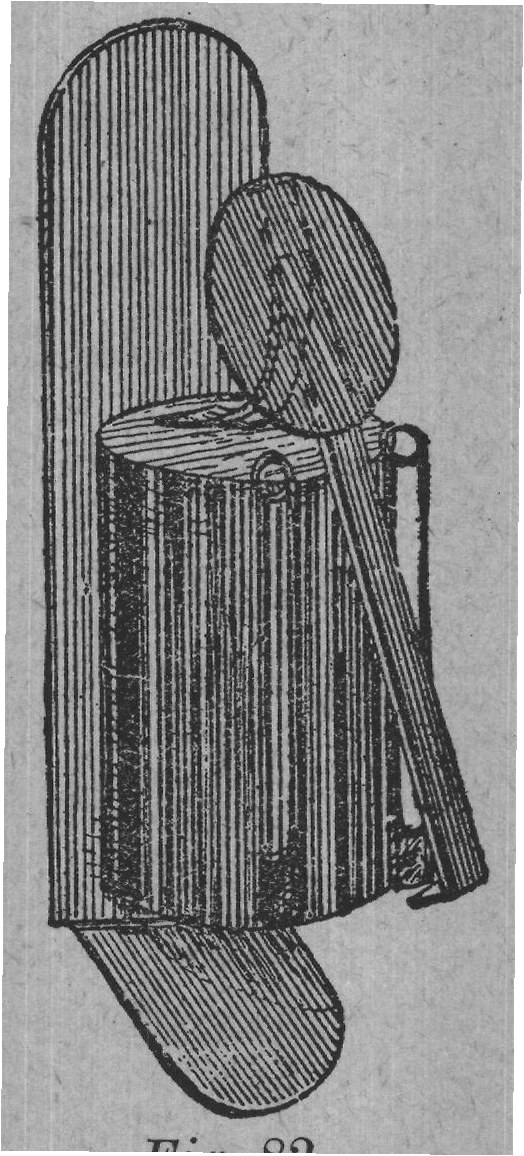
Fig. 82 depicts another adaptation of the above idea, designed by Mr. William E. Robinson. This holds more coins than the preceding one, from twenty to twenty-five, and upon the plate a being pressed the whole stack of coins drop noiselessly into the hand.
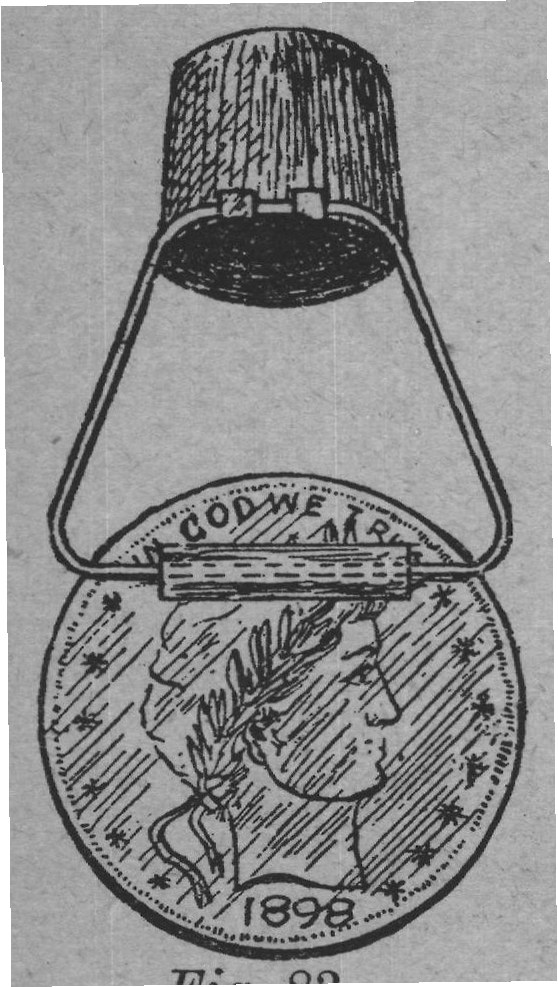
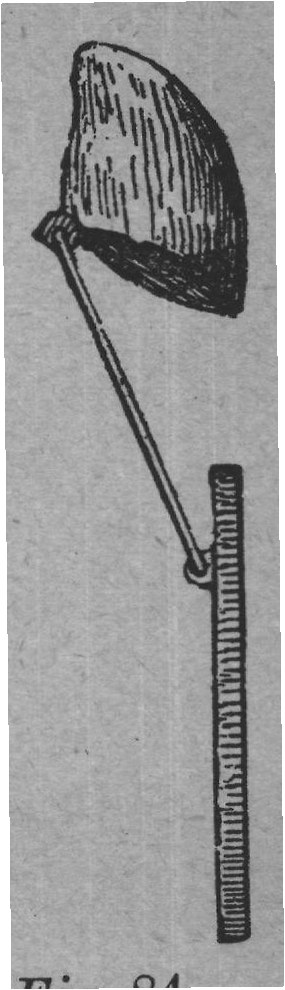
A "very" mechanical method of causing the appearance and disappearance of a coin is described in Figs. 83 and 84; A is a flesh-colored Fig. 82. metal finger top, which just fits over the middle finger, with the coin attached to it by means of hinged wires hanging on the back of the hand.
The front of the hand is now shown empty, and the coin swung round to the front, when the back can be shown, then again the front, and the coin then swung round and produced.
CODWE 1898 Fig. 83.
NOTE Fig. 84.
The author has not included the following in the chapter devoted to miscellaneous coin tricks and combinations, for the reason that some of same have been described from time to time in the conjurer's journal, Mahatma. As this book, however, is intended as a complete manual of the art of conjuring with coins, the author feels that same would be incomplete if some of the following excellent tricks and sleights were omitted, hence the reason of their reproduction in these pages, which is by courtesy of the very able editor (Mr. T. Francis Fritz) of the journal above referred to.