Home › The Unicorn › The Unicorn: Shan
The Unicorn: Shan
The Shan Hai King describes an animal as existing among the plains of Mongolia, having the appearance of a horse, with a white body, black tail, one horn, teeth and claws like a tiger, which howls like the roll of a drum, devours tigers and leopards, and is capable of being used instead of soldiers; it is called Poh.
The 'Rh Ya describes the same animal as like a horse, with saw teeth, existing on tigers and leopards.
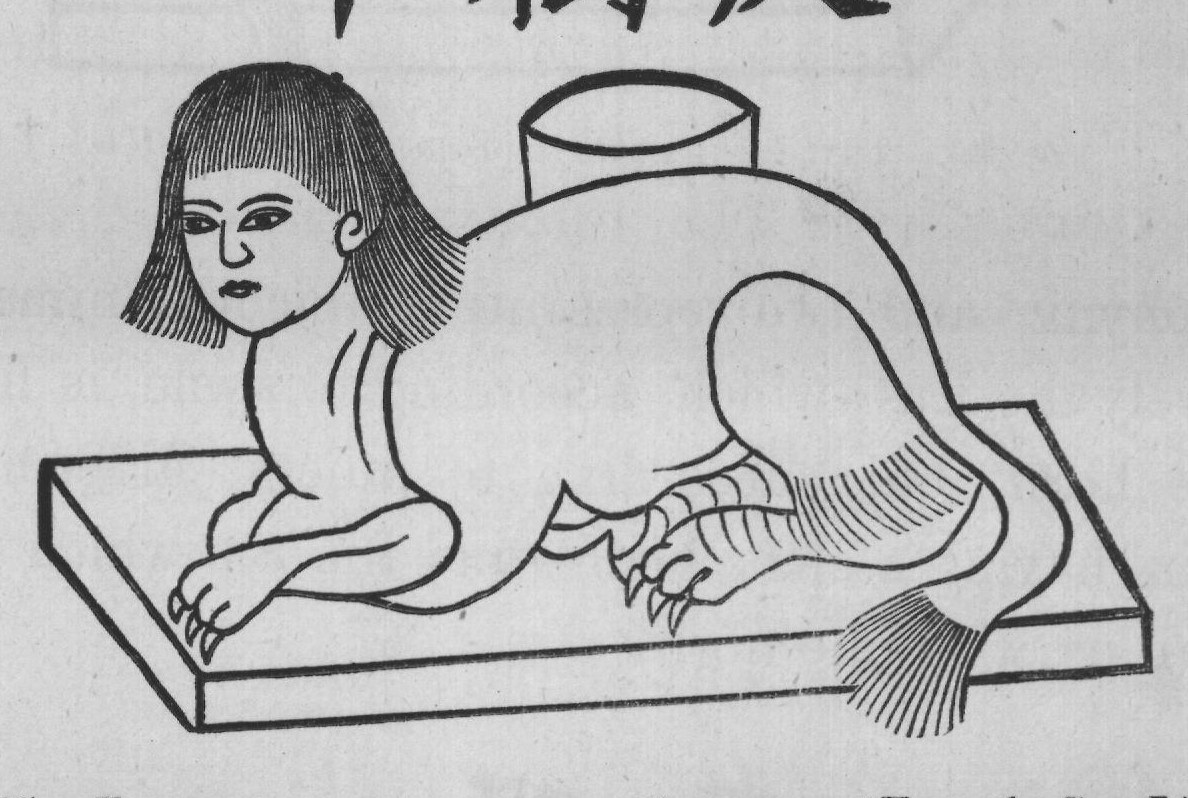
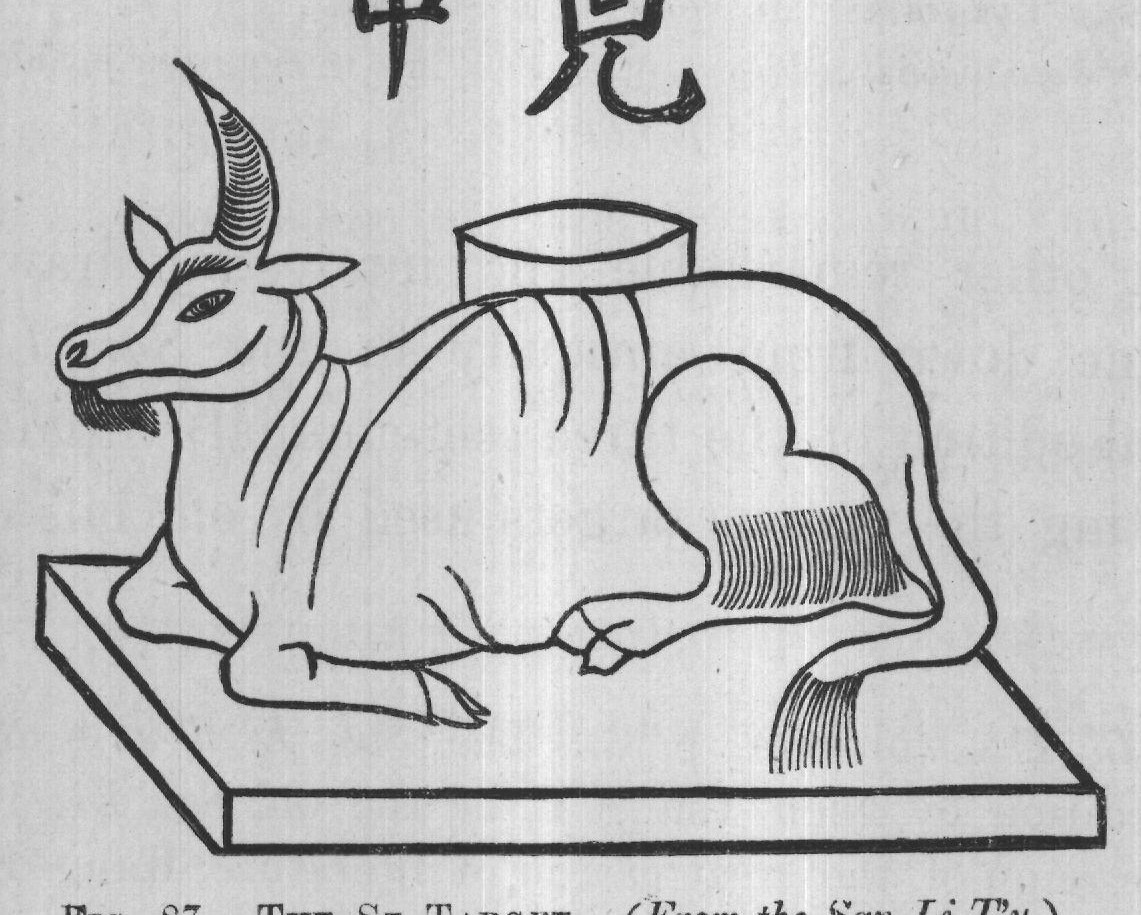
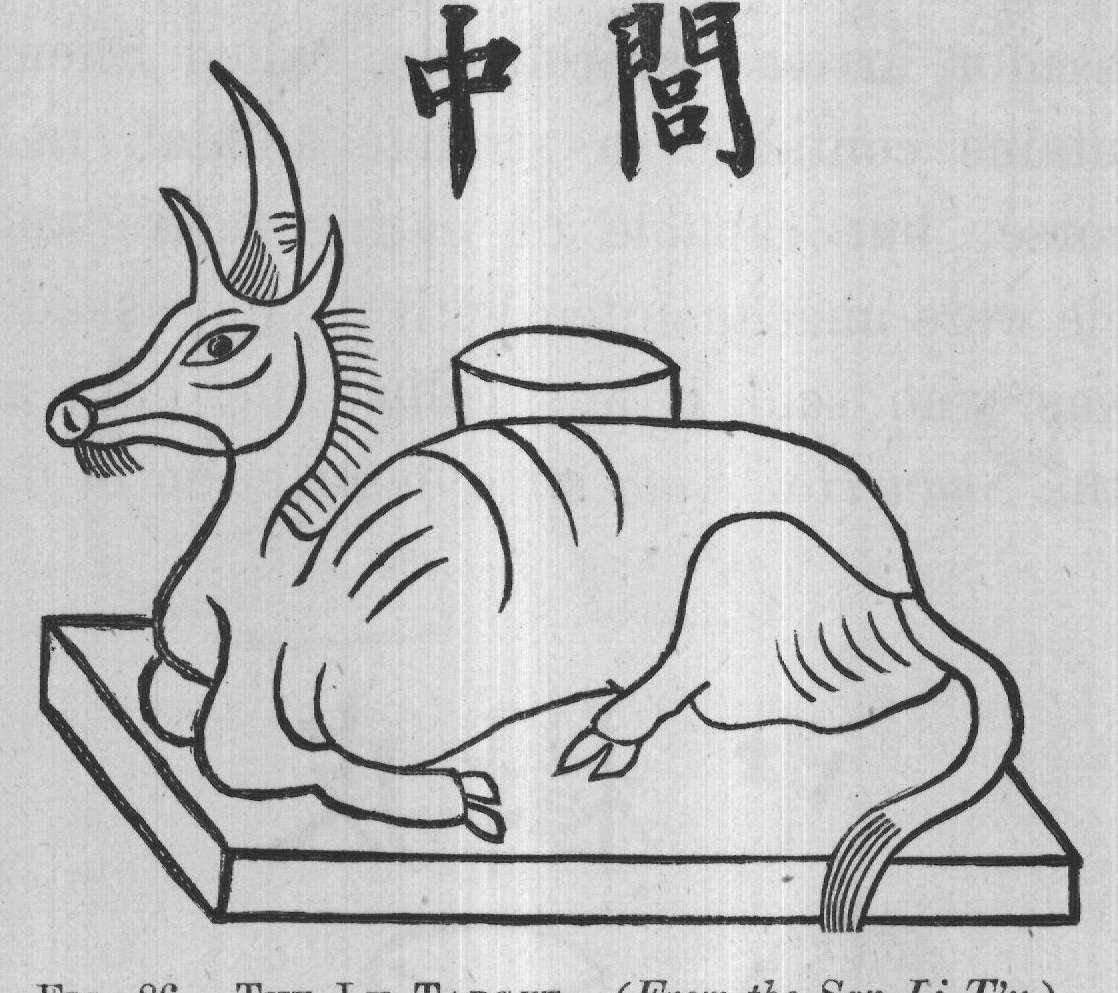
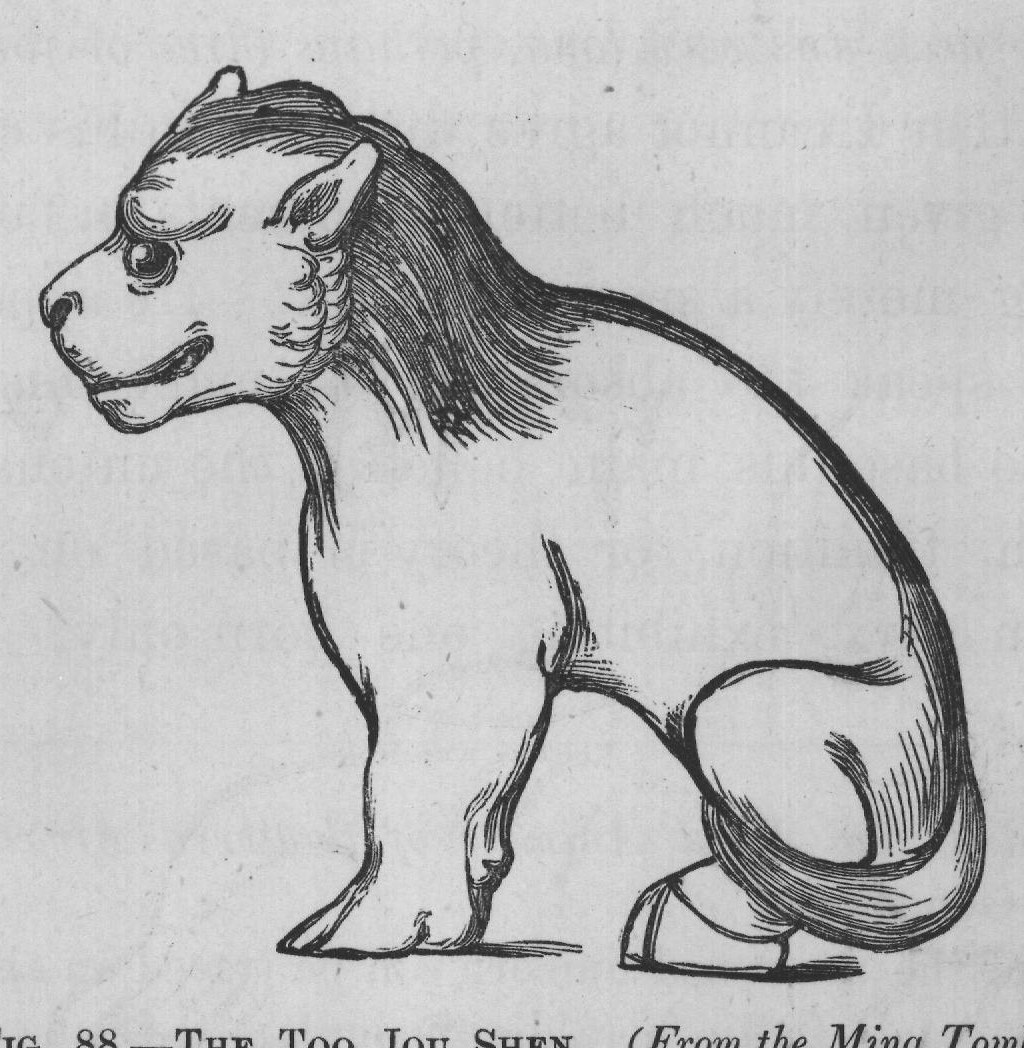
The "History of the North" says that in the Kingdom of Peh Chi (?) a magistrate named Chung Wa held office, * Vol. ccccxxxii. p. 38. † This will have to be reduced by nearly one-half, to equate it with the present measures of length. who was very equitable in his rule. His district was invaded by some ferocious animals. Suddenly six of the Poh came and killed and devoured them as a reward for his good rule. The Sung History says that a man named Leu Chang, an ambassador, arrived at a district called Shen Su, where the mountains contained a strange animal, in appearance like a horse, but capable of eating tigers and leopards. The people were unacquainted with it, and asked Leu Chang what it was, who said it was called the Poh, and referred them to the Shan Hai King for a description of it. 中樹皮 FIG. 85. TARGET IN THE FORM OF A SPHYNX. (From the San Li T'u.). The arrows were discharged upwards and fell into the cylinder behind the figure. * Among other remarkable and interesting drawings which have come down from antiquity in the San Li Tu, or illustrated edition of the three (ceremonial) rituals, are some representing the various targets used by officials of different * San Li T'u, vol. viii. p. 3. The San Li Tu is an illustrated, modern, edition by Nieh Tsung I. of the old San Li; it was written during the reign of the great patron of literature, Kang Hi (A.D. 1661 to 1723). ranks in the military examinations, in which the arrows had to be lodged by shooting upwards from a distance. These are fashioned in the form of animals, one realising the idea 中間 FIG. 86. THE LU TARGET. (From the San Li Tu.) of the sphynx, and two representing unicorn animals, called respectively the Lu-which, according to some, is like an ass with one horn, but, according to others, differing from a donkey in having a cleft hoof-and the Sz, which is said to be like an ox with one horn. 中咒 FIG. 87. THE SZ TARGET. (From the San Li Tu.) FIG. 88. THE TOO JOU SHEN. (From the Ming Tombs.) a The Too Jou Shen is the name of an animal with a lionlike body and head, cloven hoofs, and a blunt short horn projecting from the centre of the forehead. Two pairs of these form portion of the avenue of stone figures of animals leading up to the Ming tombs, about eighty miles north of Pekin. I have not found it described in any book.
FIG. 89.-THE TOO JOU SHEN.
A writer in the China Review* endeavours to prove that the Ki-Lin is a (From the Ming Tombs.) reminiscence of the giraffe, which he supposes may once have spread over Asia, and, in addition to various passages included among those which I have quoted above, adduces one from the Wu Tsah Tsu, which states that, "In the period Yung Loh of the Ming dynasty (1403-1425) a Ki-Lin was caught, and a painter was ordered to make a sketch and hand it up to the high magistrates. According to the picture, the body was perfectly shaped like that of a * Vol. vii. No. 1, p. 72. deer, but the neck was very long, perhaps three or four feet." I must admit that I cannot agree with him in his conclusions. Harris* has given much better arguments in favour of the unicorn being merely a species of oryx. He appears to me, however, to speak too absolutely, to make his facts too pliant, and to base his main belief on the untenable theory that the myth, tradition, or theory is based on the profile drawing of an oryx, exhibiting one horn only. We might * Harris, Game and Wild Animals of Southern Africa. The Oryx Capensis-The Gemsbock. "The figure of the renowned unicorn can be traced in all the ancient ear-rings, coins, and Latin heraldic insignia, to some one of the members of the oryxine family; of all the whimsies of antiquity, whether emanating from the unbridled and fertile fancies of the people of Egypt and Persia, or devised by the more chaste and classic taste which distinguished Greece and Rome, the unicorn-unquestionably the most celebrated-is the chimera which has in modern ages engrossed the largest portion of attention from the curious. "The rhinoceros is supposed to be the animal so often alluded to in Scripture under the name of reem or unicorn, yet the combination presented in the oryx of the antelopine and equine characters, the horns and cloven hoof of the one, blended with the erect mane, general contour and long switch tail of the other, corresponds in all essential particulars with the extant delineations and descriptions of the heraldic unicorn, which is universally represented to have been possessed of a straight slender horn, ringed at the base, and to have the hoof divided; to have worn a mane reversed, a black flowing tail, and a turkey-like tuft on the larynx, whilst both the size and ground colour were said to be those of the ass, with the addition of sundry black markings, imparting to the face and forehead a piebald appearance. "The alterations required to reduce the African oryx to the standard of this model, are slight and simple, nor can it be doubted that they have been gradually introduced by successive copyists; the idea of the single horn having been derived in the first instance from profile representations of that animal given in bas-relief on the sculptured monuments of ancient Egypt and Nubia.. They have in their aspect a certain bovine expression; and Arabs and other natives never consider them as antelopes but as a species of buffalo.
The oryx boldly defends itself when pressed by the hunters, is quarrelsome during the rutting season, and it is said that even the lion dreads an encounter with it." ... just as soon expect people to start stories of two-legged cows or horses, or one-legged races of men, if so slender a basis for forging a species were sufficient. What the zoological status of the unicorn may be I am not prepared to show, but I find it impossible to believe that a creature whose existence has been affirmed by so many authors, at so many different dates, and from so many different countries, can be, as mythologists demand, merely the symbol of a myth. There is a possible solution, which does not appear to have struck previous writers on the subject, viz., that the unicorn may be merely a hybrid produced occasionally and at more or less rare intervals.
By accepting this view we could explain the extraordinary combinations of character assigned to it, and the discrepancy which exists between the qualities of courage and gentleness ascribed to it by Western and Chinese authors. A valuable chapter remains to be written by naturalists and progressionists on the limits within which hybridization exists in a state of nature among the higher animals; its prevalence among the lower and among plants is, of course, well known. A cross between some equine and cervine species might readily result in a unicorn offspring, and either the courageous qualities of the sire* or the gentleness of the dam might preponderate, according to the relations of the species in each of the instances.