Home › The Unicorn › The Unicorn: Ki-Lin
The Unicorn: Ki-Lin
Turning to the Chinese classics and books of antiquity, we find references, sometimes vague and mythical, sometimes exact, to several distinct unicorn animals. These may be enumerated as :- † 1. The Ki-Lin, represented in Japan by the Kirin. 2. The King. 3. The Kioh Twan. 4. The Poh. 5. The Hiai Chai. 6. The Too Jon Sheu.
Besides these there are clear descriptions of the rhinoceros, which cannot in any way be confounded with the above. The only one of these popularly familiar is the Ki-Lin, the history of which is interwoven with that of remote ages. The first mention of it is made in the Bamboo Books---only in that part, however, of them which is apparently a commentary, note, or subsequent addition, though some authorities hold it to be a portion of the actual text. The work states that, during the reign of Hwang-Ti (в.c. 2697), Ki-Lins appeared in the parks.
Their appearance was generally supposed to signalise the reign of an upright monarch, and Confucius considered that * Prejevalski's Mongolia, vol. ii. p. 207; London, 1876. † See 'Rh Ya and Yuen Keen Luy Han, vol. ccccxxix. p. 1. the appearance of one during his epoch was a bad omen, as it did not harmonise with the troubled state of the times. The name Ki-Lin is a generic or dual word, composed of those of the Ki and the Lin, the respective male and female of the creature.
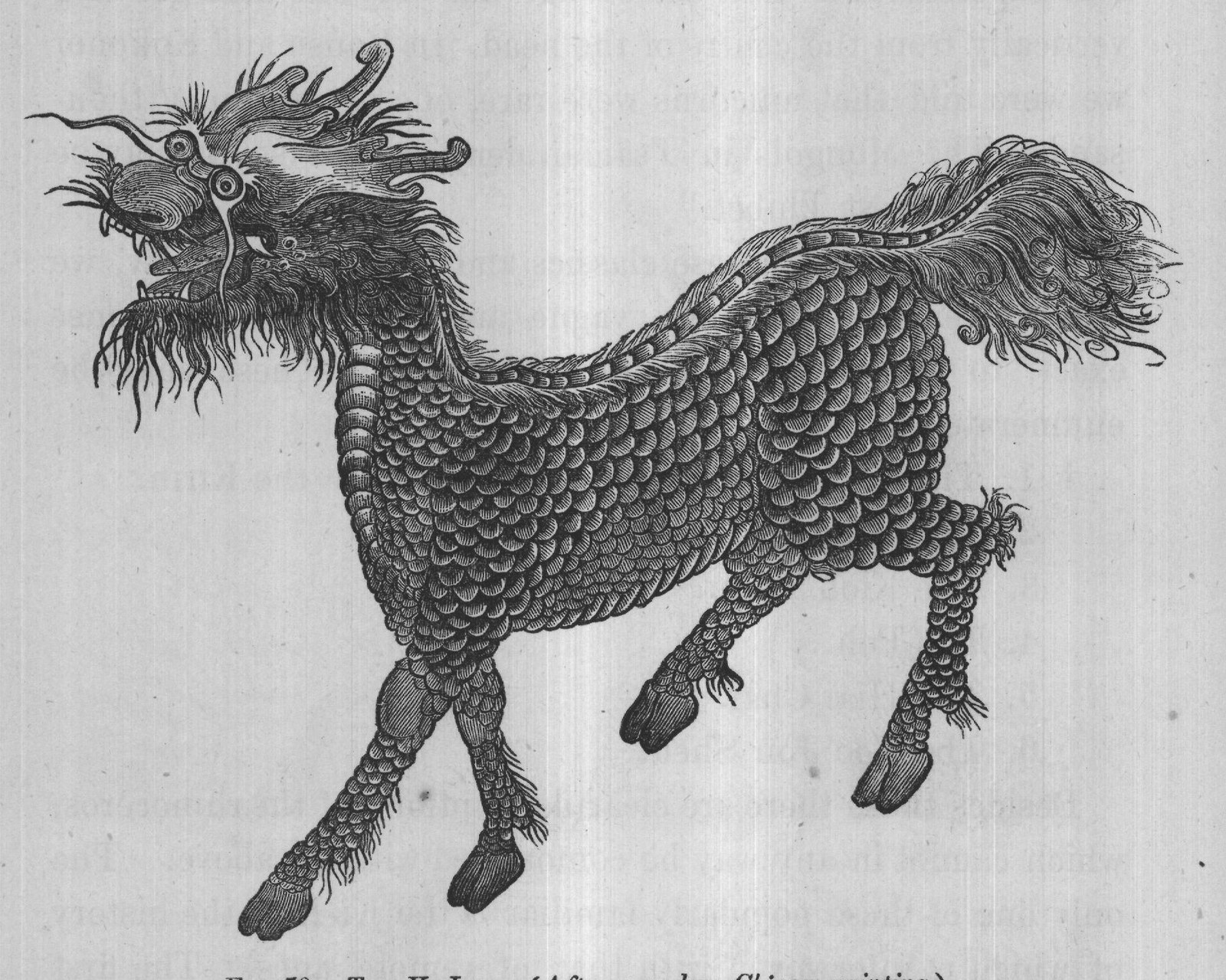
FIG. 79. THE KI-LIN. (After a modern Chinese painting.) This peculiar species of word formation is adopted in other instances in reference to birds and animals; thus we have the male Fung and the female Hwang united in the Fung Hwang, or so-called Chinese phenix, and the Yuen and Yang in the Yuen Yang, or mandarin duck.
Sometimes the word Lin alone is used with the same generic meaning.
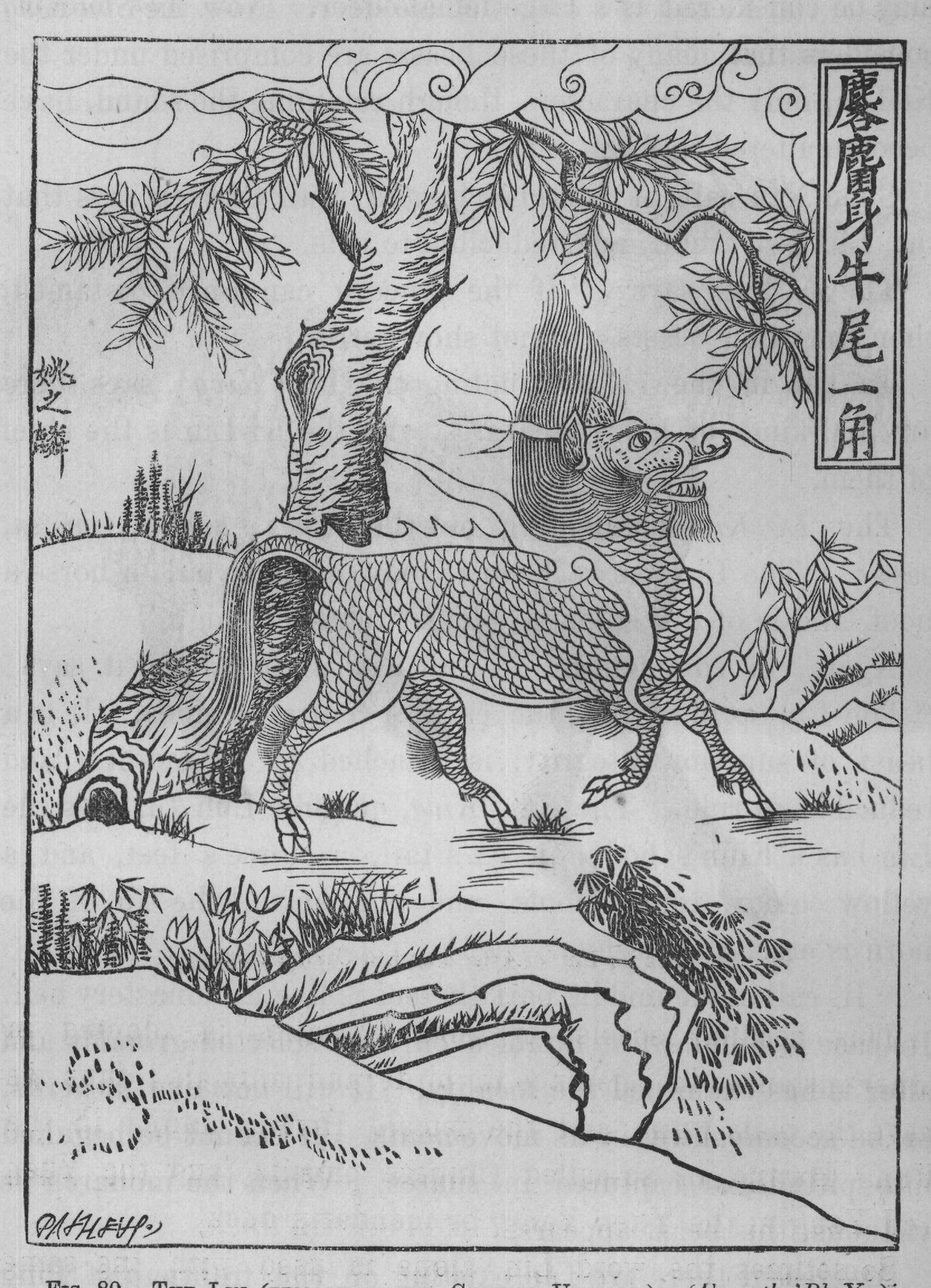
The 'Rh Ya, in the original text, defines the Lin as having a Kiun's body (the Kiun is a kind of muntjack or deer), an ox's tail, and one horn. The commentary states that the tip of the horn is fleshy, and that the King Yang chapter of the "Spring and Autumn Annals" of Confucius defines it as a horned Kiun. 專屬身牛尾一角 姚之麟 PAHHEH FIG. 80. THE LIN (FEMALE OF THE CHINESE UNICORN). (From the 'Rh Ya.) The preface to the Shi Shu quotes Li Siün to the effect that the Lin is an auspicious and perfect beast.
Sun Yen says it is a spiritual beast. The Shwoh Wan says the Lin is the female of the K'i and the K'i is a beast endowed with goodness, possessing a Kiun's body, an ox's tail, and one horn. According to the Shwoh Wan, the Lin may be considered as a large female deer. Now the Shu King considers that many of these beasts are comprised under the Ki-Lin, only the characters, though retaining the sound, have become altered in form.