Home › The Unicorn › The Unicorn: Chw'en
The Unicorn: Chw'en
Cheu Nau calls it Lin-che-chi and Man Chw'en says that the Lin is truthful, and reducible to rule.
The Li Yuen says: "If the unicorn can once be tamed, then the other beasts will not show terror."
Ta Tai, in the Li Ki, quoting the Yih [King], says there are 360 kinds of hairy creatures, and the Ki-Lin is the chief of them.
The Li Ki, commenting on the King Fang I Chw'en, says: "The Lin has a Kiun's body, an ox's tail, a horse's hoof, and is of five colours. It is twelve feet high." * Again, in commenting on Fuh Kien's Ho Chwen, it says: "The Lin springs from the earth's central regions. It is a beast of superior integrity, is attached to its mother, and reducible to rule. The Shu King, quoting Luh Li, says the Lin has a Kiun's body, an ox's tail, a horse's feet, and a yellow colour, round hoofs, and one horn; the tip of the horn is erect and fleshy. " Its call in the middle part thereof is like a monastery bell. Its pace is regular; it rambles only on selected grounds and after it has examined the locality. It will not live in herds, or be accompanied in its movements. It cannot be beguiled into pitfalls, or captured in snares. When the monarch is virtuous, this beast appears."
At present there are Lin existing on the frontiers of Ping * This height will have to be reduced in accordance with the difference between the magnitude of old and new standards of measurement. Cheu. Even the large or small Lin are always like deer, so that this species is not the auspicious Ying Lin; although Tsz Ma Siang Su, * in his odes on the shooting of the Mi and trapping Lin, says that it is.
The top of the horn being fleshy is a characteristic of the Lin, and Mao Chw'en says that the Lin's horn is an emblem of goodness. Ching Tsien says that the horn has a fleshy termination, indicating the peaceful character of the beast, and that it has no use for it.
The "Book of Rites," quoting the Kwang Ya, says that on account of its elegant style it takes place, par excellence, among the large-horned beasts; the existing edition of the Kwang Ya omits this.
The Kung Yang Chw'en says the Kiun also has horns.
Kung Ssun Tsz, in the annals of the fourteenth year of the Duke Ngai (State of Lu), says that the Kiun has fleshy horns.
Kwoh, in his preface, proves the Lin to have a Kiun's body.
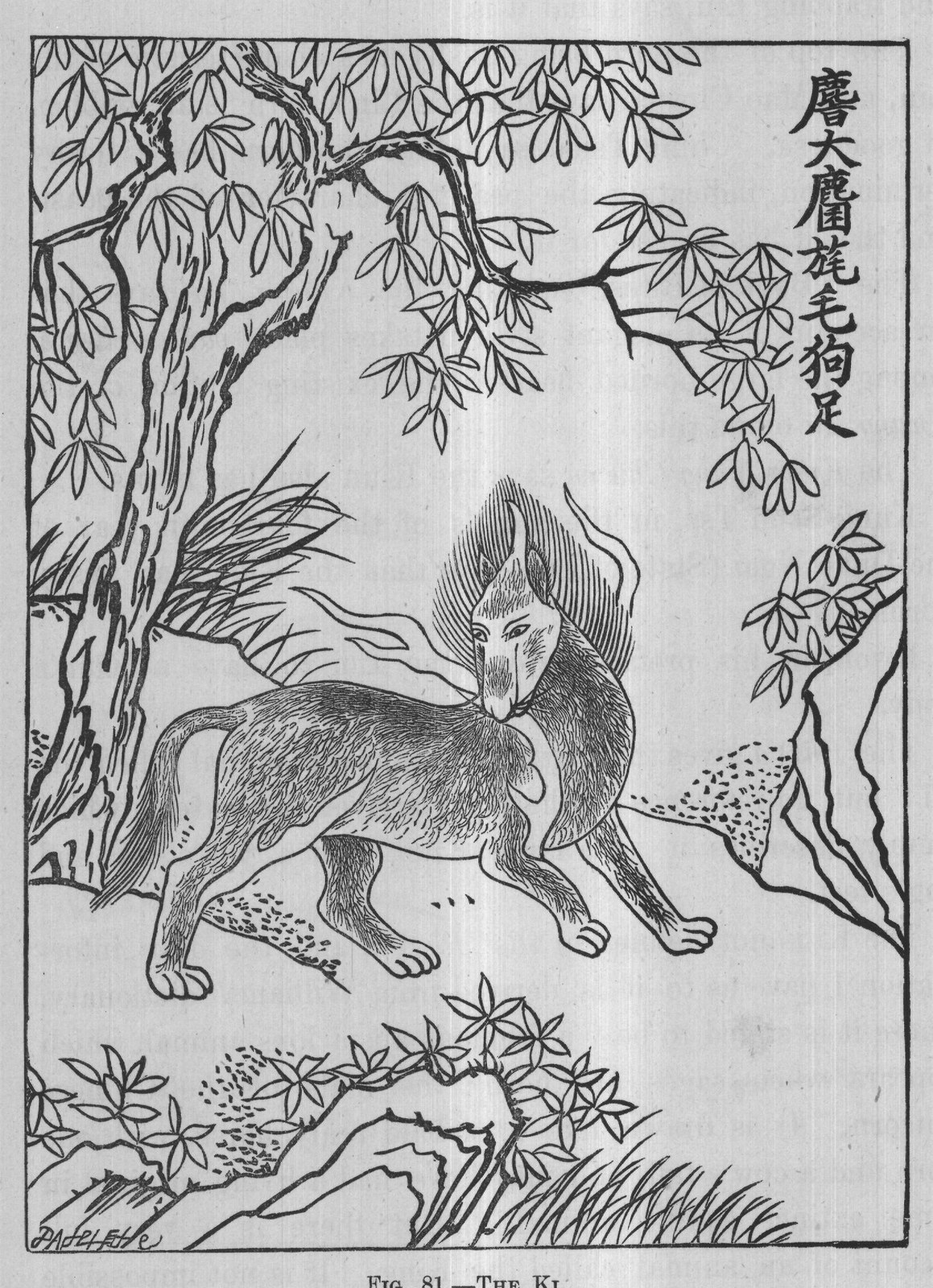
The 'Rh Ya gives the drawing of a unicorn animal called the Ki; but no reference to the horn is given in the text, which simply describes it as a large Kiun with a yak's tail and dog's feet.
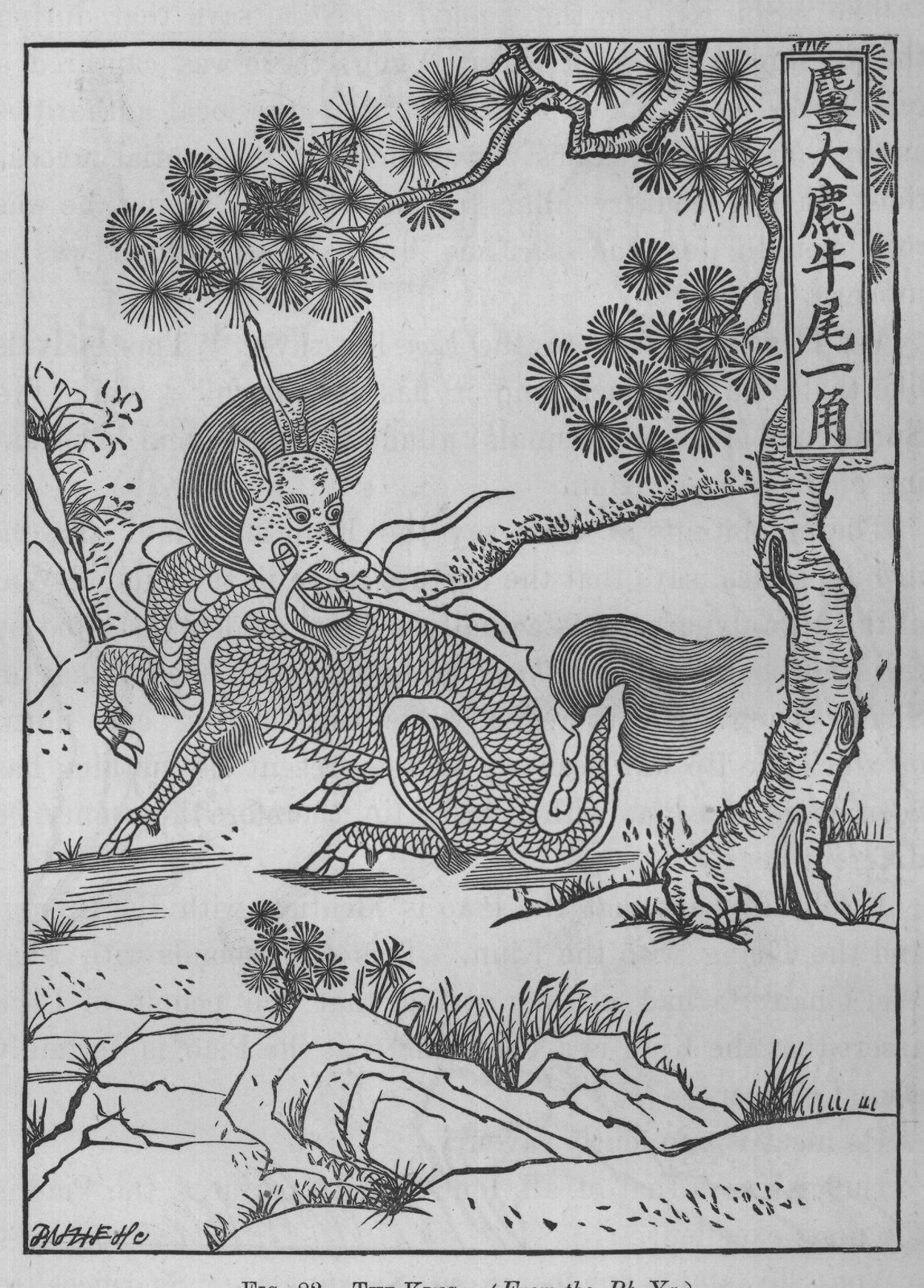
The Ki is not defined in the 'Rh Ya, and the only information I have as to it is derived from Williams' dictionary, where it is stated to be " a fabulous auspicious animal, which appears when sages are born; the male of the Chinese unicorn. It is drawn like a piebald scaly horse, with one horn and a cow's tail, and may have had a living original in some extinct equine animal." But there is a very full account of an animal called the King. It is not impossible that it is identical with the King which, in the usual brief * A poet, native of Hang Cheu, style of the original text of the 'Rh Ya, is epitomised as a large Biao (a kind of stag), with an ox's tail and one horn; and the several commentaries on it are as follows:- Patelle FIG. 81. THE KI. 廖大庸旄毛狗足 "In the time of the Emperor Wu, of the Han dynasty, during the worship of heaven and earth at the solstices at Yung, there was captured a unicorn beast like a Piao; it was at that time designated the Lin; it was, however, a Piao related to the Chang (a kind of deer)."
The Shwoh Wan says: "The King is a large stag with an 臺大農牛尾一角 PHHEHO A FIG. 82. THE KING. (From the Rh Ya.) ox's tail and one horn." It may be a large form of the Piao. The Wang Hwu Analects say that the Piao is an object of the chase, and that it is as swift as a stag. Kwan Tsz, in the Ti Yuen volume, says that as there are Mi and Piao and many species of deer, so also the Piao is a species of deer.
The "Shi Ki," in the book Fung Shen, says that during the worship at the solstices at Yung, there was captured a one-horned beast like a Piao, and that the local authorities assert that as His Majesty was making reverential invocations on the country altar to the Supreme Being, he was recompensed for the sacrifice by a beast which was a unicorn.
Wu Chao's preface to the Loh Yiu says: "The body is like that of a muntjack, and it has one horn"; while the Spring and Autumn (Annals) allude to this animal in speaking of the horned Kiun. The inhabitants of Ch'u say the Kiun is a Piao. Kwoh, in his preface, says that the capture made in the time of Wu, of the Han dynasty, was actually a Piao, as demonstrated by the Han books. The Chung Kiun narrative states that in Shang Yung was captured a white Lin bearing one horn, of which the tip was fleshy. At the present day nothing has been heard of a Piao with a fleshy tip, therefore these must be different beasts.