Home › The Sea-Serpent › The Sea-Serpent: Pauline
The Sea-Serpent: Pauline
The Barque "Pauline" Sea-serpent.
To the Editor of the Calcutta Englishman.
SIR,-As I am not sure that my statement respecting the sea-serpent reached the Shipping Gazette in London, I enclose a copy that may be interesting to your numerous readers. I have been sent plenty of extracts from English papers, nearly all of them ridiculing my statement. I can laugh and joke on the subject as well as anyone, but I can't see why, if people can't fairly refute my statement, they should use falsehood to do so. The Daily Telegraph says, "The ribs of the illfated fish were distinctly heard cracking one after the other, with a report like that of a small cannon; its bellowings ceased, &c. To use the eloquent words of the principal spectator, it 'struck us all aghast with terror." If the writer knew anything of sailors, he would not write such bosh. Fear and terror are not in Jack's composition; and such eloquent words he leaves to such correspondents as described the everdoubtful "man-and-dog-fight." I am just as certain of seeing what I described, as that I met the advertisement that the Telegraph has the largest circulation in the world staring me at every street corner in London. It is easy for such a paper to make any man, good, great, or interesting, look ridiculous. Little wonder is it that my relatives write saying that they would have seen a hundred sea-serpents and never reported it; and a lady also wrote that she pitied anyone that was related to anyone that had seen the sea-serpent. It is quite true that it is a sad thing for any man to see more, to feel more, and to know more, than his fellows; but I have some of the philosophy that made O'Connell rejoice in being the most abused man in the United Kingdom, for he also had the power of giving a person a lick with the rough side of his tongue. If I had any such power I would not use it, for contempt is the sharpest reproof; and this letter is the only notice I have taken of the many absurd statements, &c. &c. &c.
Barque Pauline, Chittagong, January 15, 1876.
GEORGE DREVAR, Master of the Pauline.
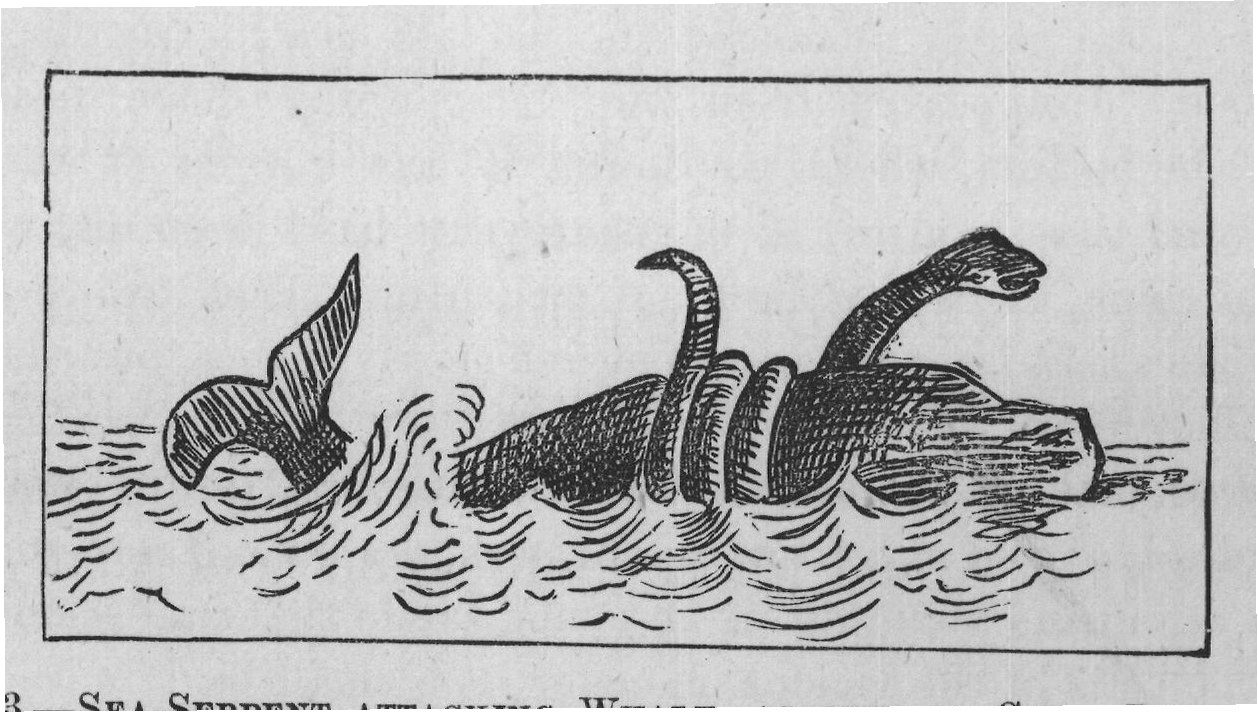
FIG. 73.-SEA-SERPENT ATTACKING WHALE, AS SEEN BY CAPT. DREVAR, OF THE BARQUE "PAULINE," IN 1876.
Barque Pauline, January 8th, 1875, lat. 5° 13' S., long. 35° W., Cape Roque, north-east corner of Brazil distant twenty miles, at 11 A.M.
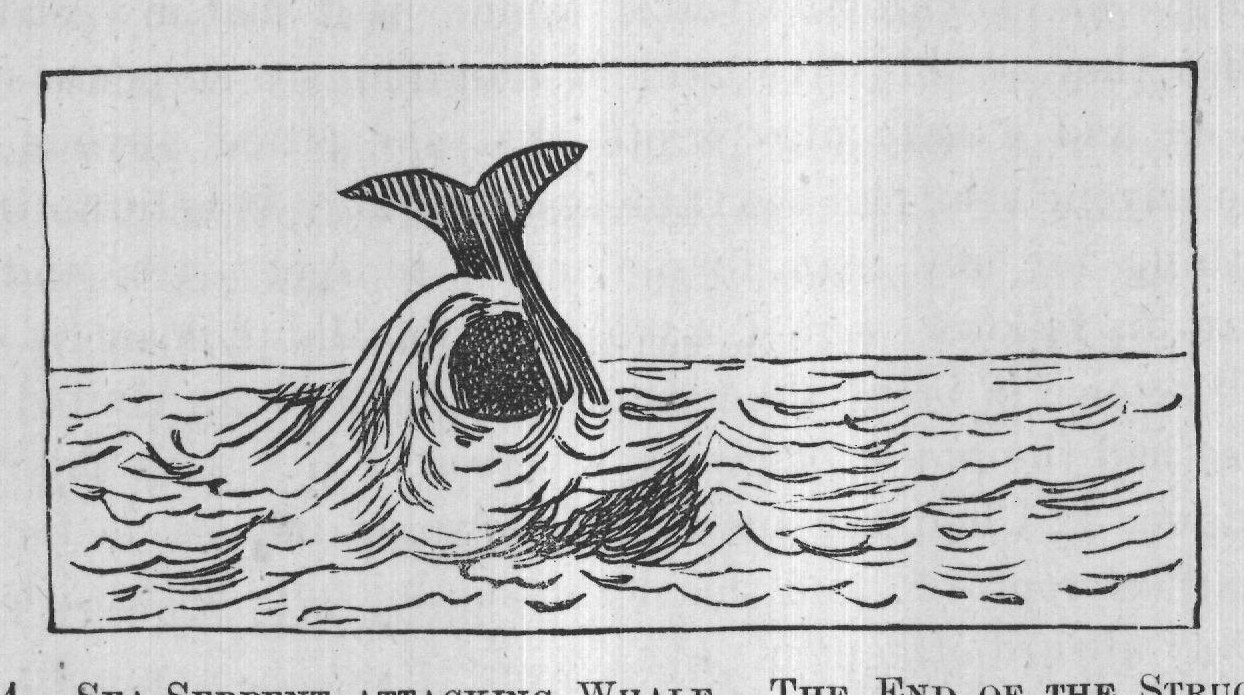
The weather fine and clear, the wind and sea moderate. Observed some black spots on the water, and a whitish pillar, about thirty-five feet high, above them. At the first glance I took all to be breakers, as the sea was splashing up fountain-like about them, and the pillar, a pinnacle rock bleached with the sun; but the pillar fell with a splash, and a similar one rose. They rose and fell alternately in quick succession, and good glasses showed me it was a monster sea-serpent coiled twice round a large sperm whale. The head and tail parts, each about thirty feet long, were acting as levers, twisting itself and victim around with great velocity. They sank out of sight about every two minutes, coming to the surface still revolving, and the struggles of the whale and two other whales that were near, frantic with excitement, made the sea in this vicinity like a boiling cauldron; and a loud and confused noise was distinctly heard.
This strange occurrence lasted some fifteen FIG. 74.-SEA-SERPENT ATTACKING WHALE. THE END OF THE STRUGGLE. minutes, and finished with the tail portion of the whale being elevated straight in the air, then waving backwards and forwards, and laving [lashing?] the water furiously in the last death-struggle, when the whole body disappeared from our view, going down head-foremost towards the bottom, where, no doubt, it was gorged at the serpent's leisure; and that monster of monsters may have been many months in a state of coma, digesting the huge mouthful. Then two of the largest sperm whales that I have ever seen moved slowly thence towards the vessel, their bodies more than usually elevated out of the water, and not spouting or making the least noise, but seeming quite paralysed with fear; indeed, a cold shiver went through my own frame on beholding the last agonising struggle of the poor whale that had seemed as helpless in the coils of the vicious monster as a small bird in the talons of a hawk. Allowing for two coils round the whale, I think the serpent was about one hundred and sixty or one hundred and seventy feet long, and seven or eight in girth. It was in colour much like a conger eel, and the head, from the mouth being always open, appeared the largest part of the body.... I think Cape San Roque is a landmark for whales leaving the south for the North Atlantic.
I wrote thus far, little thinking I would ever see the serpent again; but at 7 A.M., July 13th, in the same latitude, and some eighty miles east of San Roque, I was astonished to see the same or a similar monster. It was throwing its head and about forty feet of its body in a horizontal position out • .. ... of the water as it passed onwards by the stern of our vessel. I began musing why we were so much favoured with such a strange visitor, and concluded that the band of white paint, two feet wide above the copper, might have looked like a fellow-serpent to it, and, no doubt, attracted its attention.
While thus thinking, I was startled by the cry of "There it is again," and a short distance to leeward, elevated some sixty feet in the air, was the great leviathan, grimly looking towards the vessel. As I was not sure it was only our free board it was viewing, we had all our axes ready, and were fully determined, should the brute embrace the Pauline, to chop away for its backbone with all our might, and the wretch might have found for once in its life that it had caught a Tartar. This statement is strictly true, and the occurrence was witnessed by my officers, half the crew, and myself; and we are ready, at any time, to testify on oath that it is so, and that we are not in the least mistaken.
A vessel, about three years ago, was dragged over by some sea-monster in the Indian Ocean. ....