Home › The Deluge Not a Myth › The Deluge Not a Myth: Chinese
The Deluge Not a Myth: Chinese
There is but a little step between carving the figure of a mammoth or horse, and using them as symbols. Multiply them, and you have the early hieroglyphic written language of the Chinese and Egyptians. It is not an unfair presumption that at no great distance, in time or space, either some generations later among his own descendants, or so many nations' distance among his coevals, the initiative faculty of the Palæolithic savage was usefully applied to the communication of ideas, just as at a much later date the Kououen symbolic language was developed or made use of among the early Chinese.* Such is, necessarily, the first stage of any written language, and it may, as I think, perhaps have occurred, been developed into higher stages, culminated, and perished at many successive epochs during man's existence, presuming it to have been so extended as the progress of geology tends to affirm. May not the meandering of the tide of civilization westward during the last three thousand years, bearing on its crest fortune and empire, and leaving in its hollow decay and oblivion, possibly be the sequel of many successive waves which have preceded it in the past, rising, some higher, some lower, as waves will.
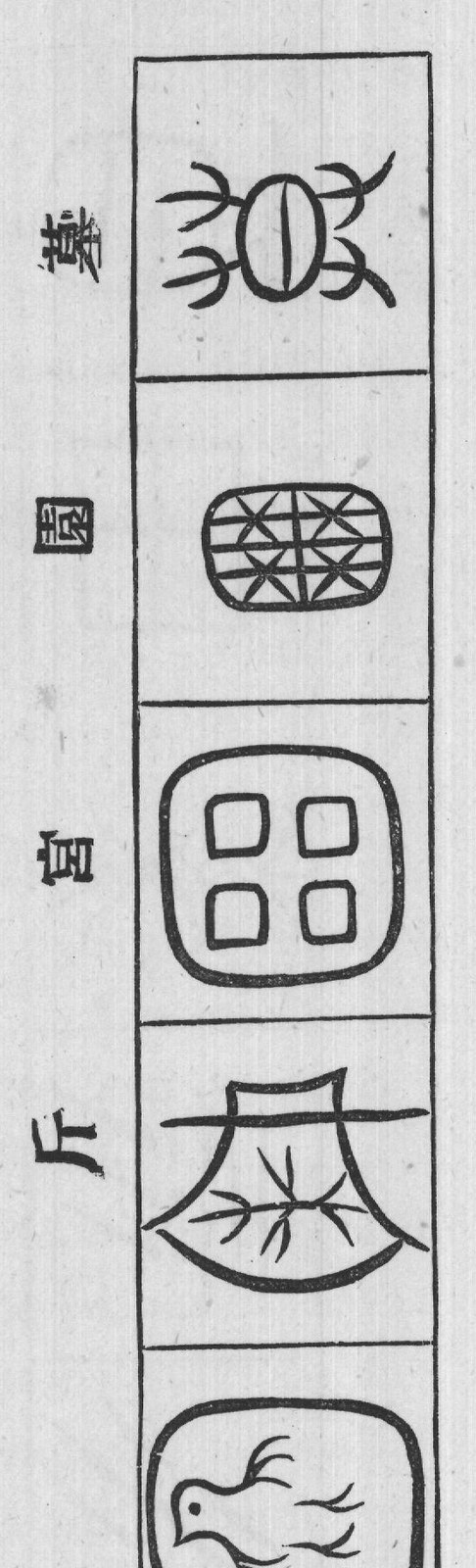
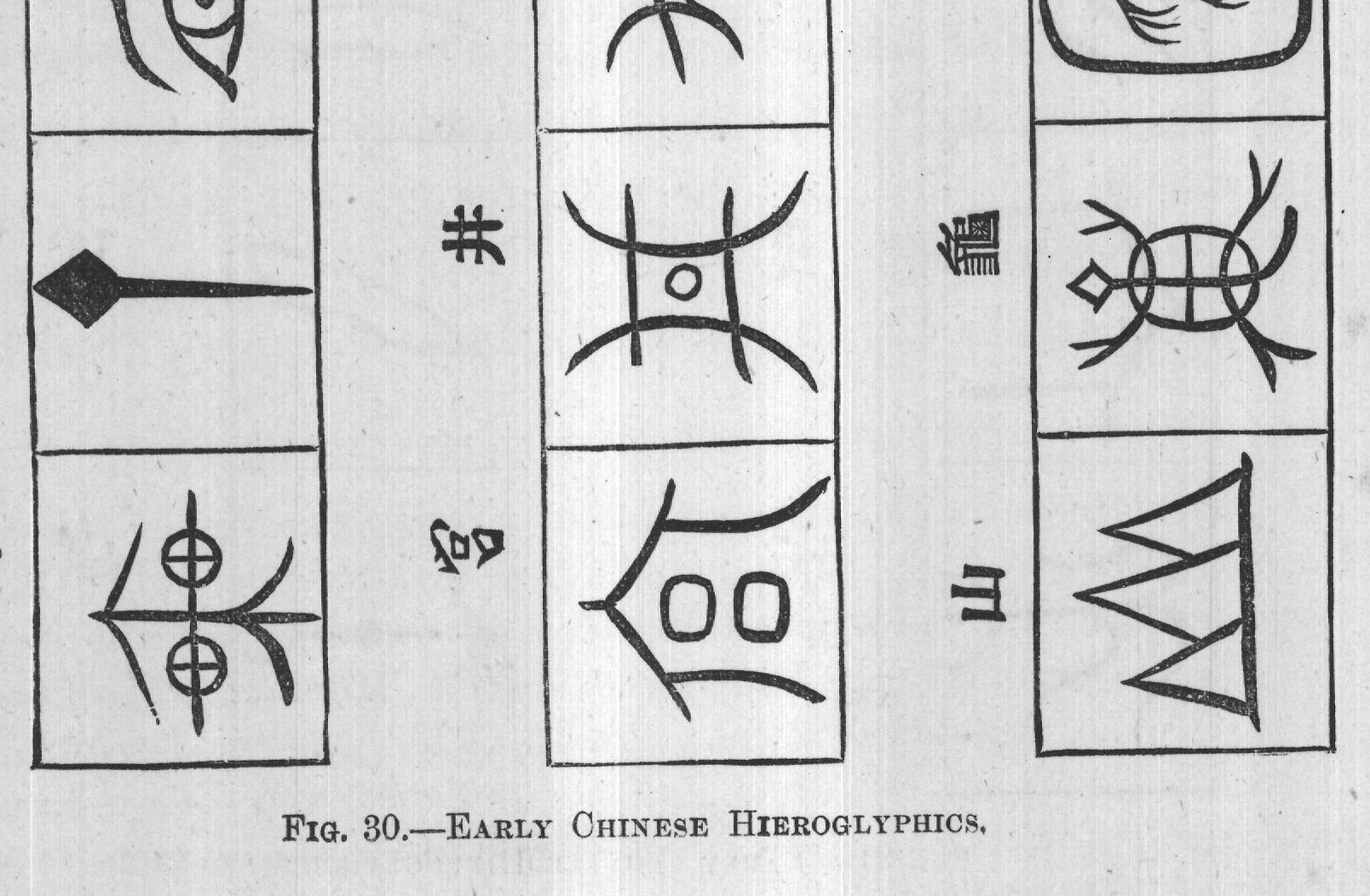
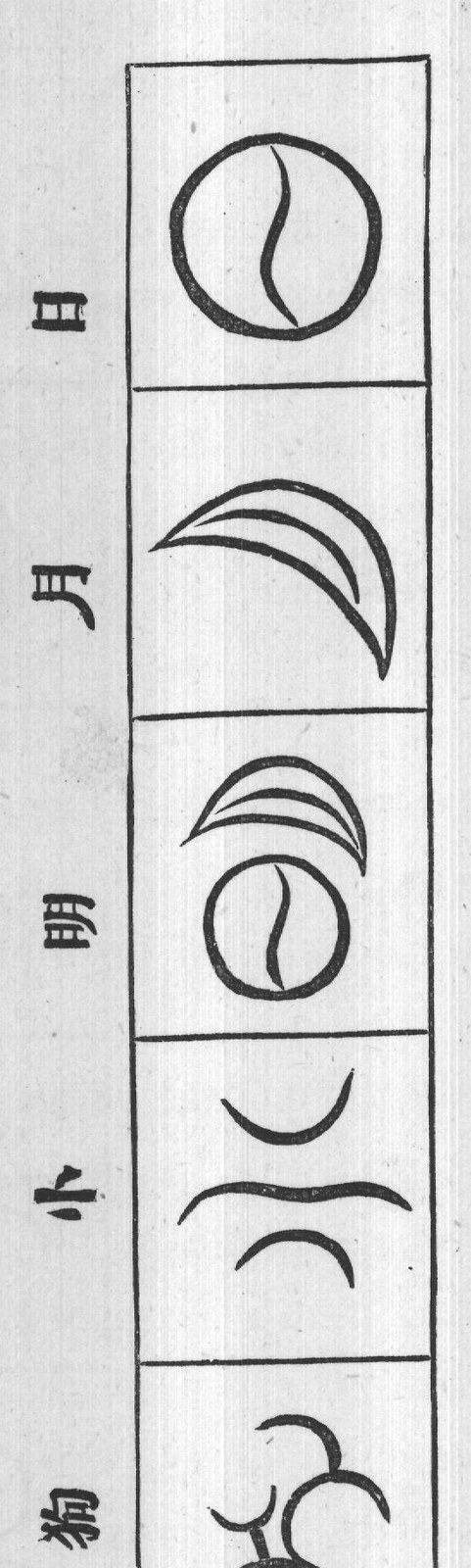
In comparison with the vast epochs of which we treat how * I have given in the annexed plates a few examples of the early hieroglyphics on which the modern Chinese system of writing is based, selected from a limited number collected by the early Jesuit fathers in China, and contained in the Mémoirs concernant l'Histoire, &c. des Chinois, par les Missionaires de Pekin, vol. i., Paris, 1776. The modern Chinese characters conveying the same idea are attached, and their derivation from the pictorial hieroglyphics, by modification or contraction, is in nearly all cases obvious. 車 丁眉 門 口 象土 a # 狗 小 合其为水 00 山 1 龜 明 月日 斤宮園墓 FIG. 30. EARLY CHINESE HIEROGLYPHICS, AD 禾谷 雨 田酒 FIG. 31. EARLY CHINESE HIEROGLYPHICS. ـمد 矢弓射飛牛牛豕 near to us are Nineveh, Babylon, and Carthage! Yet the very sites of the former two have become uncertain, and of the last we only know by the presence of the few scattered ruins on the shores of the Mediterranean Sea. Tyre, the vast entrepôt of commerce in the days of Solomon, was stated, rightly or wrongly, by Benjamin of Tudela, to be but barely discernible (in 1173) in ruins beneath the waves; and the glory of the world, the temple of King Solomon, was represented at the same date by two copper columns which had been carried off and preserved in Rome. It is needless to quote the cases of Persia, Greece, and Rome, and of many once famous cities, which have dissolved in ruin; except as assisting to point the moral that conquest, which is always recurring, means to a great extent obliteration, the victor having no sympathy with the preservation of the timehonoured relics of the vanquished. When decay and neglect are once initiated, the hand of man largely assists the ravages of time. The peasant carts the marbles of an emperor's palace to his lime-kiln,* or an Egyptian monarch strips the casing of a pyramidt to furnish the material for a royal residence.
Nor is it beyond the limits of possibility that the arrogant caprice of some, perhaps Mongol, invader in the future, may level the imperishable pyramids themselves for the purpose of constructing some defensive work, or the gratification of an inordinate vanity. * "The Porcelain Tower of Nankin, once one of the seven wonders of the world, can now only be found piecemeal in walls of peasants' huts."-Gutzlaff, Hist. China, vol. i. p. 372. † The outer casing of the pyramid of Cheops, which Herodotus (Euterpe, 125) states to have still exhibited in his time an inscription, telling how much was expended (one thousand six hundred talents of silver) in radishes, onions, and garlic for the workmen, has entirely disappeared; as also, almost completely, the marble casing of the adjacent pyramid of Sen-Saophis. According to tradition the missing marbles in each instance were taken to build palaces with in Cairo. In later dates how many comfortable modern residences have been erected from the pillage of mediæval abbey, keep, or castle ? and how many fair cities* must have fallen to decay, in Central and Eastern Asia, and how many numerous populations dwindled to insignificance since the days when Ghenghis and Timour led forth their conquering hordes, and Nadun could raise four hundred thousand horsement to contest the victory with Kublai Khan.
The unconscious ploughman in Britain has for centuries guided his share above the remains of Roman villas, and the inhabitants of the later city of Hissarlik were probably as ignorant that a series of lost and buried cities lay below them, as they would have been incredulous that within a thousand years their own existence would have passed from the memory of man, and their re-discovery been due only to the tentative researches of an enthusiastic admirer of Homer. Men live by books and bards longer than by the works of their hands, and impalpable tradition often survives the material vehicle which was destined to perpetuate it. The name of Priam was still a household word when the site of his palace had been long forgotten.
The vaster a city is, the more likely is it to be constructed upon the site of its own grave, or, in other words, to occupy the broad valley of some important river beneath whose gravels it is destined to be buried.