Home › The Chinese Phenix › The Chinese Phenix: Hwang
The Chinese Phenix: Hwang
When it crows, in walking, it utters "Quai she" [returning joyously]; when it stops crowing, "T'i fee" [I carry assistance?]; when it crows at night it exclaims "Sin" [goodness]; when in the morning, "Ho si" [I congratulate the world]; when during its flight, "Long Tu che wo" [Long Tu knows me] and "Hwang che chu sz si" [truly Hwang has come with the Bamboos]. * Hence it was that Confucius wished to live among the nine I [barbarian frontier countries] following the Fung's pleasure.
The Fung appears to have been fond of music, for, according to the Shu King, when you play the flute, in nine cases out of ten the Fung Wang comes to bear you company; while, according to the Odes, or Classic of Poetry, the Fung, * In reference to Hwang Ti (?) writing the Bamboo Books? THE CHINESE PHΕΝΙΧ. in flying, makes the sound hwui hwui, and its wings carry it up to the heavens; and when it sings on the lofty mountain called Kwang, the Wu Tung tree flourishes, * and its fame spreads over the world.
The presence of the Fung was always an auspicious augury, and it was supposed that when heaven showed its displeasure at the conduct of the people during times of drought, of destruction of crops by insects (locusts), of disastrous famines, and of pestilence, the Fung Wang retired from the civilised country into the desert and forest regions. It was classed with the dragon, the tortoise, and the unicorn as a spiritual creature, and its appearance in the gardens and groves denoted that the princes and monarch were equitable, and the people submissive and obedient. Its indigenous home is variously indicated. Thus, in the Shan Hai King, it is stated to dwell in the Ta Hueh mountains, a range included in the third list of the southern mountains; it is also, in the third portion of the same work (treating of the Great Desert), placed in the south and in the west of the Great Desert, and more specifically as west of Kwan Lun.
There is also a tradition that it came from Corea; and the celebrated Chinese general, Sieh Jan Kwéi, who invaded and conquered that country in A.D. 668, is said to have ascended the Fung Hwang mountain there and seen the phœnix.
According to the Annals of the Bamboo Books phœnixes, male and female, arrived in the autumn, in the seventh month, in the fiftieth year of the reign of Hwang Ti (в.c. 2647), and the commentary states that some of them abode * The Wu Tung is the Eleococca verrucosa, according to Dr. Williams; others identify it with the Sterculia platanifolia. There is a Chinese proverb to the effect that without having Wu Tung trees you cannot expect to see phenixes in your garden, in the Emperor's eastern garden; some built their nests about the corniced galleries (of the palaces), and some sung in the courtyard, the females gambolling to the notes of the males.
The commentary of the same work adds that (among a variety of prodigies) the phenix appeared in the seventieth year of the reign of Yaou (в.c. 2286), and again in the first year of Shun (в.c. 2255).
Kwoh P'oh states that, during the times of the Han dynasty (commencing B.c. 206 and lasting until A.D. 23), the phenixes appeared constantly.
In these later passages I have adopted the word phenix, after Legge and other Sinologues, as a conventional admission; but, as will be seen from all the extracts given, there are but few grounds for identifying it, whether fabulous or not, with the phenix of Greek mythology. It reappears in Japanese tradition under the name of the Ho and O (male and female), and, according to Kempfer, who calls it the Foo, "it is a chimerical but beautiful large bird of paradise, of near akin to the phenix of the ancients. It dwells in the high regions of the air, and it hath this in common with the Ki-Rin (the equivalent of the Chinese Ki-Lin), that it never comes down from thence but upon the birth of a sesin (a man of incomparable understanding, penetration, and benevolence) or that of a great emperor, or upon some such other extraordinary occasion."
It is a common ornamentation in the Japanese temples; and I select, as an example, figures from some very beautiful panels in the Nichi-hong-wanji temple in Kioto. They depart widely from the original (Chinese) tradition, every individual presenting a different combination of gorgeous colours; they only agree in having two long central tail feathers projecting from a plumose, bird-of-paradise-like arrangement.
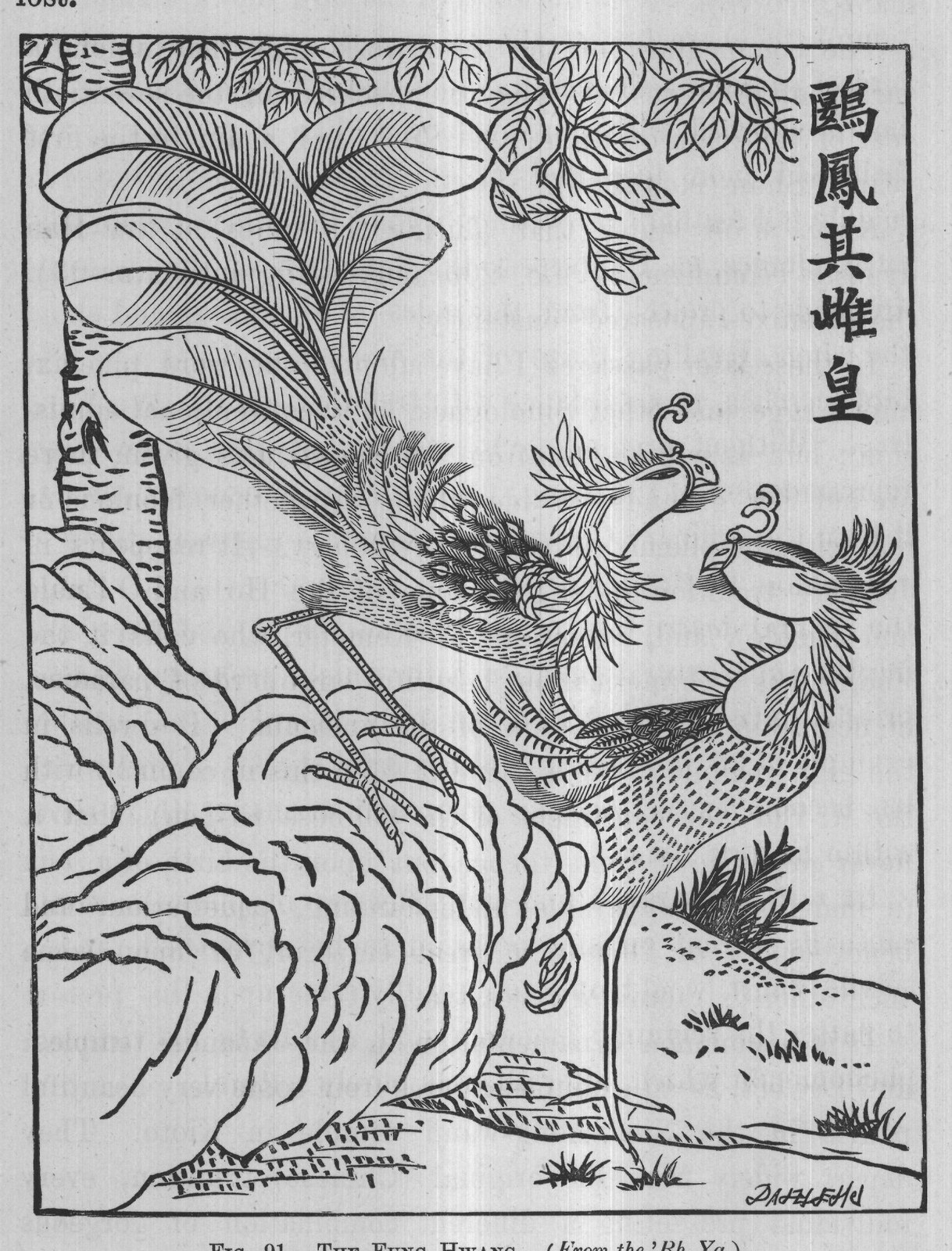
These can only be accepted as the evolution of an artist's fancy; nor can any opinion be arrived at from the figure of it illustrating the 'Rh Ya, of which I reproduce a fac-simile. I have already stated that Kwoh Pʻoh's illustrations have been lost. 鷗鳳其雌皇 DALHEH FIG. 91. THE FUNG HWANG. (From the 'Rh Ya.) The frontispiece to this volume is reduced from a large and very beautiful painting on silk, which I was fortunate enough to procure in Shanghai, by an artist named Fang Heng, otherwise styled Sien Tang; it professes to be made according to the designs of ancient books. The original is, I believe, of some antiquity.
In this case the delineation of the bird shows a combination of the characters of the peacock, the pheasant, and the bird of paradise; the comb is like that of a pheasant. The tail is adorned with gorgeous eyes, like a peacock's, but fashioned more like that of an argus pheasant, the two middle tail feathers projecting beyond the others, while stiffened plumes, as I interpret the intention of the drawing, are made to project from the sides of the back, and above the wings, recalling those of the Semioptera Wallacii. The bird perches, in accordance with tradition, on the Wu-Tung tree. Without pretending to assert that this is an exact representation of the Tung, I fancy that it comes nearer to it than the ordinary Chinese and Japanese representations. Looking to the history of the appearance of the Fung, the general description of its characteristics, and disregarding the supernatural qualities with which, probably, Taouist priests have invested it, I can only regard it as another example of an interesting and beautiful species of bird which has become extinct, as the dodo and so many others have, within historic times.
Its rare appearance and gorgeousness of plumage would cause its advent on any occasion to be chronicled, and a servile court would only too readily seize upon this pretext to flatter the reigning monarch and ascribe to his virtues a phenomenon which, after all, was purely natural.
APPENDICES.