Home › The Phenix of the East › CHAPTER XI
The Phenix of the East
THE CHINESE PHΕΝΙΧ.
FROM the date of the earliest examination of the literature of China, it has been customary among Sinologues to trace a fancied resemblance between a somewhat remarkable bird, which occupies an important position in the early traditions of that Empire, and the phenix of Western authors. Some mythologists have even subsequently concluded that the Fung Hwang of the Chinese, the phenix of the Greeks, the Roc of the Arabs, and the Garuda of the Hindoos, are merely national modifications of the same myth. I do not hold this opinion, and, in opposing it, purpose, in the future, to discuss each of these birds in detail, although in the present volume I treat only of the Fung Hwang.
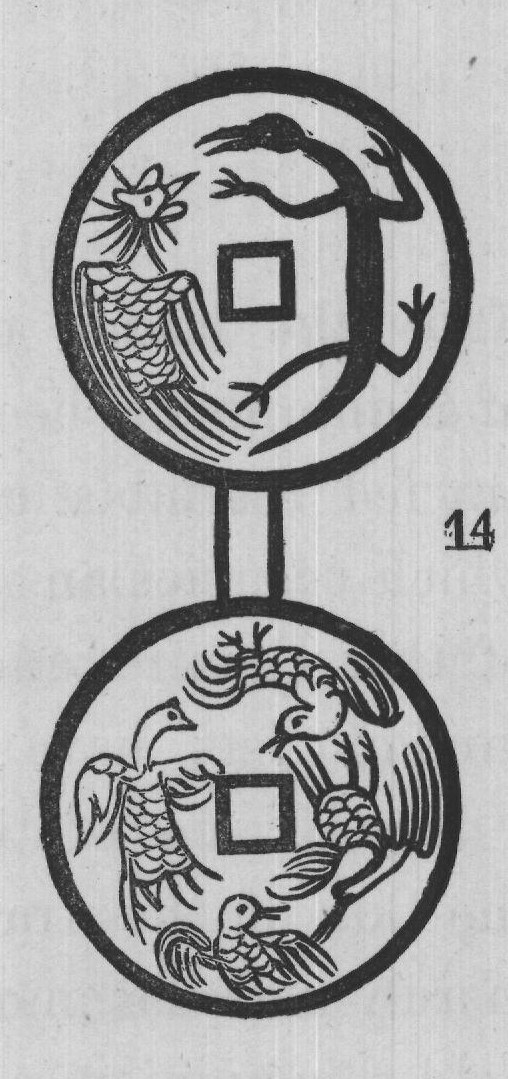
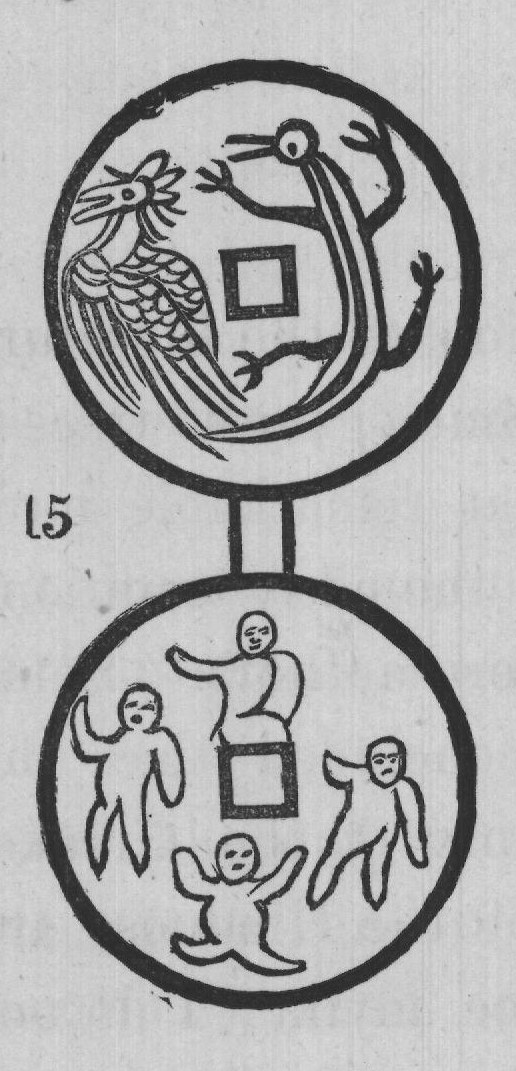
The earliest notice of it is contained in the 'Rh Ya, which, with its usual brevity, simply informs us that the male is called Fung and the female Hwang; the commentator, Kwoh P'oh, adding that the Shui Ying bird (felicitous and perfect -a synonym for it) has a cock's head, a snake's neck, a swallow's beak, a tortoise's back, is of five different colours, and more than six feet high. The 'Rh Ya Chen I, a later and supplementary edition of the former work, quotes the Shwoh Wan to the effect that the united name of the male and female bird is Fung Hwang, and that Tso's commentary on the 17th year of the Chao, says one appeared in the time of the Emperor Che (dynastic title, Shaou Haou). The 15 THE CHINESE PHŒNIX. 13 26 29 FIG. 90.-TEMPLE MEDALS FROM CHINA: DRAGON AND PHOENIX, 14 original passage in the Tso Chuen is so interesting that I quote in extenso Dr. Legge's translation of it :- "When my ancestor, Shaou-Haou Che, succeeded to the kingdom, there appeared at that time a phenix, and therefore he arranged his government under the nomenclature of birds, making bird officers, and naming them after birds. There were so and so Phenix bird, minister of the calendar; so and so Dark bird [the swallow], master of the equinoxes; so and so Pih Chaou [the shrike], master of the solstices; so and so Green bird [a kind of sparrow], master of the beginning (of spring and autumn); and so and so Carnation bird [the golden pheasant], master of the close (of spring and autumn).
The five Che [Pheasants] presided over the five classes of mechanics. • "So in previous reigns there had been cloud officers, fire officers, water officers, and dragon officers, according to omens."
I think there is some connection between this old usage and the present or late system of tribe totems among the North American Indians. Thus we have Snake, Tortoise, Hare Indians, &c., and I hope some day to explain some of the obscure and apparently impossible passages of the Shan Hai King, in reference to strange tribes, upon what I may call the totem theory.
The Kin King, a small work devoted to ornithology, and professing to date back to the Tsin dynasty [A.D. 265 to 317], opens its pages with a description of the Fung Hwang, because, as it states, the Fung is the principal of the three hundred and sixty different species of birds. According to it, the Fung is like a swan in front and like a Lin behind ; it enumerates its resemblances pretty much as the commentator in the 'Rh Ya gives them; but we now find a commencement of extraordinary attributes. Thus the head is supposed to have impressed on it the Chinese character expressing virtue, the poll that for uprightness, the back