Home › Contents › The Little Fishmongers
The Little Fishmongers
the ice which, even in the most severe in Calcutta, from the crowding of the winters, remain unfrozen. In this hole Narwhals in their eagerness to keep to hundreds of Narwhals were protruding the place. Hundreds of Esquimaux and Danes resorted thither with their dogs other. The Narwhal is chiefly an inhabitand sledges and while one shot the animal ant of the Polar regions, and very rarely another harpooned it, to prevent its being strays to temperate latitudes; still fossil pushed aside by the anxious crowd of remains of it have been found both in fishermen. Dozens of Narwhals were England and France. A male taken enkilled, but many were lost before they tangled among the rocks at the entrance were brought home, the ice breaking up of the sound of Weesdale, in Zetland, soon after. In the ensuing summer the measured twelve feet, exclusive of the natives found many dead washed up in tusk. Such is the velocity of this animal the bays and inlets around. Neither the and the impetus of its course, that it has Narwhal nor the whale are timid animals, been known to plunge its tusk through but will approach close to, and gambol the side of a vessel, which has been for hours in the vicinity of a ship.
Double Tusks. snapped off in the timbers by the violence of the blow. In this respect it bears a strong resemblence to the sword-fish.
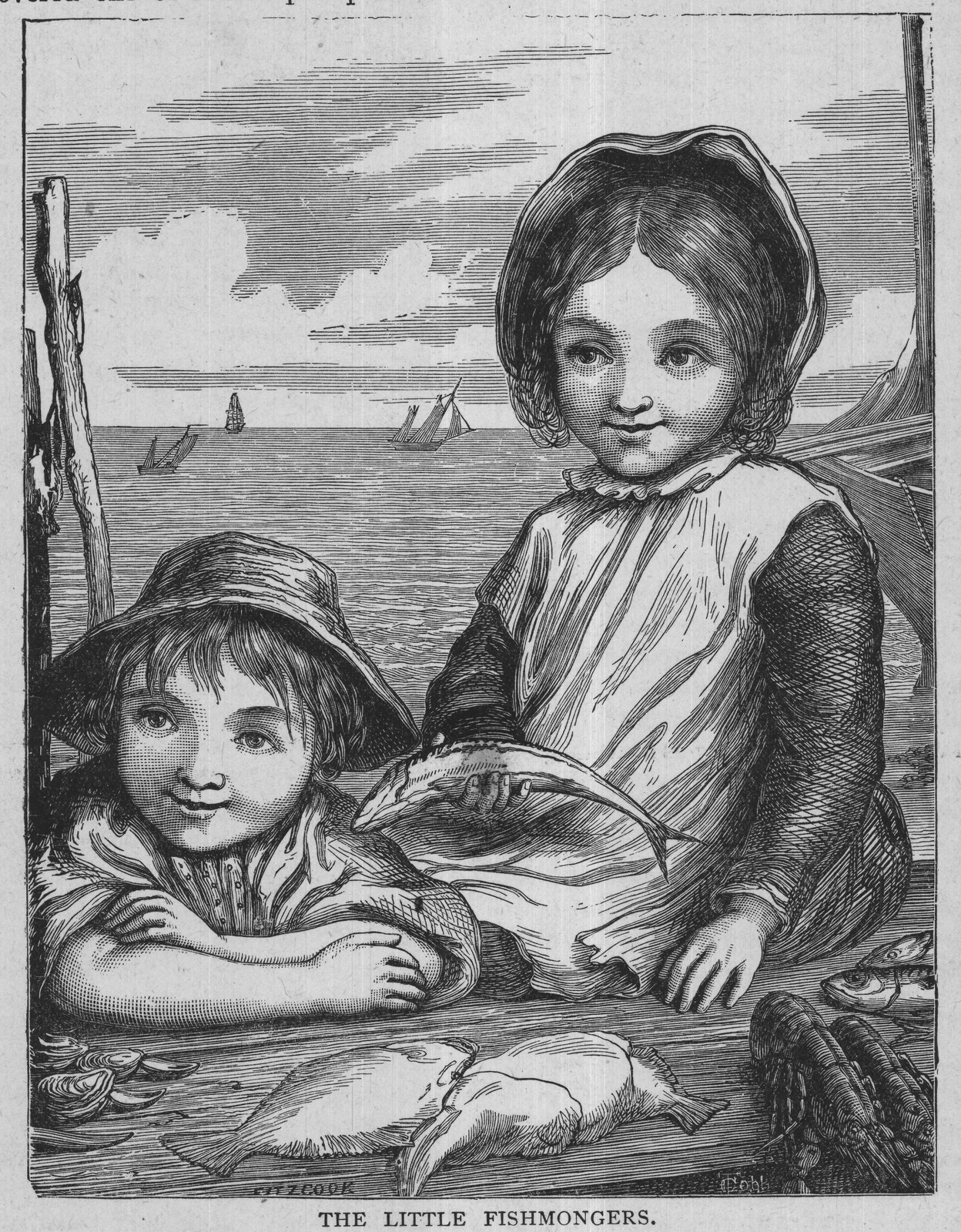
In the female of the Narwhal the tusks are rudimentary, but are about ten inches Some fish are taken, like the Narwhal long, rough, and with no inclination to and whale, for the oil, bone or ivory; but spire; in fact, not unlike a miniature piece the great value of the products of the sea of pig-iron. On the other hand, the un- is for food. Millions of people are daily developed tusk in the male is smooth and supplied with fish from the great deep. tapering, and wrinkled longitudinally. These are brought to market, exposed for Double tusked Narwhals are not uncom- sale and are eagerly sought. The busimon. They have been seen swimming ness of the fishmonger is as permanent about among the herd, and several such as that of the coal dealer or the shoeskulls have been preserved. The color of maker. Two young fishmongers you may the animal is grayish, or velvet-black, see in the engraving, whose bright eyes with white spots, sometimes roundish, but would tempt you to buy even if your more frequently irregular blotches of no certain outline, running into one another.
There are no spots on the tail or flippers, but waxy-like streaks shade off on each side at the junction of the tail, which is white at the line of indentation.
The female is more spotted than the male. The young is, again, much darker; and individuals have been seen which were almost white, like the one Anderson marketing were all done.
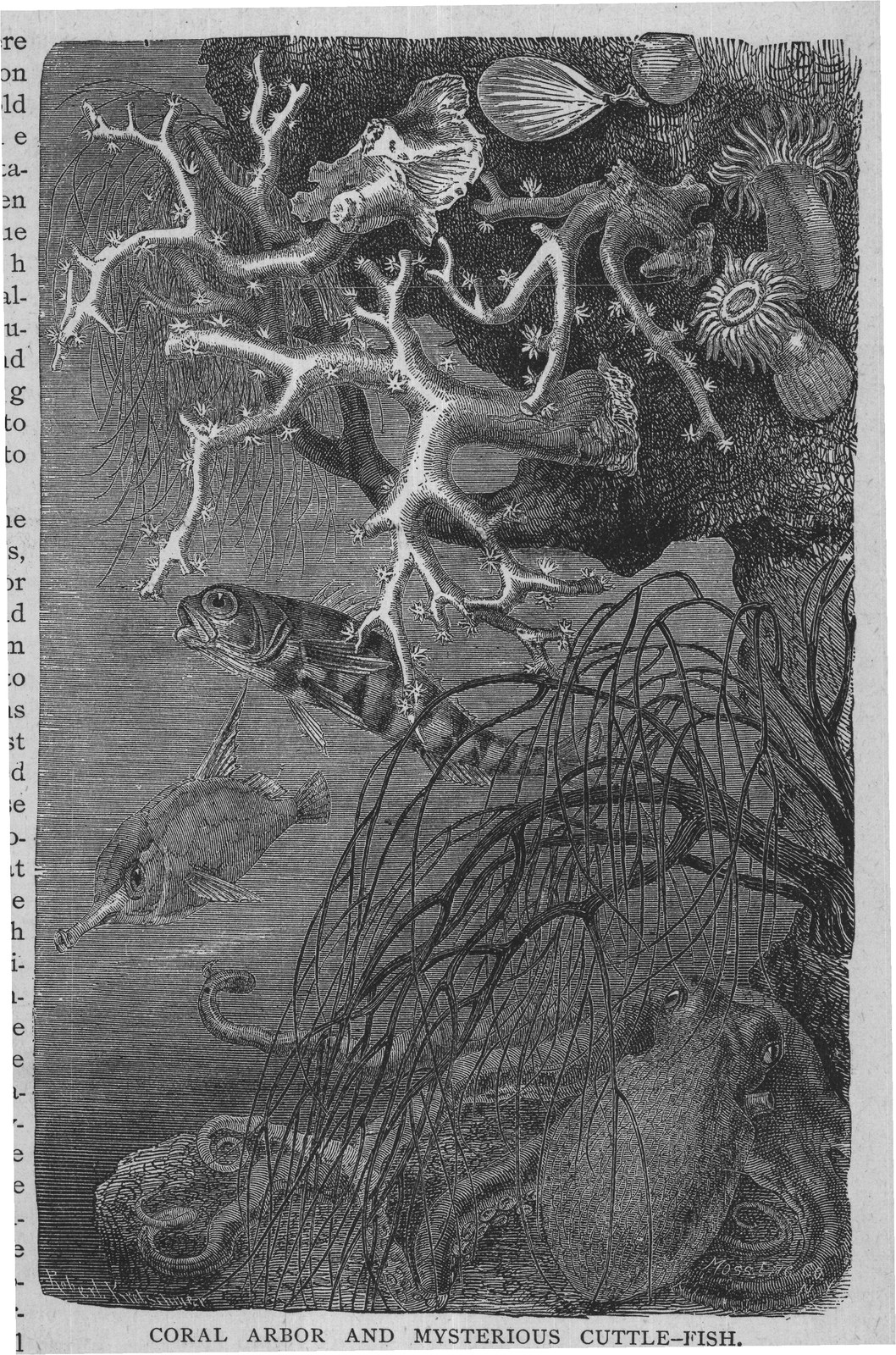
Little Builders in the Sea, Coral is the stony frame which belongs to polypi, and may be called their skeleton. It is formed within the coral animals by secretion, each individual adding to the common structure by the involuntary secretion of calcareous matter. The Corals are the results of a growth analogous to that of the bones in other describes as having come ashore at the animals. Coral is a carbonate of lime, mouth of the Elbe. In a female, killed like common limestone, and it is taken by at Pond's Bay, the stomach was corru- the polyp from the sea water or from its gated in complicated folds, as were also own food. Coral polypi produce eggs and the small intestines. It contained crus- young, like other animals, and also multaceans, bones of fishes, and an immense tiply, through a process of budding, quantity of the horny jaws of some species which is like the growth by buds in the of cuttle firmly packed one within the vegetable kingdom. A new polyp commen ces as a mere prominence on the side of an old one; soon the mouth and tentacles appear, then both continue growing, each adding to the calcareous accumulation within and each sending foith new buds to be developed into new polypi.
Among the tribes of Corals, some species or other are found in all oceans from the equator to the polar regions and to the lowest depths explored by man.
These tribes which produce the great Coral reefs are developed with peculiar luxuri: ance in the warmvaest parts of the Pacific, where the temperature ries from seventyfive to eighty-five degrees. The higher the temperature the greater is the profusion and variety of the Coral Mosste Co