Home › Contents › R. Illnar.sc
R. Illnar.sc
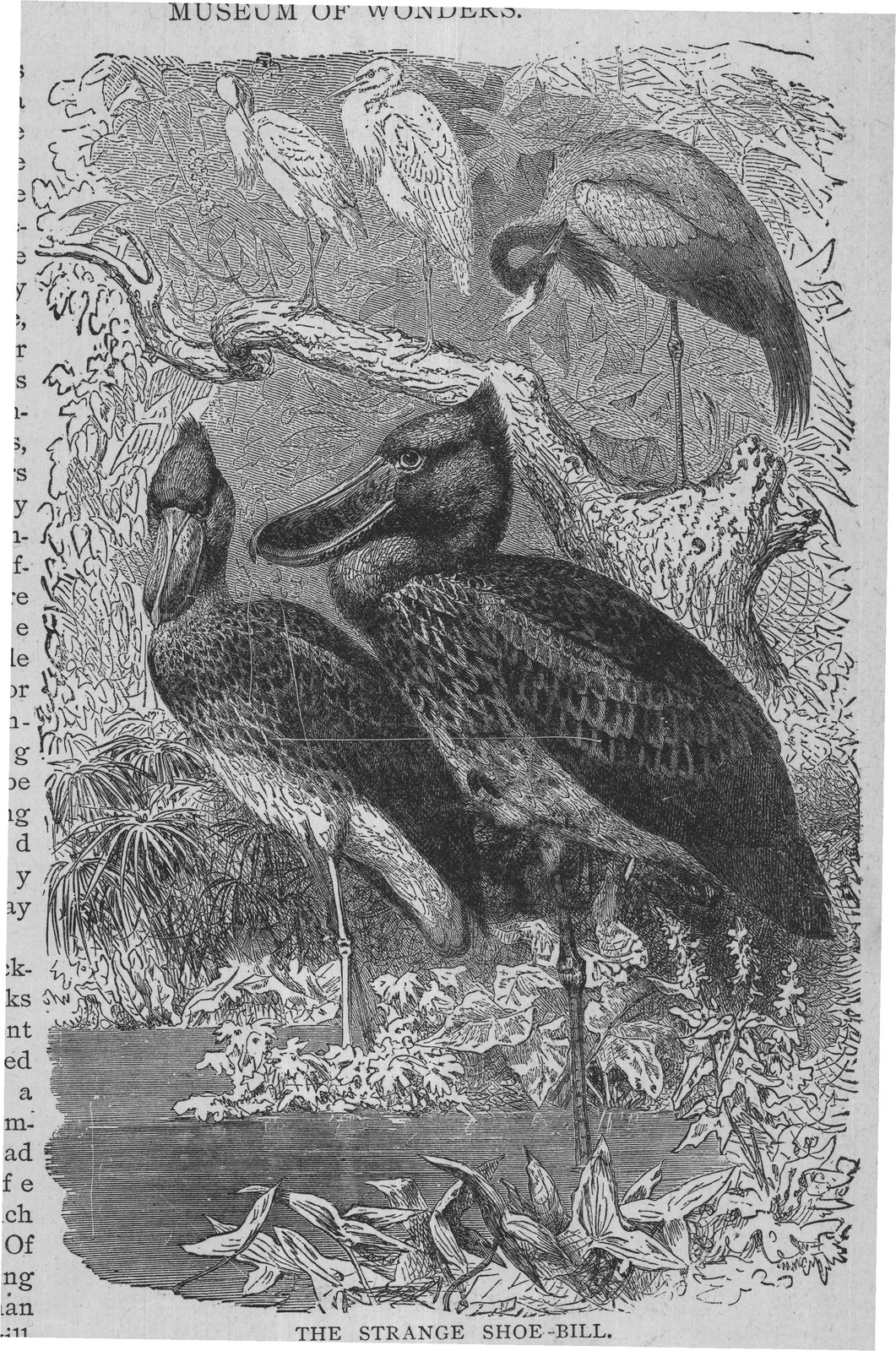
(317) The Shoe-Bill. sometimes sing as merrily in December as The most singular bird of Africa and in June; but our Negro Melodist only even of the whole globe is probably the practises once or twice perhaps in Janu. Shoe-bill. It has a bulky body, a thick ary, and then remains silent till spring neck, a large head and a curiously formed has really come. He waits till the horrid bill, not unlike a clumsy wooden shoe. blackthorn, professing summer and bring- Its color is an ashy gray, with jet black ing back winter, has done blossoming, wing feathers. carrying off with its fading flowers biting The Shoe-bill is the giant of the wading winds and bitter nights. But one month birds and is found in pairs or smaller later, when chestnut buds have burst their societies as remote as possible from bonds, the bloom is on the apple, the elms human habitations, mostly in the impene- and beeches are hurrying out their foliage trable swamps of the White Nile and to see which will be green first; when the some of its tributaries. At the approach chiff-chaff repeats its name in willows of man it flies away, and when frightened whose fragrant blossoms coax forth the by shots it rises to a great altitude and bees; when all is teeming with life, and never returns to its swamp as long as feeling encouragement from the warm there is any suspicion of danger. This breath of the fairest of the year's months bird selects for its breeding place a small - then it is our friends, the Blackbirds, elevation in the reeds, either immediately gladden every dell and corner of the on the border of the water or in the country with their music. swamp, mostly where surrounding water renders an approach difficult.
A Negro Melodist.
Take a look at one of them in the copse on a fine April morning, as he sits on the bough of the silver birch, the "lady of the forest," already sprinkled with a shower of delicate leafage. First he pipes It has often been remarked that in the bird-world the rule is for the males to have the brilliant plumage, and for the a few notes, to see if his voice has lost ladies to be the dowdy ones-a rule compass since last season; then, satisfied which would entail a revolution in fash- upon this point, away he goes to the field ions startling and ludicrous, if it were to where the lambs are romping, hopping be introduced for variety among our own and running along till, spying what he is kind; also, that gaily-dressed birds have looking for, he gives a jump and a pull, the least pleasing song-the screaming and out comes a great long worm, exjay bearing an unfavorable comparison tracted only to disappear down his throat. with the thrush-and the modestly-attired Again, with startled cry, back he hurries nightingale having furnished, in all ages, to the bramble-thicket, to be sure Mrs. B. a brilliant example of virtue unadorned. is carrying on her hatching arrangements We have another bird who, in voice, satisfactorily-then up to the big oak stands unrivalled, no competitor approach- scarcely yet tempted to verdure, there to ing anywhere near him for fluency, rich- begin his song afresh. ness and liquid melody of song-to wit: the Blackbird.
As often as not these birds, like their cousins the thrushes, appear to fix on a Thrushes scarcely spare their lungs at spot for their nest rather as a "happy any season-if the west wind blows thought" than with a view to concealwarmly, and food be plentiful, they will ment, a more or less conspicuous position being at times chosen when a less observable one could be obtained close at hand. Sometimes, too, the nest, like many a modern house, is put together all in a hurry, as though by contract; at others, the builders seem to delay their work unnecessarily. After the eggs are hatched, the male has little enough time for singing-hungry gaping mouths must be fed, keeping himself and mamma busy the whole day through.
W What a Blackbird most seeks w for is retirement -a neglected ditch with a canopy of brambles overhead being a safe place in which to find him. Of less confiding disposition than a thrush, he will,