Home › Contents › G. Weatherly
G. Weatherly
(419) A The Wonderful Weaver.
HERE'S a wonderful weaver High up in the air, And he weaves a white mantle For cold earth to wear.
With the wind for his shuttle, The cloud for his loom, How he weaves, how he weaves, In the light, in the gloom!
O, with finest of laces He decks bush and tree, On the bare, flinty meadows A cover lays he.
Then a quaint cap he places On pillar and post, And he changes the pump To a grim, silent ghost!
But this wonderful weaver Grows weary at last, And the shuttle lies idle That once flew so fast.
Then the sun peeps abroad On the work that is done, And he smiles: "I'll unravel It all, just for fun!"
A Good Name.
LTHOUGH riches, learning and high position are within the reach only of a few, a good character may be obtained by every person; and a good name is better than all these. It is important to every individual. It is necessary in all situations. It becomes the source of the purest gratifications. It is the most solid honor. If we are without it, we can gain no sincere respect among our fellow-creatures.
Should respect be paid to a person destitute of character, it is only on account of extrinsic circumstances which compel the tongue to use language that the feelings of the heart condemn. Without a character which commands respect, our importance in society is unfelt, and the bloom and vigor of life pass without a proportionate elevation in the community of which we form a part. According as we are deficient in character we sink in public estimation.
A Strange Sleeping-Place.
E'VE lost our dear Harry, our own little boy!
Oh, where can the little one be?
WEVE We've searched every corner and nook of the house; Nurse wants him to come to his tea.
Let's look in the garden. Alas! he's not there!
The shadows of evening have come. "Oh, Harry!" cries mother, her heart full of fear, "Come home, my wee darling, come home!"
But what is the matter with Oscar just now?
He seems quite excited and wild ; And what do I see in the back of his couch But the dress of my dear little child?
Asleep in the kennel, curled up in the straw, His rosy face pressed on his arm; While honest old Oscar lies down by his side To keep his companion from harm.
H Teaching Public School.
ORTY little urchins, Coming through the door, Pushing, crowding, making A tremendous roar.
Why don't you keep quiet?
Can't you keep the rule ?- Bless me, this is pleasant, Teaching public school!
Forty little pilgrims On the road to fame; If they fail to reach it, Who will be to blame?
High and lowly stations- Birds of every feather- On a common level Here are brought together.
Dirty little faces, Loving little hearts, Eyes brimful of mischief, Skilled in all its arts.
That's a precious darling!
What are you about? "May I pass the water??? "Please, may I go out?"
Boots and shoes are shuffling, Slates and books are rattling; And in a corner yonder Two pugilists are battling:
Others cutting didos - What a botheration!
No wonder we grow crusty From such association!
Anxious parent drops in, Merely to inquire Why his olive branches Do not shoot up higher; Says he wants his children To mind their p's and q's, And hopes their brilliant talents Will not be abused.
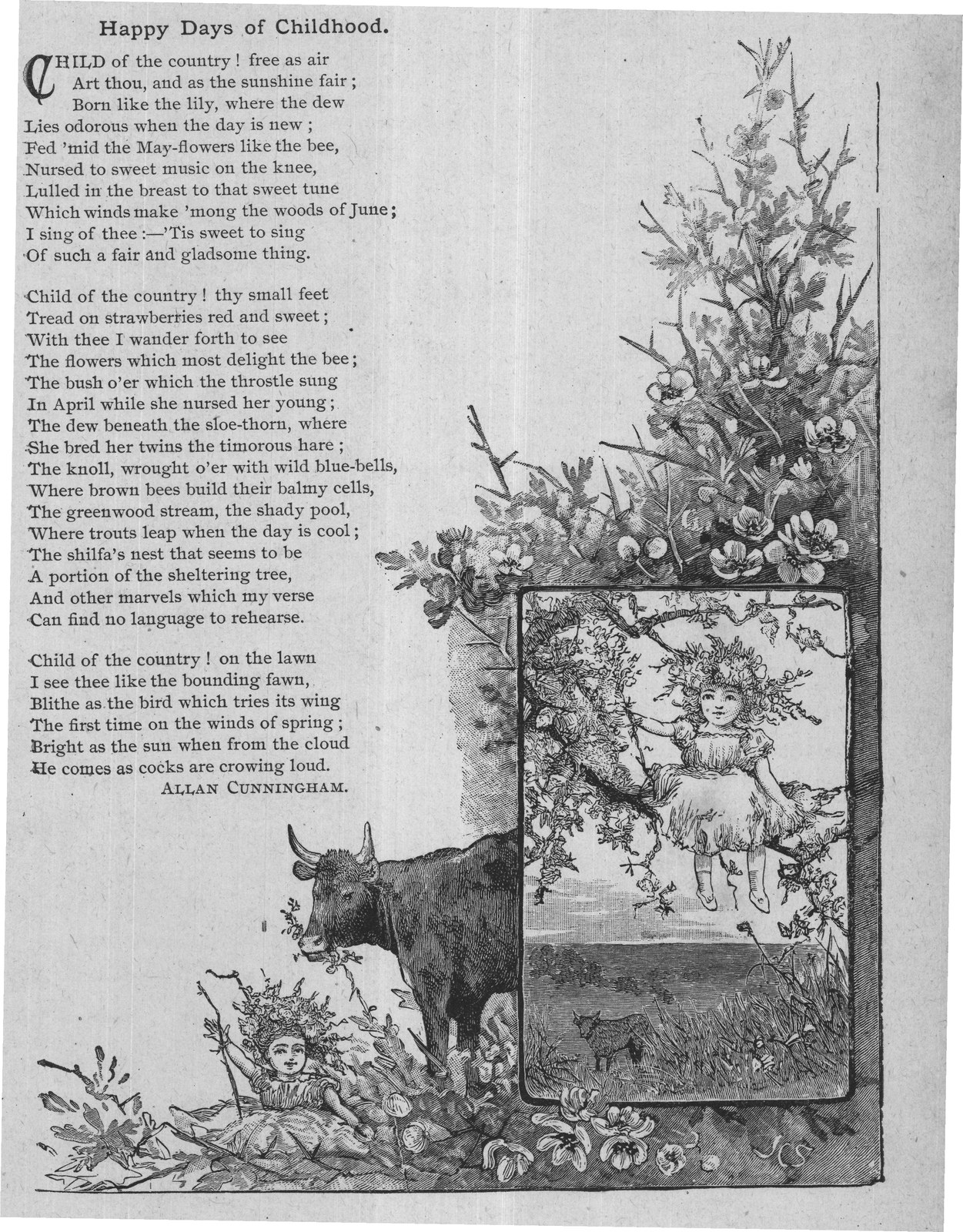
C Happy Days of Childhood.
HILD of the country ! free as air Art thou, and as the sunshine fair; Born like the lily, where the dew Lies odorous when the day is new; Fed 'mid the May-flowers like the bee, Nursed to sweet music on the knee, Lulled in the breast to that sweet tune Which winds make 'mong the woods of June; I sing of thee :-'Tis sweet to sing Of such a fair and gladsome thing.
Child of the country! thy small feet Tread on strawberries red and sweet; With thee I wander forth to see The flowers which most delight the bee; The bush o'er which the throstle sung In April while she nursed her young; The dew beneath the sloe-thorn, where She bred her twins the timorous hare; The knoll, wrought o'er with wild blue-bells, Where brown bees build their balmy cells, The greenwood stream, the shady pool, Where trouts leap when the day is cool; The shilfa's nest that seems to be A portion of the sheltering tree, And other marvels which my verse Can find no language to rehearse.
Child of the country! on the lawn I see thee like the bounding fawn, Blithe as the bird which tries its wing The first time on the winds of spring; Bright as the sun when from the cloud He comes as cocks are crowing loud.