Home › Curiosities Respecting Animals › Suriosities Respecting Animals: Lapland
Suriosities Respecting Animals: Lapland
Thus the elephant, the rhinoceros, and the various kinds of monkeys, are destined to live in the torrid regions, where the sun darts its fiercest rays; their skins are therefore naked, for were they covered with hair, they would perish with heat. They are also of such conformation of body as to suit their different manner of life. The rein-deer has his habitation in the coldest parts of Lapland; his food is the liverwort, which grows nowhere else so abundantly; and as the cold is in that country intense, this useful animal is covered with hair cf the densest kind; by this means he easily defies the keenness of the arctic regions. The rough-legged partridge passes its life in the Lapland Alps, where it feeds on the seeds of the dwarf birch: while, to withstand the cold, and to enable it to run freely among the snow, even its feet are thickly beset with feathers.
The camel is a native of the arid sandy deserts, which, with their dreadful sterility, are yet capable of yielding him support. How wisely has the Creator formed him! his foot is made to traverse the burning sands; and as the place of his habitation affords but little water, he is made capable of enduring long journeys, and going many days without quenching his thirst; for he is furnished with a natural reservoir, in which, when he drinks, he stores up a quantity of water, and has the power of using it in a frugal and sparing manner, when, for his food, he crops the dry thistle of the desert. The bullock delights in low rich grounds, because there he finds the food which is most palatable to him. The wild horse chiefly resorts to woods, and feeds upon leafy plants. Sheep prefer hills of moderate elevation, where they find a short sweet grass, of which they are very fond. Goats climb up the precipices of mountains, that they may brouse on the tender shrubs; and, in order to fit them for their situation, their feet are made for jumping.
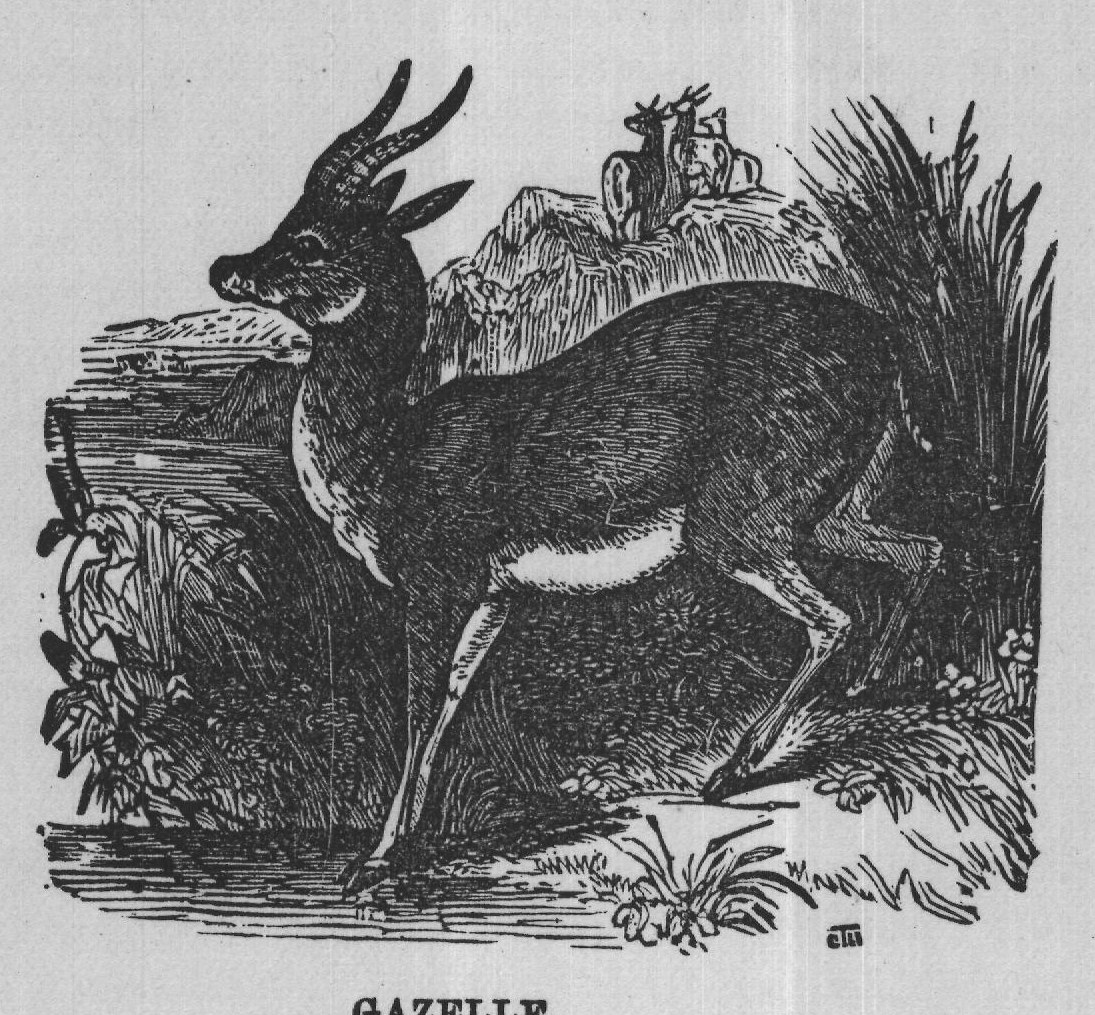
Swine chiefly get provision by turning up the earth; for which purpose their snouts are peculiarly formed. In this employment they find succulent roots, insects, and reptiles. So various is the appetite of animals, that there is scarcely any plant which is not chosen by some, and left untouched by others. Thus the horse refuses the water hemlock, which the goat will eat: the goat will not feed on monkshood, but the horse eats it with avidity. The long-leafed water hemlock is avoided by the bullock; yet the sheep is fond of it. The spurge is poisonous to man; but the caterpillar finds it a wholesome nourishment. Some animals live on the leaves of certain plants, others on the stalks, and others still on the rind, or even the roots of the same vegetable GAZELLE.
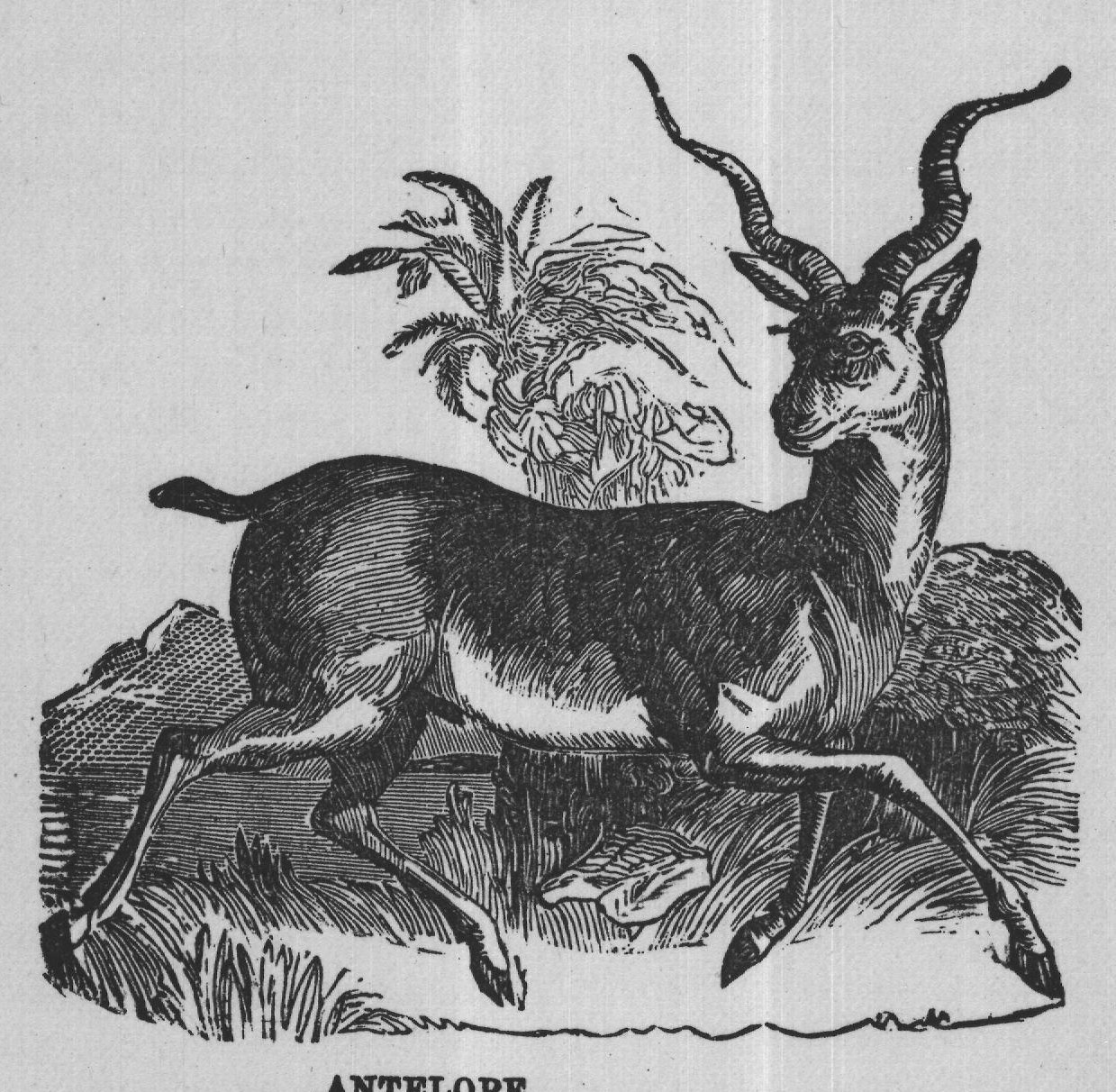
ANTELOPE.
ΘYXEITE - It should seem from hence, that no plant is absolutely poisonous, but only relatively so: that is, there is no plant but what is wholesome food to some animal or other. Thus divine wisdom has assigned an use for all its productions. The care of Providence is further evident in giving to each animal an instinctive knowledge of its proper aliment; but that delicacy of taste and smell, by which they accurately distinguish the wholesome from the pernicious, is not so evident in domestic animals as in those which are in a state of nature.
All birds of the goose kind pass great part of their lives in water, feeding on water-insects, fishes, and their eggs. It is evident that they are calculated for this mode of existence; their beaks, their necks, their feet, and their feathers, are formed for it. All other birds are as aptly fitted for their manner of life as these. The sea-swallow is said to get his food in a very singular way. Fish are his support, but he is not capable of diving in order to catch them like other aquatic birds; the sea-gull, therefore, is his caterer: when this last has gorged himself, he is pursued by the former, who buffets him till he casts up a part of his prey, which the other catches before it reaches the water; but in those seasons when the fishes hide themselves in deep water, the merganser supplies even the gull himself with food, being capable of plunging deeper into the sea.
Small birds are generally supposed to live principally upon the berries of ivy and hawthorn; but modern naturalists contradict this, and affirm that their winter food is the knot-grass, which bears heavy seeds, like those of the black bind-weed. This is a very common plant, not easily destroyed; it grows in great abundance by the sides of roads, and trampling on it will not kill it; it is extremely plentiful in corn-fields after harvest, and gives a reddish hue to them by the multitude of its seeds. Wherever the husbandman ploughs, this plant will grow, nor can all his art prevent it: thus a part of his labours are necessarily destined for the propagation of a plant which our heavenly Father has designed immediately for the support of the "fowls of the air;" for though "they sow not, neither gather into barns," yet are they fed by him. Some birds who live on insects, migrate every year to foreign regions, in order to seek food in a milder climate; while all the northern countries, where they live well in summer, are covered with snow. Some naturalists reckon the different species of the Hirundo, or swallow, among the birds of passage; while others affirm that they do not migrate, but, at the approach of winter, seek an asylum from the cold in the clefts of rocks, with which our island is surrounded, or take refuge in the bottom of pools and lakes, among the reeds and rushes; others still, who have made their observations with more attention and patience than either of the former, allow that. the old swallows with their early brood do migrate; but that the latter hatches, which are incapable of distant flight, lay themselves up, and become torpid during the winter; and at the approach of spring, by the wonderful appointment of Nature, they come forth again with renewed life and activity. In these, and all other animals which become torpid in the winter, the peristaltic motion of the bowels ceases while they are dormant, so that they do not suffer by hunger. Dr. Lister remarks, concerning this class of animals, that their blood, when poured into a vessel, does not coagulate, like that of all other animals; and therefore is no less fit for circulation when they revive, than before.
The birds called moor-fowl, during great snows, work out paths for themselves under its surface, where they live in safety, and get their food. They moult in summer, so that about the latter end of August they cannot fly, and are therefore obliged to run in the woods; but then the blackberries and bilberries are ripe, from whence they are abundantly supplied with food: but the young do not moult the first year, and therefore, though they cannot run so well, are enabled to escape danger by flight.
The migration of birds is not only a fact, but, as it relates to many kinds of them, is an useful fact to mankind. This remark applies to such of them as feed on insects, the number of which is so great, that if these birds did not destroy them, it would be almost impossible for us to live.
Of the various kinds of water-fowl that are known in Europe, there is hardly any but what, in the spring, are found to repair to Lapland. This is a country of lakes, rivers, swamps, and mountains, covered with thick and gloomy forests, that afford shelter during summer to these birds. In these arctic regions, by reason of the thickness of the ' woods, the ground remains moist and penetrable, and the waters contain the larvæ of the gnat in innumerable quantities. The days there are long, and the beautiful and splendid meteors of the night indulge them with every opportunity of collecting so minute a food; at the same time, men are very sparingly scattered over that vast northern waste. Yet, Linnæus, that great explorer of nature, in his excursion to Lapland, was astonished at the myriads of water-fowl that migrated with him out of that country, which exceeded in multitude the army of Xerxes, covering, for eight whole days and nights, the surface of the river Calix! The surprise of Linnæus was occasioned by his supposing their support to be furnished chiefly by the vegetable kingdom, almost denied 2 0101