Home › Miscellaneous Curiosities › Long Fasts
Long Fasts
day, the gastric symptoms being a great deal worse at each recurrence of the fever, but never disappearing altogether. In this condition he had gone on for the last ten days of his extraordinary performance, growing feebler and feebler as the days wore slowly on, but maintaining his resolution to finish, or at least hold out to the last extremity, which he did.
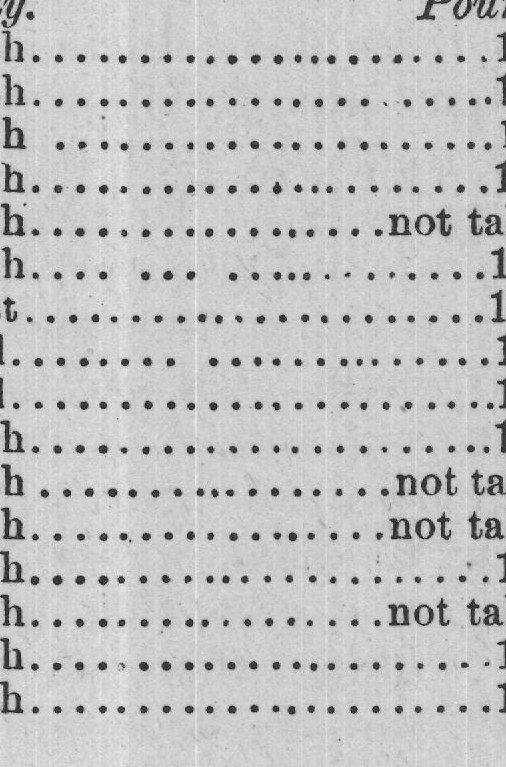
The following is a table of the loss in weight from day to day:
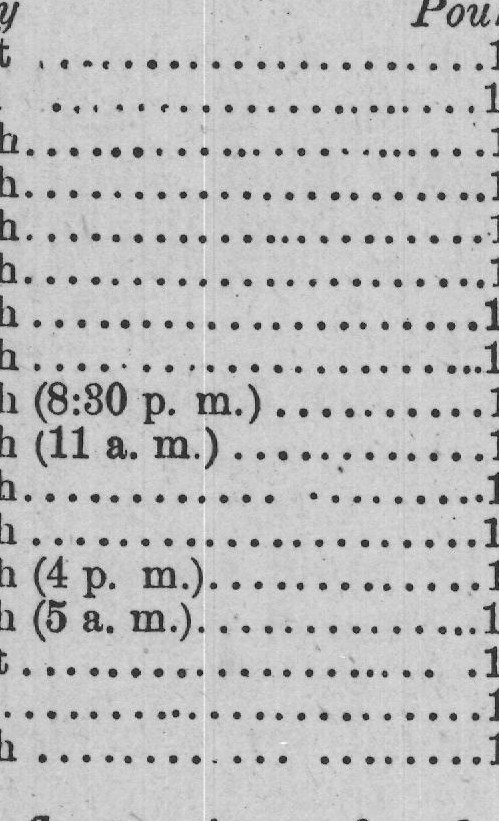
Day 1st Pounds. 131 131 3d 5th... 7th. 11th. ...... ............. ....... 13th. 14th 16th. 17th (8:30 p. m.) 17th (11 a. m.) .. 18th... 19th ... 20th (4 p. m.)....... 20th (5 a. m.). 21st 22d. .. 24th Pounds.
Day. .157 25th. 153 26th. 147 27th ... ........... 143 28th. ........... 139 29th. .136 30th. ... ... ..... 133 31st. ....... 132 32d. .. .... .....133 33d. ......... 1354 34th. 136 35th .... 136 36th. .. 135 37th. ...... ............ 135 38th.. 135 39th. 133 40th. 132 .. 1303 129 3 .not taken ... .130 128 127 126 ..126 not taken .not taken 1251 not taken 122 121 The fluctuations of pulse, temperature, and respiration bave been unimportant. Contrary to the advice of his physicians, who dreaded gastric fever, Dr. Tanner commenced eating meat and fruits and drinking wine and milk, and speedily regained health and strength.
OTHER LONG FASTS. - Ann Moore, the famous fasting woman of Tutbury, pretended to have lived for eight years entirely without food. A Watch Committee was appointed, which detected the fraud in a very ingenious manner. The bed and bedding, with the woman in it, were placed on a delicate weighing machine, which resulted in the inevitable exposure. At the expiration of the ninth day of this strict watching, being warned that she was sinking, she acknowledged her imposture, and admitted--which is an important fact--that, so long as the watch upon her was but imperfect, her daughter had contrived, when washing her face, to feed her every morning by using towels made very wet with gravy, milk, and other nourishing fluids, and had also while kissing her contrived to convey small portions of solid food from mouth to mouth. Guillaume Granet, a prisoner at Toulouse, resorted to starvation to avoid punishment. For the first seven days the symptoms were not very remarkable. After this period he was compelled to drink water to relieve his raging thirst, and after lingering on in terrible agony he died in convulsions on the fifty-eighth day. The case is reported by Van Swieten. There is no doubt as to its truth. Viterbi, a Corsican, condemned to death for the assassination of Frediani, resolved to starve himself to death. He died on the twenty-first day. He, too, occasionally moistened his mouth with water. The medical details of his case, which are very horrible, will be found in Paris's "Medical Jurisprudence." Of accidental starvation, the most remarkable example is, perhaps, that reported by Dr. Sloane, of Ayr: "A man, some 65 years of age, of a spare habit of body, and uncommonly vigorous for his time of life, was accidentally incarcerated in a coal mine for twenty-three days, during the first few of which he had access to water strongly impregnated with iron. He then became unable to move, and had unfortunately fallen some distance from the water. In this instance, Dr. Sloane thinks that an impure atmosphere, by lowering the vital powers, might tend to slightly prolong life under circumstances of privation. The unhappy man died on the third day after his removal." In 1866 Captain Casey, of the James Lowden, passed twenty-eight days in an open boat without food or water. He contrived however, to drink as much rain as he could collect, and it is, possiole, of course, that he may have chewed fragments of his clothes. Thus, then, so far as ascertained cases go, life has actually, on one occasion, been sustained for fifty-eight days without food, but not without water. Some time in 1331 or 1832 a son of Deacon Kelsey, of Fairfield, N. Y., abstained from all manner of food, but drank often of pure cold water and washed freely with it. He gradually wasted away to a mere skeleton, but did not die till the end of fifty-six days. Dr McNaughton, a professor in Fairfield Medical College, wrote an account of this case at the time, the faster having been a student of the college.
SCRIPTURAL CASES OF LONG FASTING. -- Moses distinctly states: "I abode in the mount forty days and forty nights; I neither did eat bread nor drink water"; and then upon his return to the mount, after breaking the first two tables of stone, he adds: "And I fell down before the Lord, as at the first, forty days and forty nights; I did neither eat bread nor drink water, because of all your sins." (Deut. ix. 9, 18). Of Elijah it is stated that he was miraculously fed (I. Kings xix. 5-8), and "went in the strength of that meat forty days and forty nights." Of the Saviour it is said (Matt. iv. 2), "He fasted forty days and forty nights." This was "in the wilderness." (See page 65). HUMAN WORK AND HUMAN WASTE. - Work means waste, equally to a human body and a locomotive engine. "More work more waste," is a motto alike true of the mechanic's apparatus and of the mechanic himself. Not an action, we repeat, is performed by us which is not accompanied by an expenditure of force derived from and accompanied by a proportional waste