Home › Curiosities Respecting Animals › Instances of Fasting
Instances of Fasting
design all of them together, without speaking to each other, or without some medium of communication equivalent to language?
Remarkable Instances of FASTING IN ANIMALS. - The following remarkable instances of brutes being able to live long without food, are related by Sir William Hamilton, in his account of the earthquakes in Italy, (Phil. Trans. vol. 73.) "At Soriano, two fattened hogs, that had remained buried under a heap of ruins, were taken out alive the 42d day; they were lean and weak, but soon recovered. - At Messina, two mules belonging to the Duke de Belviso, remained under a heap of ruins, one of them 22 days, and the other 23: they would not eat for some days, but drank water plentifully, and are now recovered. There are numberless instances of dogs remaining many days in the same situation; and a hen belonging to the British vice-consul at Messina, that had been closely shut up under the ruins of his house, was taken out the 22d day, and is now recovered: it did not eat for some days, but drank freely; it was emaciated, and shewed little signs of life at first. From these instances, and several others of the same kind that have been related to me, but which, being less remarkable, I omit, one may conclude, that long fasting is always attended with great thirst and total loss of appetite."
An instance not less remarkable than any of these, we find in the Gent. Mag. for Jan. 1785. "During the heavy snow which fell in the night of the 7th of January, 1776, a parcel of sheep belonging to Mr. John Wolley, of Matlock, in Derbyshire, which were pastured on that part of the East Moor that lies within the manor of Matlock, were covered with the drifted snow. In the course of a day or two all the sheep that were covered with the snow were found again, except two, which were consequently given up as lost, but on the 14th of Feb. following (some time after the break of the snow in the valleys, and 38 days after the fall) as a servant was walking over a large parcel of drifted snow, which remained on the declivity of a hill, a dog he had with him discovered one of the two sheep that had been lost, by winding (or scenting) it, through a small aperture which the breath of the sheep had made in the snow. The servant thereupon dug away the snow, and released the captive from its prison; it immediately ran to a neighbouring spring, at which it drank for a considerable time, and afterwards rejoined its old companions, as though no such accident had befallen it. On inspecting the place where it was found, it appeared to have stood between two stones which lay parallel with each other, at about two feet and a half distance, and probably were the means of protecting it from the great weight of the snow, which in that place lay several yards thick: from the number of stones around it, it did not appear that the sheep had been able to pick up any food during its confinement. Soon afterwards its owner removed it to some low lands; but as it had nearly lost its appetite, it was fed with bread and milk for some time: in about a fortnight after its enlargement, it lost its sight and wool; but in a few weeks afterwards they both returned again, and in the course of the following summer it was quite recovered. The remaining sheep was found dead, about a week after the discovery of the other."
The following authentic history of the EXTRAORDINARY ADVENTURES OF A SHEEP, which was transmitted to a respectable periodical journal, from Salisbury, where the animal died, will, we doubt not, prove interesting to our readers, as it affords an instance of animal sagacity, in that species on which Nature has bestowed it with a sparing hand.
She was born in the North Highlands of Scotland; embarked, in 1804, in the Arab, and visited Iceland, Greenland, and Norway: here she was sent on shore to graze; the next day, seeing the boat row past the place where she was feeding, she leaped into the water, and swam to the boat: this circumstance protected her ever after from the butcher, and her life was one scene of gratitude. She was in fourteen different actions with the enemy's flotilla and batteries off Boulogne, in the last of which she lost part of one of her horns. After that she traversed the whole of the western extent of Africa, across the equator to the Brazils, and along the Guiana coast of South America to the West Indies; from thence to Ireland, and then home. She was so tame as to feed from the hand, and, like the dog, followed her protector; would dance for a cabbage leaf; preferred the house and fire-side to the stable; for several months was never known to touch hay or grass, living with the sailors on pudding and grog, and nibbling the ends of rope or canvass. The paring of an apple or a potato was her highest luxury. The docility of the animal was highly amusing: putting her head under your arm, she would eat off your plate at dinner; would drink wine or spirits, and tea, if well sweetened; run up and down the stairs; and, if she got into the kitchen, would take the cover from the pot, and peep into it. Her wool was of a soft and silky nature.
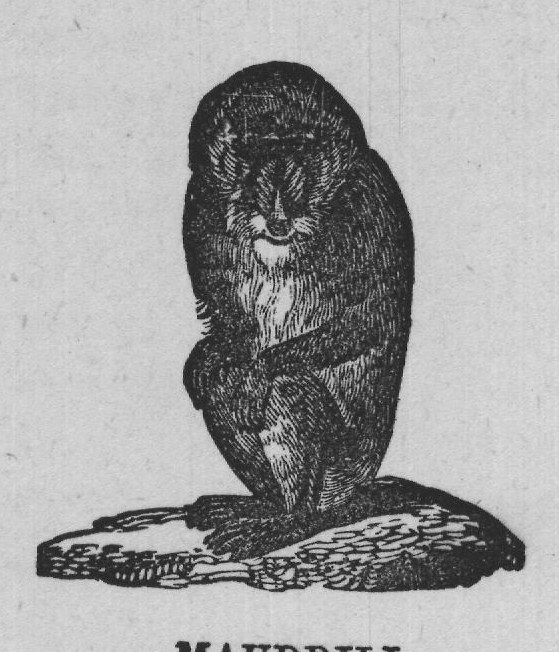
After having weathered so many storms and hardships, she was brought as a present by Lieut. Bagnold, of the royal navy, to a lady in Salisbury; where, alas! their fleecy friend died of a bowel complaint the second day after her arrival, most sincerely lamented, the 22d of January, 1808. MAUDRILL.
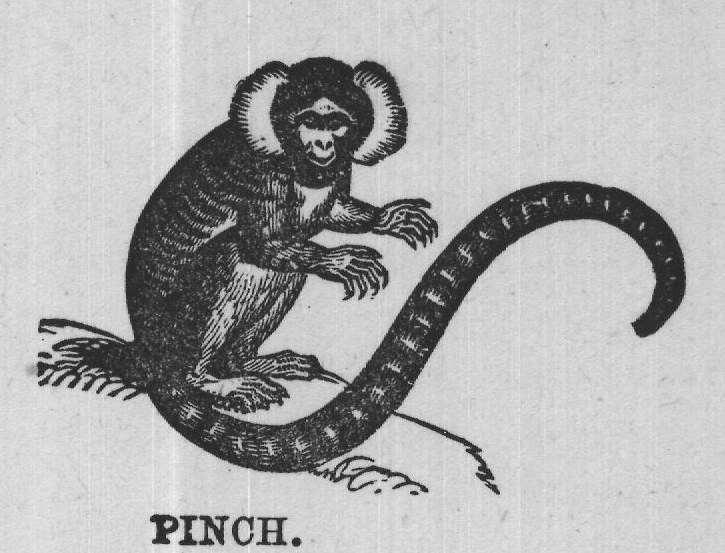
PINCH.
MACAQUE.
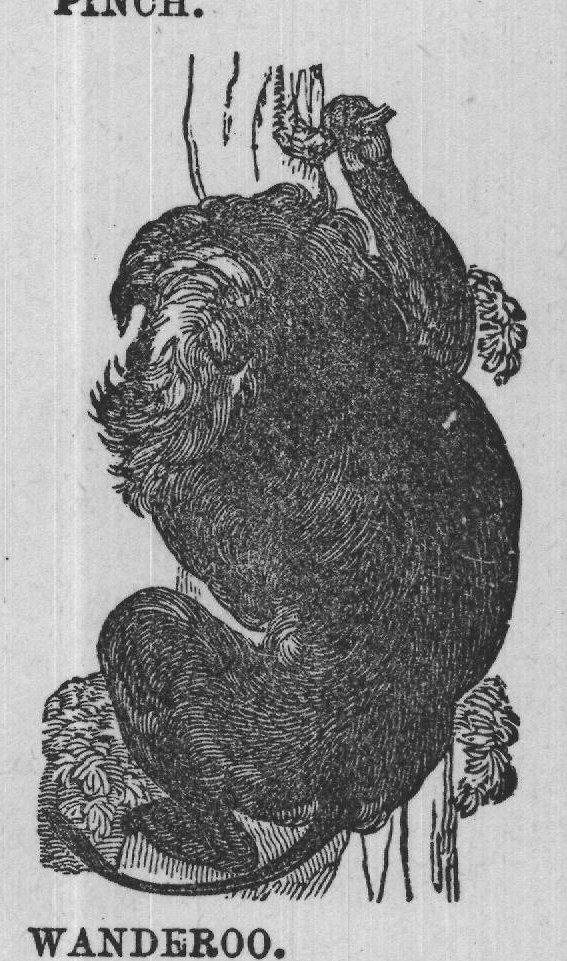
WANDEROO.
MONA. .