Home › Aurora Borealis › Aurora Borealis
Aurora Borealis
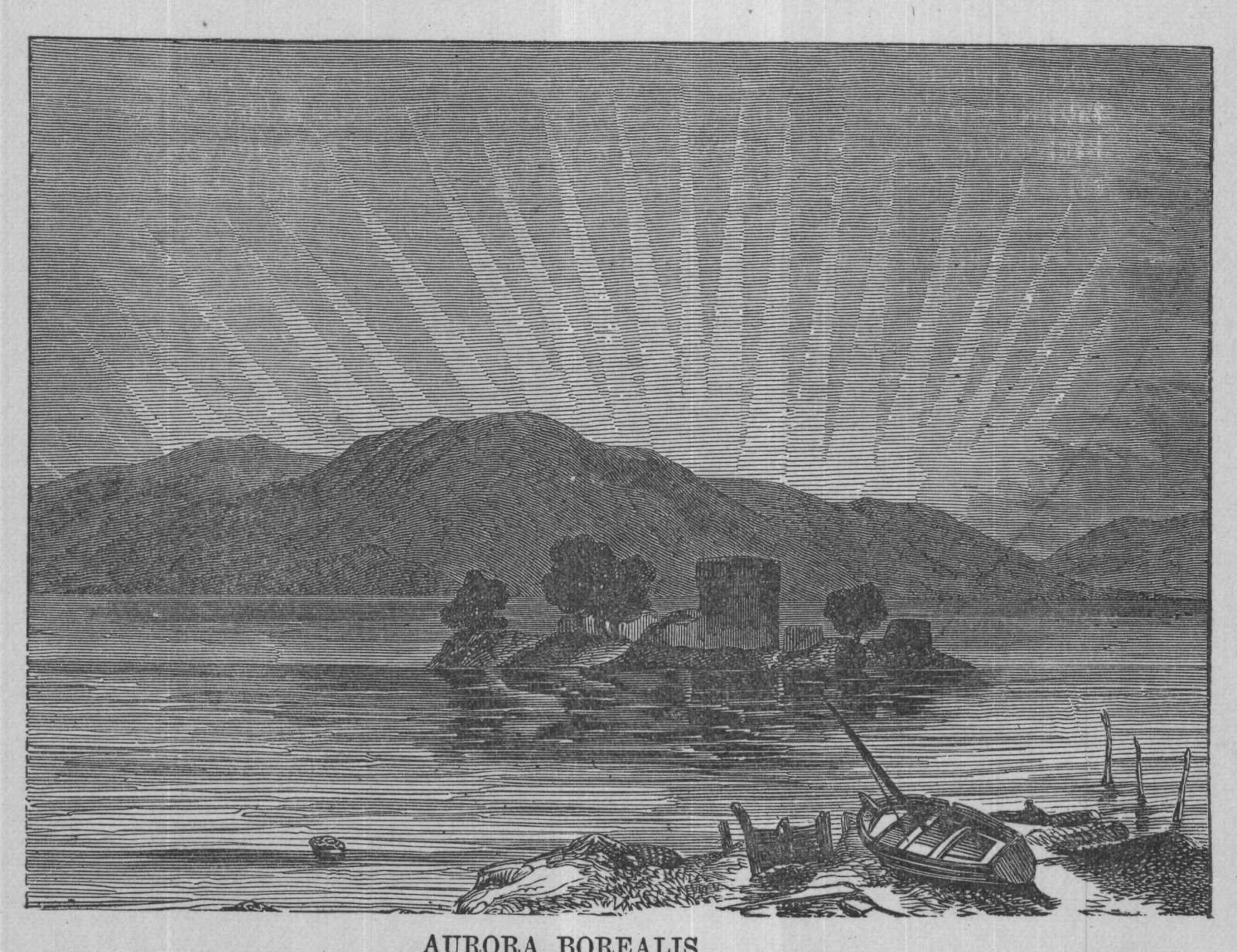
This is an aspect of the Aurora Borealis sometimes observed in Scotland. The view embraces a portion of Loch Leven, with the island and the castle in which the unfortunate Mary Queen of Scots was imprisoned.
Dr. Hamilton observes, that he could plainly discern the smallest speck in the Pleiades through the density of those clouds which formed the Aurora Borealis in 1763, without the least diminution of its splendour, or increase of twinkling This kind of meteor, which is more uncommon as we approach towards the equator, is almost constant during the long winter, and appears with the greatest lustre in the polar regions. In the Shetland isles, the "Merry Dancers," as the northern lights are there called, are the constant attendants of clear evenings, and afford great relief amidst the gloom of the long winter nights. They commonly appear at twilight, near the horizon , of a dun colour, approaching to yellow; they sometimes continue in that state for several hours, without any perceptible motion; and sometimes they break out into streams of stronger light, spreading into columns, and altering slowly into ten thousand different shapes, and varying their colours from all the tints of yellow, to the most obscure russet. They often cover the whole hemisphere, and then exhibit the most brilliant appearance. Their motions at this time are most amazingly quick; and they astonish the spectator with the rapid changes of their form. They break out in places where none were seen before, skimming briskly among the heavens, are suddenly extinguished, and are succeeded by a uniform dusky tract. This again is brilliantly illuminated in the same manner, and as suddenly left a dark space. In some nights, they assume the appearance of large columns, on one side of the deepest yellow, and on the other, gradually changing, till it becomes undistinguished from the sky. They have generally a strong tremulous motion from one end to the other, and this continues till the whole vanishes.
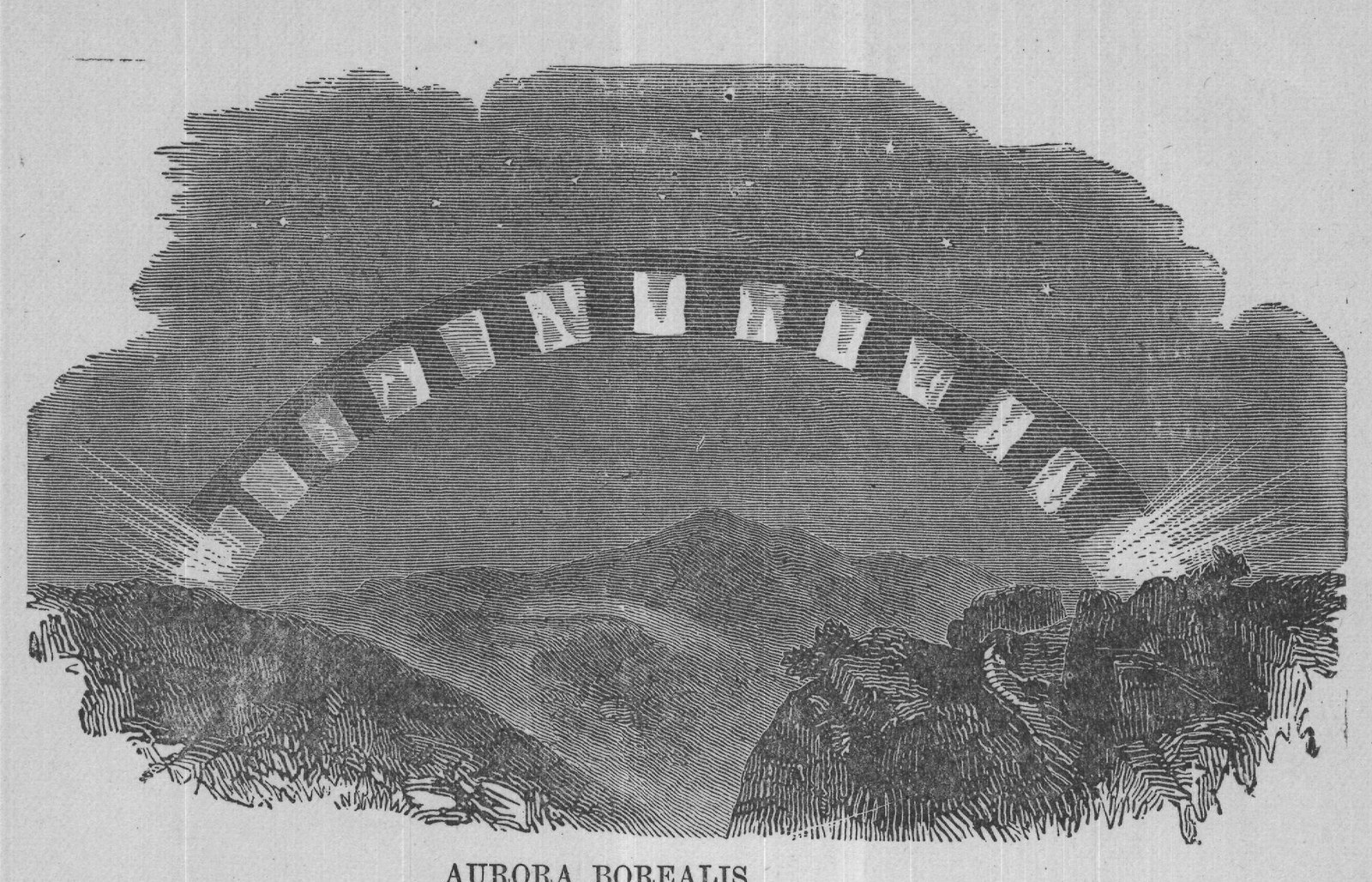
As for us, who see only the extremities of these northern phenomena, we can have but a faint idea of their splendcar and motions.
According to the state of the atmosphere, they differ in hue; and sometimes assuming the colour of blood, they make a dreadful appearance. The rustic sages who ob serve them, become prophetic, and terrify the spectators with alarms of war, pestilence, and famine. Nor, indeed, were these superstitious presages peculiar to the northern islands: appearances of a similar nature are of ancient date; and they were distinguished by the appellations of" phasmata," "trabes," and "balides, " according to their forms and colours. In old times they were either more rare, or less frequently noticed : they were supposed to portend great events, and the timid imagination formed of them aërial conflicts.
In the northern latitudes of Sweden and Lapland, the Aurora Boreales are not only singularly beautiful in their appearance, but they afford travellers, by their almost constant a very beautiful light during the whole night. In Hudson's Bay the Aurora Borealis diffuses a variegated splendour, which is said to equal that of the full moon. In the northeastern parts of Siberia, according to the description of Gmelin, these northern lights are observed to "begin with single bright pillars, rising in the north, and almost at the same time in the north-east, which, gradually increasing, comprehend a large space of the heavens, rush about from place to place with incredible velocity, and, finally, almost cover the whole sky up to the zenith, and produce an appearance as if a vast tent were expanded in the heavens, glittering with gold, rubies, and sapphire. A more beautiful spectacle cannot be painted ; but whoever should see such a northern light for the first time, could not behold it without terror. For, however fine the illumination may be, it is attended, as I have learned from the relation of many persons, with such a hissing, crackling, and rushing noise through the air, as if the largest fire-works were played off. To describe what they then hear, they make use of the expression, 'The raging host is passing.' The hunters, who pursue the white and blue foxes in the confines of the Icy Sea, are often alarmed in their course by these northern lights. Their dogs are then so much frighetned, that they will not move, but lie obstinately on the ground, till the noise has passed. Commonly, clear and calm weather follows this kind of northern lights. This account has been confirmed by the uniform testimony of many, who have spent part of several years in these northern regions, and inhabited different countries from the Yenisei to the Lena; so that no doubt of its truth can remain. This seems, indeed, to be the real birth-place of the Aurora Borealis."
A person who resided seven years at Hudson's Bay, confirms M. Gmelin's relation of the fine appearance and brilliant colours of the northern lights, and particularly of their rushing noise, which he affirms he has frequently heard, and he compares it to the sound produced by whirling round a stick swiftly at the end of a string. A similar noise has likewise been noticed in Sweden. Mr. Nairne also, being in Northampton at the time when the northern lights were remarkably bright, is confident he heard a hissing or whizzing sound. Hampshi Mr. Belknap, of Dover, in New Hampshire, North America, , testifies to this fact. M. Cavallo says, that the cracking noise is distinctly audible, and that he has heard it more than once. .
Similar lights, called Aurora Australes, have been long since observed towards the south pole, and their existence has been lately ascertained by Mr. Forster, who assures us, that in his voyage round the world with Captain Cook, he observed them in high southern latitudes, though attended with phenomena somewhat different from those which are seen here.
On February 17, 1773, in south latitude 58°, " a beautiful phenomenon (he says) was observed during the preceding night, which appeared again this and several following nights. It consisted of long columns of a clear white light, shooting up from the horizon to the eastward, almost to the zenith, and gradually spreading on the whole southern part of the sky. The columns were sometimes bent sideways at their upper extremities; and though in most respects similar to the northern lights (Aurora Borealis) of our hemisphere, yet they differed from them in being always of a whitish colour, whereas ours assume various tints, especially those of a fiery and purple hue. The sky was generally clear when they appeared, and the air sharp and cold, the thermometer standing at the freezing point."
The periods of the appearance of these northern lights are very inconstant. In some years they occur very frequently, and in others they are more rare; and it has been observed, that they are more common about the time of the equinoxes than at other seasons of the year. Dr. Halley (see Philos. Trans. No. 347, p. 406,) has collected together several observations, which form a kind of history of this phenomenon. After having particularly described the various circumstances which attended that observed by himself, and many others, in March, 1716, and which was singularly brilliant, he proceeds with informing us, that the first account of similar phenomena recorded in the English annals, is that of the appearance noticed January. 30, 1560, and called, Burning Spears, by the author of a book entitled, "A Description of Meteors," by W. F. D.D.; reprinted at London, in 1654 The next appearance of a like kind, recorded by Stow, occurred on October 7, 1564. In 1574, as Camden and Stow inform us, an Aurora Borealis was seen for two successive nights, viz. on the 14th and 15th of November, with appearances similar to those observed in 1716, and which are now commonly noticed. The same phenomenon was twice seen in Brabant, in 1575, viz. on the 13th of February, and the 28th of September; and the circumstances attending it were described by Cornelius Gemma, who compares them to "spears, fortified cities, and armies fighting in the air." In the year 1580, M. Masline observed these phasmata, as he calls them, at Baknang, in the county of Wirtemberg, in Germany, no less than seven times in the space of twelve months; and again at several different times, in 1581. On September 2d, 1621, the same phenomenon was seen over all France; and it was particularly described by Gassendus, in his "Physics," who gave it the name of Aurora Borealis. Another was seen all over Germany, in November, 1623, and was described by Kepler. Since that time, for more than eighty years, we have no account