Home › Legends of Charlemagne › Legends of Charlemagne: Alcuin
Legends of Charlemagne: Alcuin
He caused learned men to be brought from Italy and from other foreign countries to revive the public schools of France, which had been prostrated by the disorders of preceding times. He recompensed these learned men liberally, and kept some of them near himself, honoring them with his friendship. Of these the most celebrated is Alcuin, an Englishman, whose writings still remain, and prove him to have been both a learned and a wise man. With the assistance of Alcuin, and others like him, he founded an academy or royal school, which should have the direction of the studies of all the schools of the kingdom. Charlemagne himself was a member of this academy on equal terms with the rest. He attended its meetings, and fulfilled all the duties of an academician. Each member took the name of some famous man of antiquity. Alcuin called himself Horace, another took the name of Augustin, a third of Pindar. Charlemagne, who knew the Psalms by heart, and who had an ambition to be, according to his conception, a king after God's own heart, received from his brother academicians the name of David.
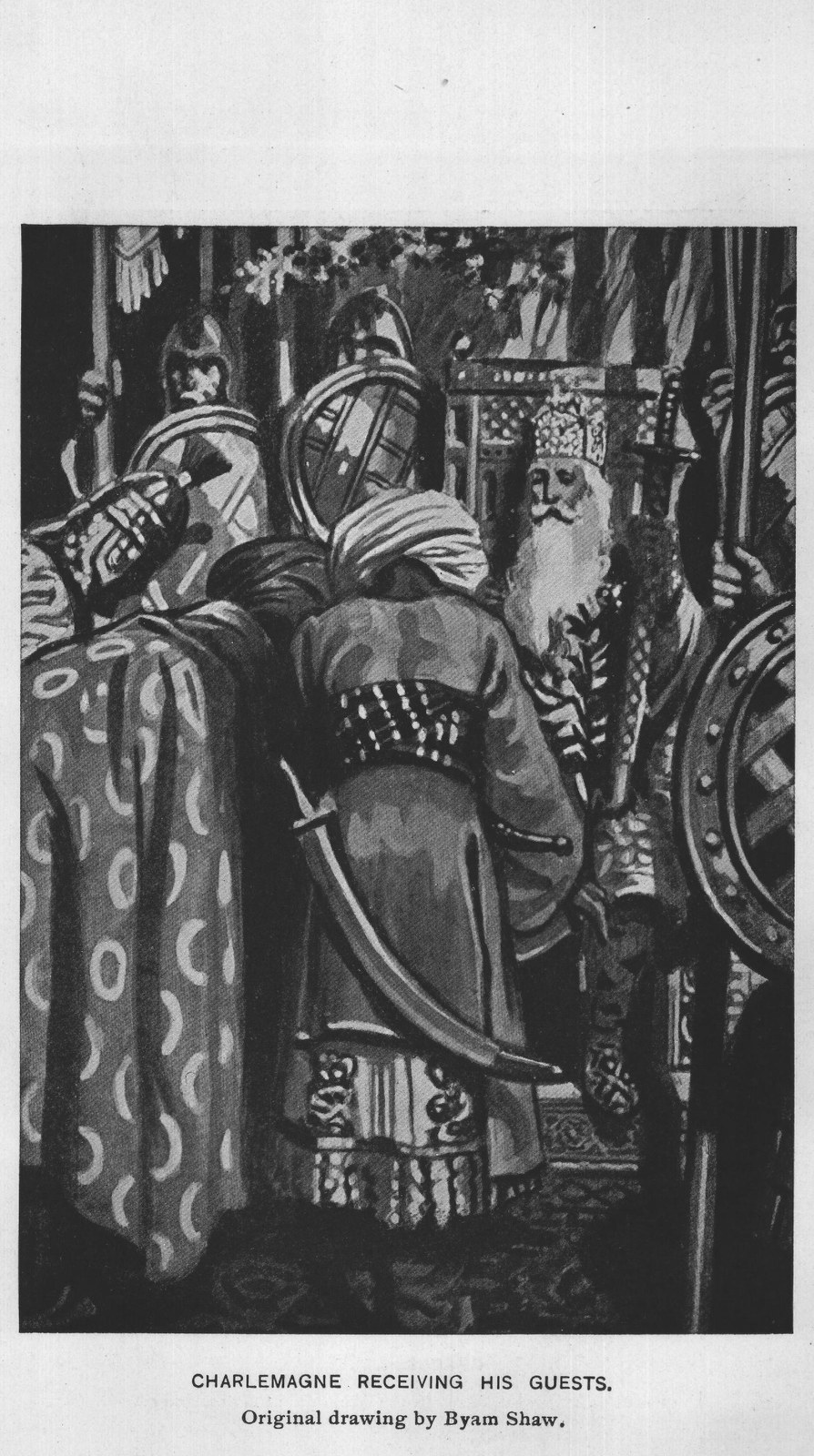
Of the respect entertained for him by foreign nations an interesting proof is afforded in the embassy sent to him by the Caliph of the Arabians, the celebrated Haroun al Raschid, a prince in character and conduct not unlike to Charlemagne. The ambassadors brought with them, besides other rich presents, a clock, the first that was seen in Europe, which excited universal admiration. It had the form of a twelve-sided edifice with twelve doors. These doors formed niches, in each of which was a little statue representing one of the hours. At the striking of the hour the doors, one for each stroke, was seen to open, and from the doors to issue as many of the little statues, which, following one another, marched gravely round the tower. The motion of the clock was caused by water, and the striking was effected by balls of brass equal to the number of the hours, which fell upon a cymbal of the same metal, the number falling being determined by the discharge of the water, which, as it sunk in the vessel, allowed their escape.
Charlemagne was succeeded by his son Louis, a well-intentioned but feeble prince, in whose reign the fabric reared by Charles began rapidly to crumble. Louis was followed successively by two Charleses, incapable princes, whose weak and often tyrannical conduct is no doubt the source of incidents of that character ascribed in the romances to Charlemagne.
The lawless and disobedient deportment of Charles's paladins, instances of which are so frequent in the romantic legends, was also a trait of the declining empire, but not of that of Charlemagne.