Home › The Sea-Serpent › The Sea-Serpent: Daheim
The Sea-Serpent: Daheim
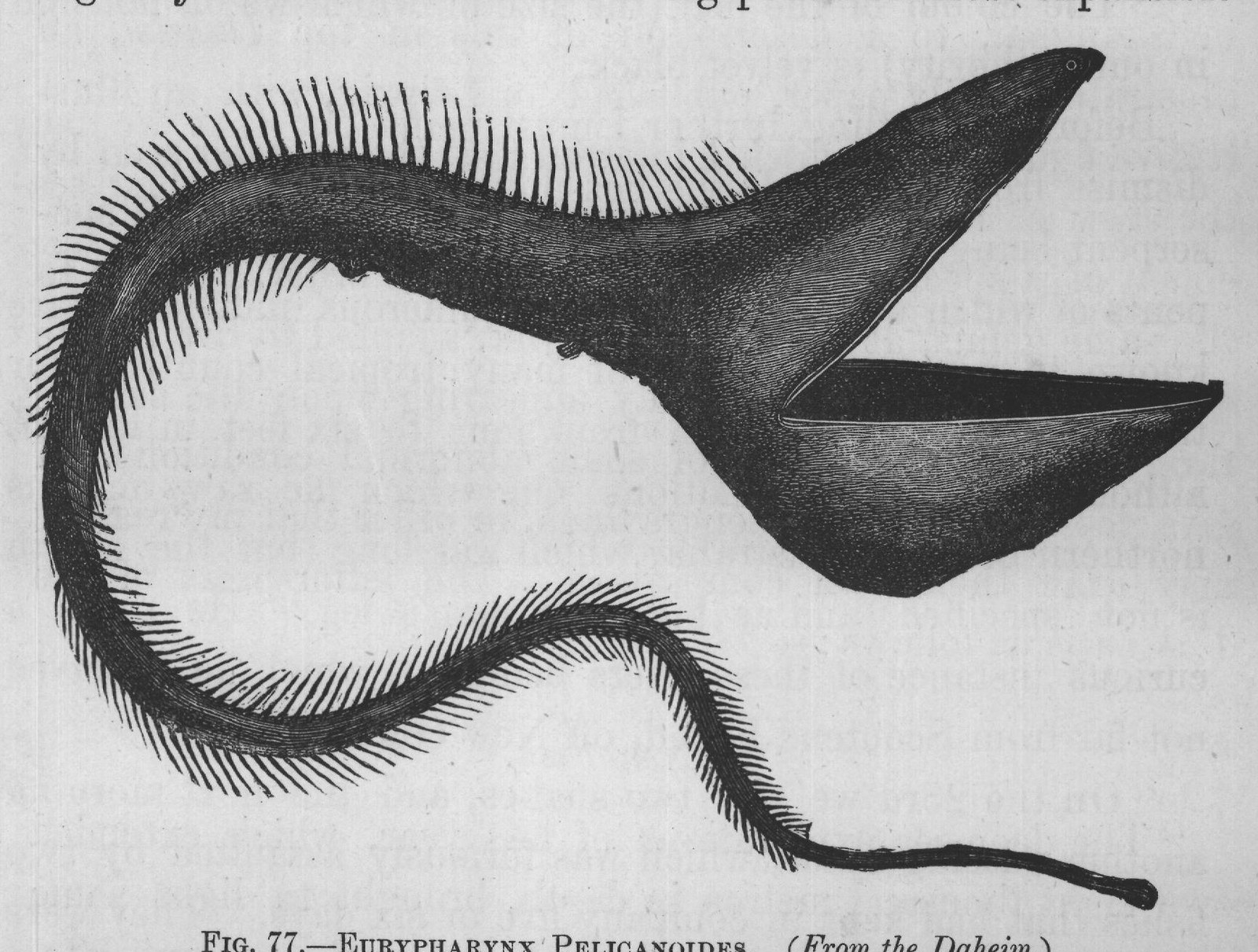
Strangely enough, a proximate counterpart of this fish, but of mimic size, was made known to science in 1882. My attention was called by Mr. Streich, of the German Consulate in Shanghai, to a description of this in the Daheim, an illustrated family paper, published in Leipzig, with an illustrative figure, from which I inferred that the monster seen by the crew of the Philomel was only a gigantic and adult specimen of a species belonging to the same order, perhaps to the same genus, as the Eurypharynx, adapted to live in the depths of the ocean, and only appearing upon the surface rarely and as the result of some abnormal conditions. I give fac-similes of both engravings, in order that my readers may draw their own comparison. The letter-press of the Daheim is as follows:- "A New Fish.* "The deep-sea explorations of last year, which extended over eight thousand metres in depth, brought to light some very extraordinary animals, of which, up to the present date, we have no idea. The most curious one was found by the French steamer Le Travailleur, on which there was a staff of naturalists, and of the number was M. Milne Edwards. They were entirely devoted to deep-sea dredging. "Between Morocco and the Canary Islands, at two thousand three hundred metres depth, the dredge caught a most wonderful animal, which at the first glance nobody thought * From the Daheim, No. 17, Supplement. January 27th, 1883. Leipzig. to be a fish. This fish, of which we give here a picture, dwells on the bottom of the sea where the water is +5° Celsius,* in a kind of red slime composed of the shells of small Globigerinæ. On account of its curious mouth it has been called Eurypharynx Pelicanoides, i.e. the Pelican-like Broad-jaws. This creature is distinguished from all its class by the peculiar construction of its mouth, its under jaw being of a structure different from that of any other fish, possessing only two small teeth and a big pouch of most expansible FIG. 77.-EURYPHARYNX PELICANOIDES. (From the Daheim.) skin, similar to the sac which a pelican has on its under jaw. In this sac it (the Broad-jaw) collects its food, and as its stomach is of very small dimensions, we may, from analogy with other fishes, conclude that it digests partly in this sac. "The swimming apparatus of this fish is not much developed, and reduced to a number of spines erect from the back and the belly. * 41° Fahrenheit, "The pectoral fins, which are immediately behind the eye, are also very small, so that we may conclude from this that this fish does not move much, and is not a good swimmer.
It only inhabits the bottom of the sea. Its body decreases gradually backwards till it finishes in a string-like tail. The organs for breathing are not much developed. Six slits (gill apertures?) allow the water to enter. "The colour of the fish (the size of which we do not find in our authority) is velvet black."
Before proceeding further I must point out that we may dismiss from our minds the possibility of the so-called seaserpent being merely a large example of those marine serpents of which several species and numerous individuals are known to exist on the coast of many tropical countries, for these are rarely more than from four to six feet in length, although Dampier* mentions one which he saw on the northern coast of Australia, which was long (but the length is not specified) and as big as a man's leg. He gives a curious instance of these biters being bit, which he observed not far from Scoutens Island, off New Guinea :- "On the 23rd we saw two snakes, and the next morning another passing by us, which was furiously assaulted by two fishes that had kept in company five or six days. They were shaped like mackerel, and were about that bigness and length, and of a yellow-greenish colour. The snake swam away from them very fast, keeping his head above water. The fish snapped at his tail; but when he turned himself that fish would withdraw and another would snap; so that by turns they kept him employed. Yet he still defended himself, and swam away at a great pace, till they were out of sight." * A Collection of Voyages, in 4 volumes. J. J. Knapton, London, Leguat* speaks of a marine serpent, over sixty pounds in weight, which he and his comrades in misfortune captured and tasted, when marooned by order of the Governor of the Mauritius on some small island off the harbour, about six miles from the shore. He says:- "It was a frightful sea-serpent, which we in our great simplicity took for a large lamprey or eel. This animal seemed to us very extraordinary, for it had fins, and we knew not that there were any such creatures as sea-serpents. Moreover, we had been so accustomed to discover creatures that were new to us, both at land and at sea, that we did not think this to be any other than an odd sort of eel that we never had seen before, yet which we could not but think more resembled a snake than an eel. In a word, the monster had a serpent or crocodile's head, and a mouth full of hooked, long and sharp teeth.