Home › Antiquity of Man › Antiquity of Man: Uintatherium
Antiquity of Man: Uintatherium
Uinta group Uintatherium Bridger group Orohippus Dinoceras Uintatherium Tinocoras Tillotherium Green River group Crocodiles Conus, Voluta, Nautilus, Coryphodon Eohippus Argile plastique and lignite Fluviatile shells Large bird Gastornis Parisiensis Cyprina, &c.
Sables de Bracheux LOWER EOCENE.
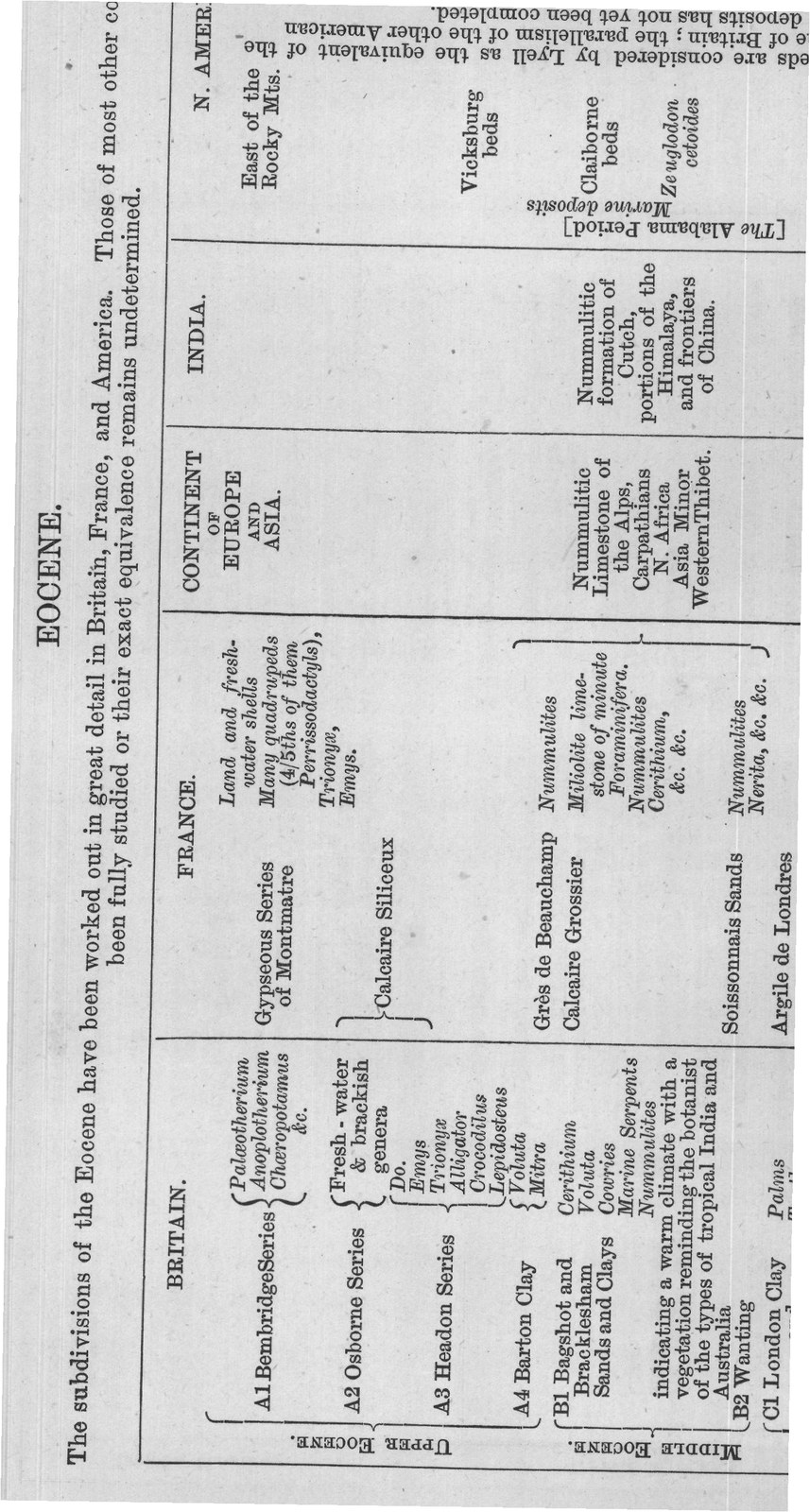
C3 Thanet Sands Pholadomya Deposits believed to be of Tertiary age, in the Pampas, contain Palæotherium to the fauna of that period in Europe. and Anoplotherium, and other forms presenting a resemblance We learn, both from the nature of these deposits and from their organic contents, that climatic oscillations have been passing during the whole period of their deposition over the surface of the globe, and inducing corresponding fluctuations in the character of the vegetable and animal life abounding on it. A complete collation of these varying conditions at synchronous periods remains to be achieved, but the study of our own country, and those adjacent to it, shows that alternations of tropical, boreal, and temperate climate have occurred in it; a remarkable series of conditions which has only lately been thoroughly and satisfactorily accounted for. Thus, during a portion of the Eocene period a tropical climate prevailed, as is evidenced by deposits containing remains of palms of an equatorial type, crocodiles, turtles, tropical shells, and other remains attesting the existence of a high temperature. The converse is proved of the Pleistocene by the existence of a boreal fauna, and the widespread evidences of glacial action. The gradations of climate during the Miocene and Pliocene, and the amelioration subsequent to the glacial period, have resulted in the gradual development or appearance of specific life as it exists at present. Corresponding indications of secular variability of climate are derived from all quarters: during the Miocene age, Greenland (in N. Lat. 70°) developed an abundance of trees, such as the yew, the Redwood, a Sequoia allied to the Californian species, beeches, planes, willows, oaks, poplars, and walnuts, as well as a Magnolia and a Zamia. In Spitzbergen (N. Lat. 78° 56') flourished yews, hazels, poplars, alders, beeches, and limes. At the present day, a dwarf willow and a few herbaceous plants form the only vegetation, and the ground is covered with almost perpetual ice and snow. Many similar fluctuations of climate have been traced right back through the geological record; but this fact, though interesting in relation to the general solution of the causes, has little bearing on the present purpose.
Sir Charles Lyell conceived that all cosmical changes of climate in the past might be accounted for by the varying preponderance of land in the vicinity of the equator or near the poles, supplemented, of course, in a subordinate degree by alteration of level and the influence of ocean currents. When, for example, at any geological period the excess of land was equatorial, the ascent and passage northwards of currents of heated air would, according to his view, render the poles habitable; while, per contrâ, the excessive massing of land around the pole, and absence of it from the equator, would cause an arctic climate to spread far over the now temperate latitudes.