Home › Antiquity of Man › Antiquity of Man: Neolithic
Antiquity of Man: Neolithic
These, again, may be divided into an earlier and a later race, strongly characterized by the marked differences in the nature of the stone implements which they respectively manufactured, both in respect to the material employed and the amount of finish bestowed upon it. To the two periods in which these people lived the terms Palæolithic and Neolithic have been respectively applied, and a vast era is supposed to have intervened between the retiring from Europe of the one and the appearance there of the other.
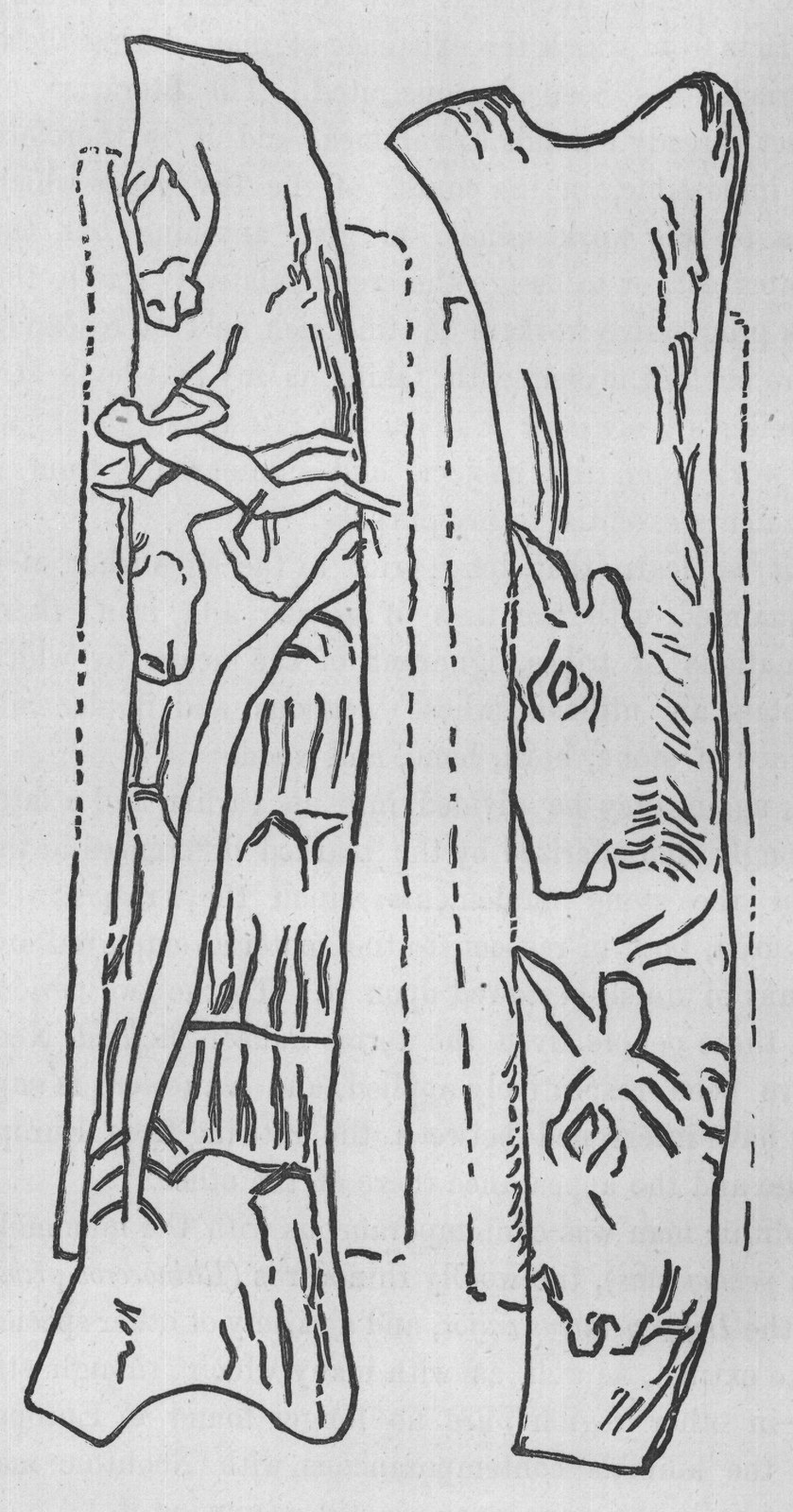
Palæolithic man was contemporaneous with the mammoth (Elephas primigenius), the woolly rhinoceros (Rhinoceros primigenius), the Hippopotamus major, and a variety of other species, now quite extinct, as well as with many which, though still existing in other regions, are no longer found in Europe; whereas the animals contemporaneous with Neolithic man were essentially the same as those still occupying it. The stone implements of Palæolithic man had but little variety of form, were very rudely fashioned, being merely LIO - FIG. 19. ENGRAVING BY PALEOLITHIC MAN ON REINDEER ANTLER.* (The two sides of the same piece of antler are here represented.) * Figs. 19 and 21 are taken, by permission of Edmund Christy, Esq., from Reliquicæ Aquitanicæ, &c., London, 1875. chipped into shape, and never ground or polished; they were worked nearly entirely out of flint and chert. Those of Neolithic man were made of many varieties of hard stone, often beautifully finished, frequently ground to a sharp point or edge, and polished all over.
Palæolithic men were unacquainted with pottery and the art of weaving, and apparently had no domesticated animals or system of cultivation; but the Neolithic lake dwellers of Switzerland had looms, pottery, cereals, and domesticated animals, such as swine, sheep, horses, dogs, &c.
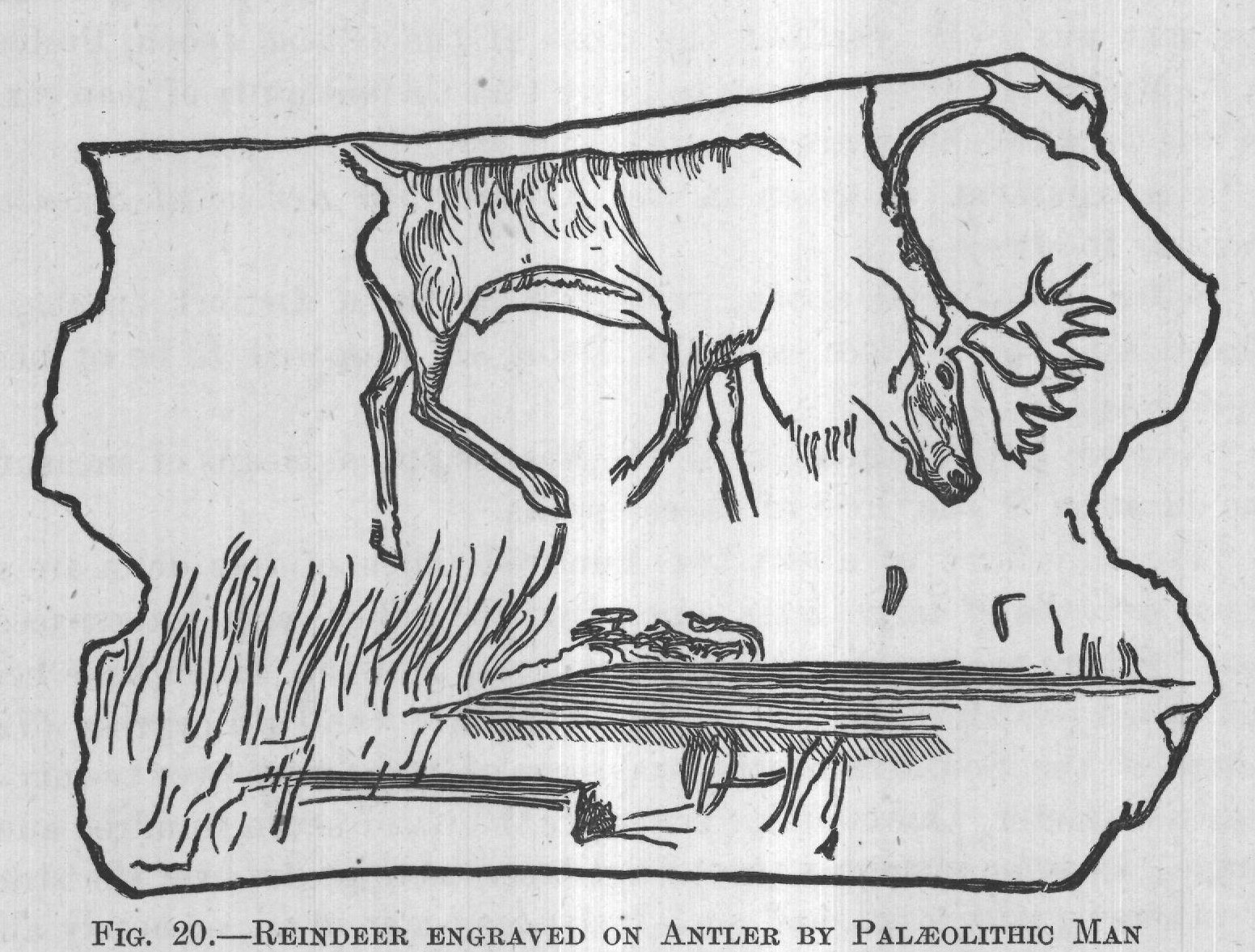
Implements of horn, bone, and wood were in common use among both races, but those of the older are frequently distinguished by their being sculptured with great ability or ornamented with life-like engravings of the various animals living at the period; whereas there appears to have been a marked absence of any similar artistic ability on the part of Neolithic man.
FIG. 20. REINDEER ENGRAVED ON ANTLER BY PALÆOLITHIC MAN (After Geikie.) Again, it is noticeable that, while the passage from the Neolithic age into the succeeding bronze age was gradual, and, indeed, that the use of stone implements and, in some parts, weapons, was contemporaneous with that of bronze in other places, no evidence exists of a transition from Palæolithic into Neolithic times. On the contrary, the examination of bone deposits, such as those of Kent's Cave and Victoria Cave in England, and numerous others in Belgium and France, attest "beyond doubt that a considerable period must have supervened after the departure of Palæolithic man and before the arrival of his Neolithic successor." The discovery of remains of Palæolithic man and animals in river deposits in England and on the Continent, often at considerable elevations* above the existing valley bottoms, and in Löss, and the identification of the Pleistocene or Quaternary period with Preglacial and Glacial times, offer a means of estimating what that lapse of time must have been.† * In some cases as much as 150 feet. † "Starting from the opinion generally accepted among geologists, that man was on the earth at the close of the Glacial epoch, Professor B. F. Mudge adduces evidence to prove that the antiquity of man cannot be less than 200,000 years. "His argument, as given in the Kansas City Review of Science, is about as follows :- "After the Glacial epoch, geologists fix three distinct epochs, the Champlain, the Terrace, and the Delta, all supposed to be of nearly equal lengths. "Now we have in the delta of the Mississippi a means of measuring the duration of the third of these epochs. "For a distance of about two hundred miles of this delta are seen forest growths of large trees, one after the other, with interspaces of sand. There are ten of these distinct forest growths, which have begun and ended one after the other. The trees are the bald cypress (Taxodium) of the Southern States, and some of them were over twenty-five feet in diameter. One contained over five thousand seven hundred annual rings. In some instances these huge trees have grown over the stumps of others equally large, and such instances occur in all, or nearly all, of the ten forest beds. This gives to each forest a period of 10,000 years. "Ten such periods give 100,000 years, to say nothing of the time covered by the interval between the ending of one forest and the beginning of another, an interval which in most cases was considerable. "Such evidence,' writes Professor Mudge, 'would be received in any Skeletons or portions of the skeletons of human beings, of admitted Palæolithic age, have been found in caverns in the vicinity of Liege in Belgium, by Schmerling, and probably the same date may be assigned those from the Neanderthal Cave near Düsseldorf. A complete skeleton, of tall stature, of probable but not unquestioned Palæolithic age, has also been discovered in the Cave of Mentone on the Riviera.
These positive remains yield us further inferences than can be drawn from the mere discovery of implements or fragmentary bones associated with remains of extinct animals.
The Mentone man, according to M. Rivière, had a rather long but large head, a high and well-made forehead, and the very large facial angle of 85°. In the Liege man the cranium was high and short, and of good Caucasian type; " a fair average human skull," according to Huxley.
Other remains, such as the jaw-bone from the cave of the Naulette in Belgium, and the Neanderthal skeleton, show marks of inferiority; but even in the latter, which was the lowest in grade, the cranial capacity is seventy-five cubic inches or "nearly on a level with the mean between the two human extremes."
We may, therefore, sum up by saying that evidences have been accumulated of the existence of man, and intelligent man, from a period which even the most conservative among geologists are unable to place at less than thirty thousand court of law as sound and satisfactory. We do not see how such proof is to be discarded when applied to the antiquity of our race. ""There is satisfactory evidence that man lived in the Champlain epoch. But the Terrace epoch, or the greater part of it, intervenes between the Champlain and the Delta epochs, thus adding to my 100,000 years. ""If only as much time is given to both those epochs as to the Delta period, 200,000 years is the total result. "-Popular Science Monthly, No. 91, vol. xvi. No. 1, p. 140, November 1878. years; while most of them are convinced both of his existence from at least later Pliocene times, and of the long duration of ages which has necessarily elapsed since his appearance-a duration to be numbered, not by tens, but by hundreds of thousands of years.
FIG. 21. ENGRAVING BY PALEOLITHIC MAN ON REINDEER ANTLER.