Home › Contents › The Great Sea-Lizard and Flying Reptile
The Great Sea-Lizard and Flying Reptile
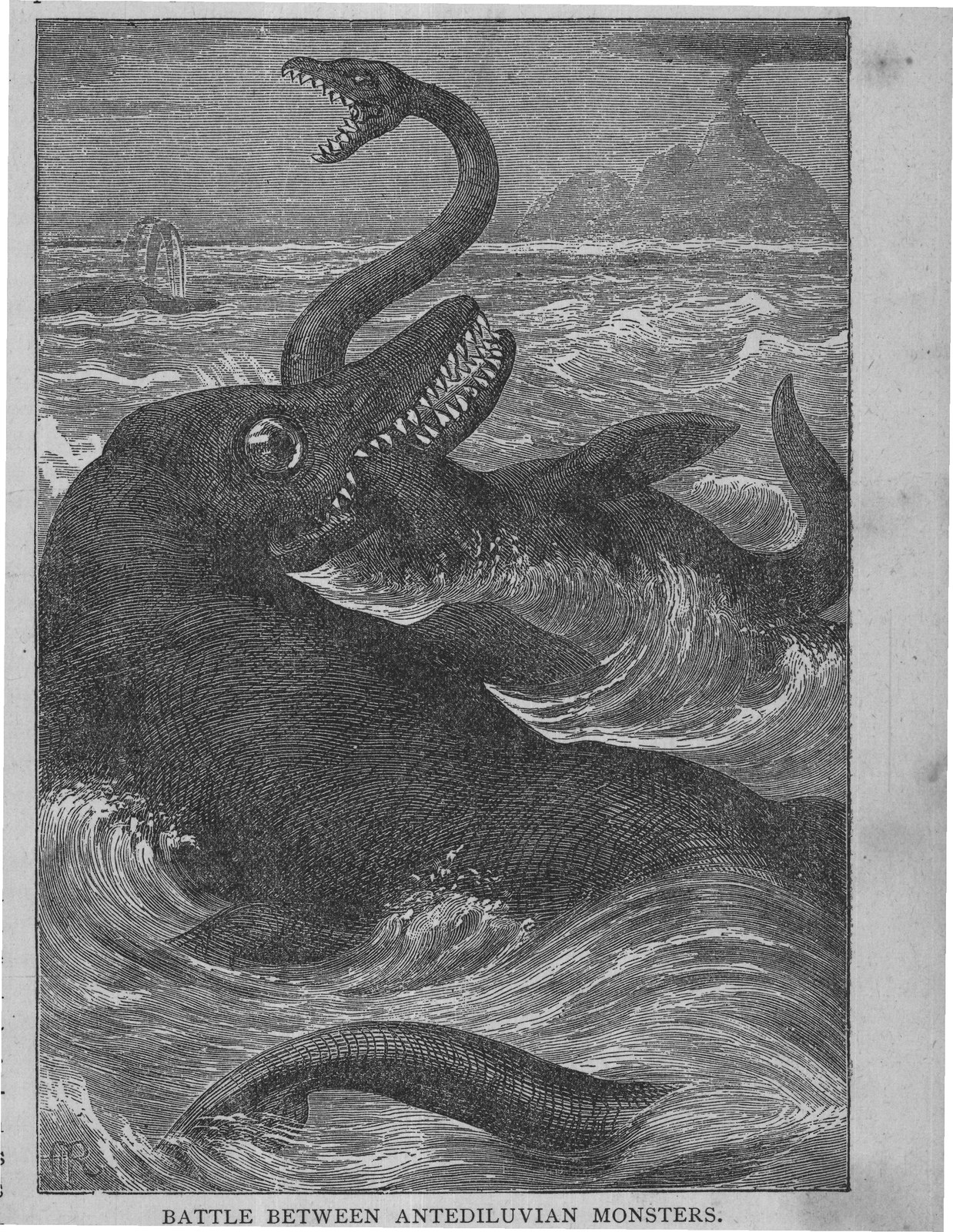
genus than fishes, especially in the character of the skeleton. formidable jaws and teeth, its rapid mo- A similar remarkable combination of tion and power of vision, to be the scourge forms appears in this animal to that and tyrant of the existing seas of its era, which distinguishes its preceding relative-the head of a lizard, the teeth of a within its reach? It may, perhaps, have crocodile, a neck resembling the body of a lurked in shoal water along the coast. serpent, the trunk and tail of an ordinary concealed among the sea-weed, and raisquadruped, the ribs of a chameleon, and ing its nostrils to the surface from a conthe paddles of a whale. Such are the siderable depth, may have found a secure strange combinations of form and struc- retreat from the assaults of dangerous ture in the Plesiosaurus, a genus the enemies; while the length and flexibility remains of which, after interment for of its neck may have compensated for the thousands of years amidst the wreck of want of strength in its jaws, and its inmillions of extinct inhabitants of the capacity for swift motion through the ancient earth, are at length recalled to water, by the suddenness and agility of light by the researches of the geologist, the attack which they enabled it to make. and submitted to our examination in nearly as perfect a state as the bones of species now existing upon the earth.
A Singular Animal.
Reptile with Wings.
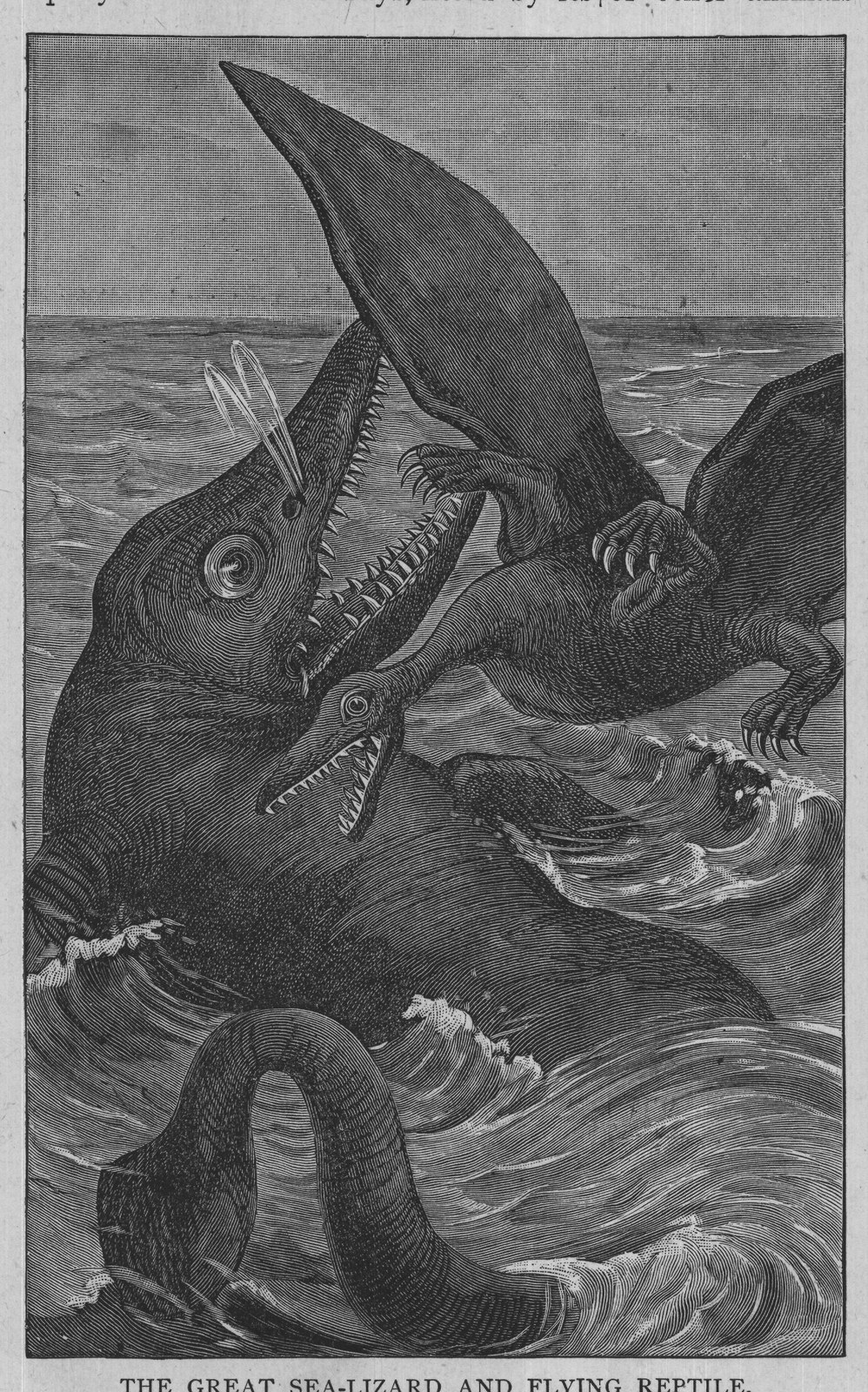
Contemporaneously with these strange animals, marine, fresh-water and terrestrial tortoises flourished, with crocodiles of extinct species, and the Pterodactyl, or Its most striking feature is the great length of the neck, which has from thirty Wing-fingered Reptile, perhaps the most to forty vertebræ, or bone joints, a larger singular and monstrous creature of the number than in any known animal, those ancient world, the type of which appears of living reptiles varying from three to in no living genus. This flying reptile six, and those of birds from nine to had such a remarkable construction that twenty-three. It has been, therefore, cor- it puzzled scientific men. Naturalists rectly compared to a serpent, threaded pored over its remains, but were unable through the body of a turtle. That it was to assign them to their true place in the aquatic, is evident from the form of its animal kingdom, some pronouncing it a paddles; that it was marine is almost bird, others a reptile, and others a bat, equally so, from the remains with which till Cuvier took its skeleton in hand. it is universally associated; that it may Behold, he observes, an animal, which, have occasionally visited the shore, the in its bone formation, from its teeth to resemblance of its extremities to those of the end of its claws, is like a reptile; nor the turtle may lead us to conjecture; its can we doubt that those characteristics motion, however, must have been very existed in the muscles and soft parts, in awkward on land; its long neck must its scales, its circulation and other organs. have impeded its progress through the But it was, at the same time, an animal water, presenting a striking contrast to provided with the means of flight, which, the organization of the Lizard-fish, which when stationary, could not have made so admirably fitted it for that purpose. much use of its anterior extremities, even May it not, therefore, be concluded (since if it did not keep them always folded as in addition to these circumstances its birds keep their wings; which, nevertherespiration must have required frequent less, might use its small anterior fingers access to air) that it swam upon or near to suspend itself from the branches of the surface, arching back its long neck trees, but when at rest must have been like the swan, and occasionally darting it ordinarily on its hind feet, like the birds, down at the fish which happened to float again; and also, like them, must have carried its neck sub-erect and curved world as we have here described. There backwards, so that its enormous head can be no doubt about it, however, for should not interrupt its equilibrium. when we take their skeletons and recon- Pterodactyls had the head and a neck of a bird, the mouth and teeth of a reptile, the wings of bat, the body and tail of one of the lower orders of animals. Their eyes were enormously large, so that they could seek their prey in the night. They could not only fly, but, like the existing vampire bat, they had the power of swimming. Thus, like Milton's fiend, qualified for all services and all elements, the Pterodactyl was a fit companion for the kindred reptiles that swarmed in the seas, or crawled on the shores of a turbulent planet.
There is nothing on the earth to day which has such a hideous 2