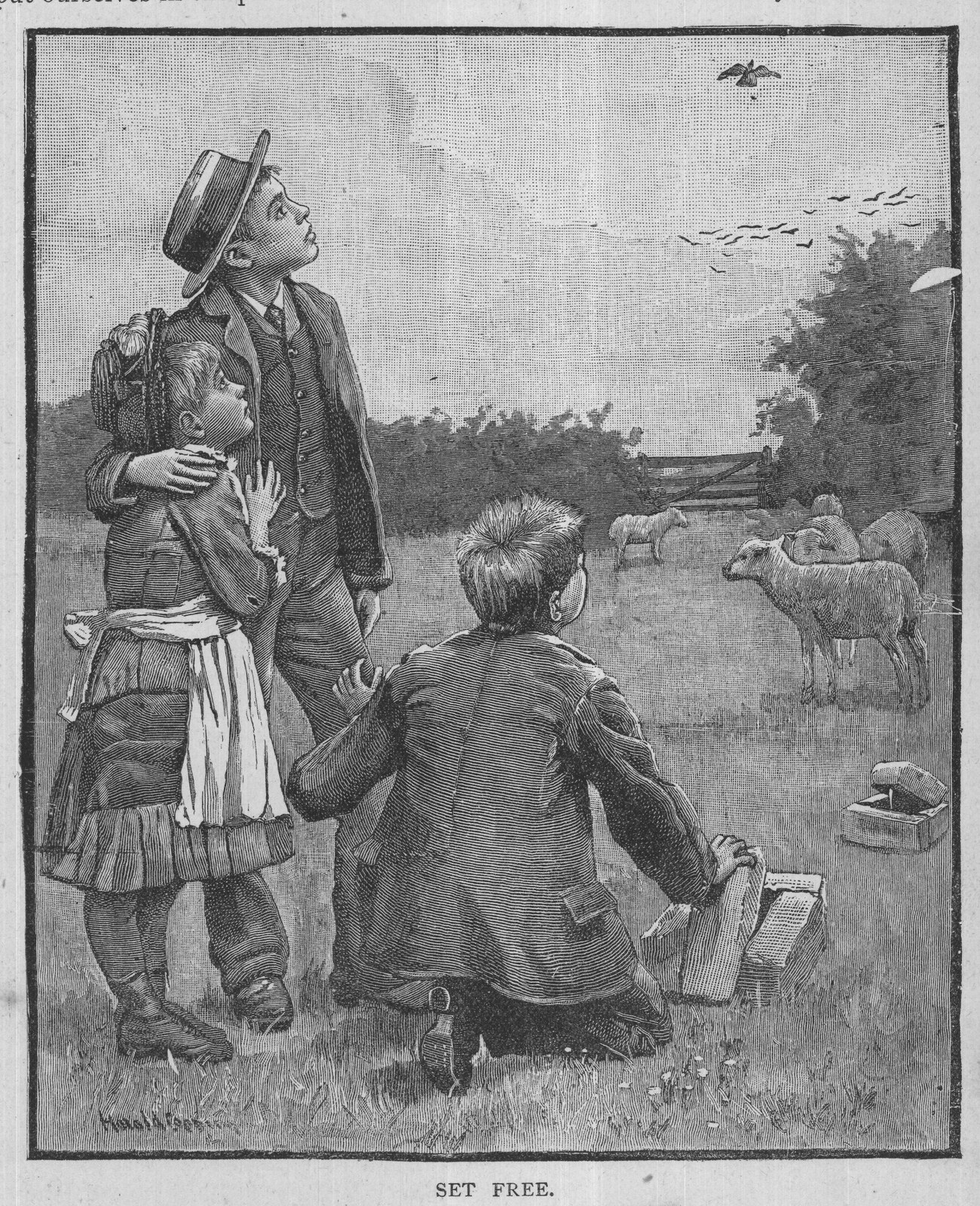
Set Free
are held as captives, we would most likely free, and are intently watching its upward open the doors of the cages, and be glad flight. We may assume that they are far to see them fly away. The engraving happier than they would be to keep this little one in confinement; the charming insects, reptiles, mollusca and sometimes creature of the air should be allowed to on grain. Its nest is usually made among spread its wings and sing its song in its reeds and tall herbage, in the marshes own native fields. Yet, as before stated, which it frequents; it, however, occathere are birds that thrive well in confine- sionally builds on ruined edifices. In its ment, and would hardly know what to do migrations it flies, like wild geese and with themselves if liberated. swans, in the form of a wedge, frequently uttering a loud cry.
The Common Crane.
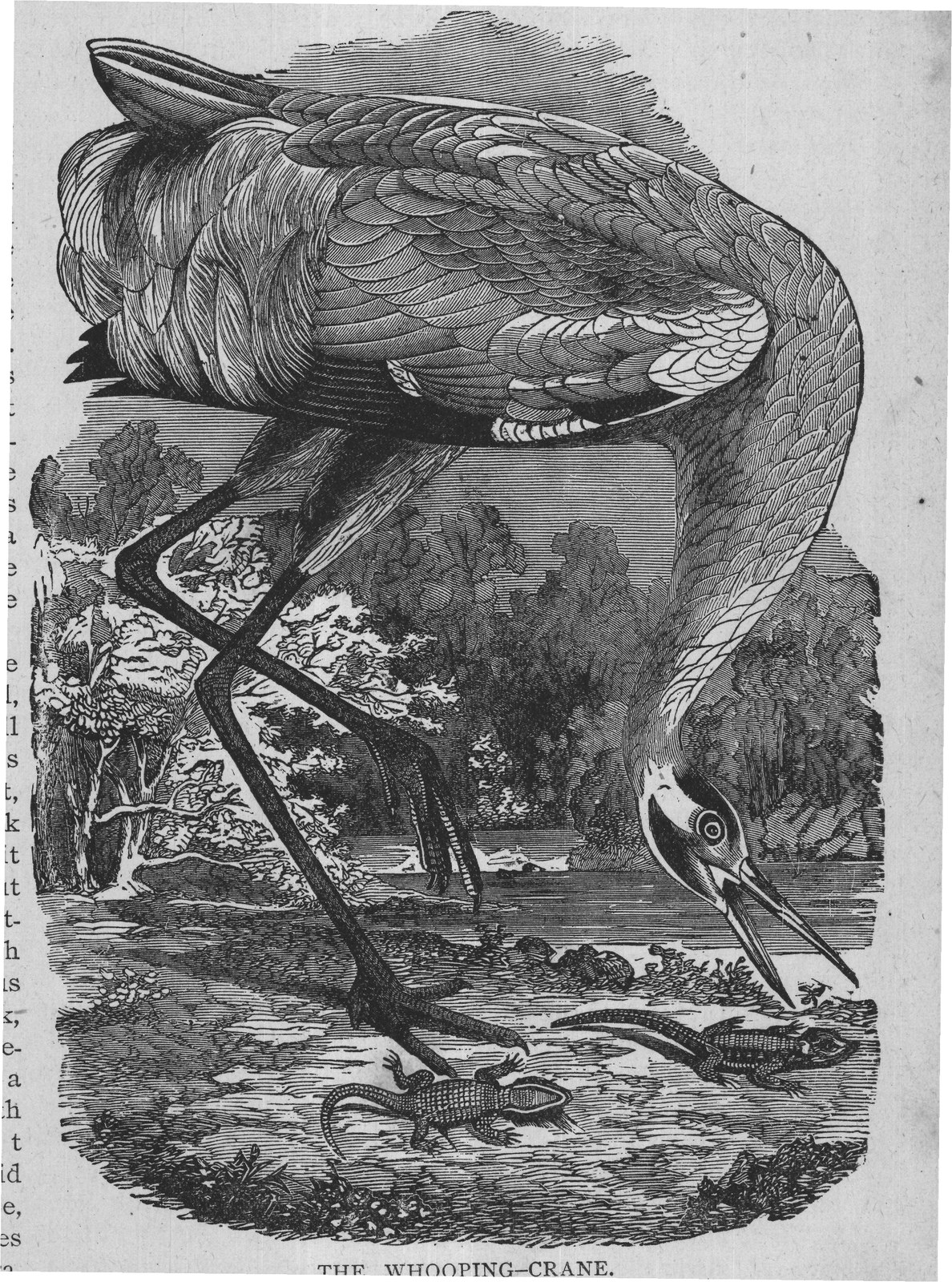
The American Crane is four feet six Cranes are large and stately birds, most of them living exclusively in warm inches long; crested; color bluish-ash; climates. The food is various, compris- feeds on crabs, shell-fish, eels and various ing insects, reptiles, worms and fish; kinds of fruit. It is stationary from some species likewise frequent ploughed the Carolinas southward; in summer it and newly-planted fields to pick up seeds, migrates as far north as New Jersey. It as well as living prey. They dwell in is often called Whooping Crane" on fields, marshes and along the margins of account of its wild, sonorous cry, which ponds, but always roost in trees, where has been compared to the whoop of sav- ⚫ they also nest, as well as on the ground. ages when rushing to battle. 66 When incubation commences, the nest is Nuttall says: In February, and in the raised to the height of the body with early part of the following month, I grass and reeds; they are said to lay but heard their clamorous cries nearly every two eggs, on which each alternately morning around the enswamped ponds of broods in a standing posture, the legs strid- West Florida, and throughout Georgia, ing the nest. They migrate in vast flocks, so that many individuals probably pass and perform very extensive periodical jour- either the winter or the whole year, in the neys, passing along in the higher regions of southern extremity of the Union. It is the atmosphere; they often move in the impossible to describe the clamor of one night, and usually in troops arranged in of these roosting flocks, which they begin long triangular lines, guided by the shrill usually to utter about sunrise. Like the voice of their leader, which, re-echoed by howling monkeys of South America, a the timorous and unseen ranks, affords single individual seemed at first as if often the only indication of the course of haranguing, or calling out to the assemtheir passage. Subject to less excite- bled company, and after uttering a round ment, they pass along silently and at a number of discordant, sonorous and braygreat elevation in fine weather, but lower ing tones, the address seemed as if retheir flight and become clamorous at the ceived with becoming applause, and was approach, or during the existence, of a seconded with trumpeting hurrahs. storm.
A Bird on Stilts.
The common Crane of Europe is four There are a few birds so odd in their feet long; bluisn-ash above; beneath appearance as the Flamingo. Its body is ash-gray. It migrates to the north of not so large as that of the Stork, but its Europe and Siberia in spring, remains legs are like long stilts. Indeed, they there and breeds in summer, and in the may be said to be quite out of proportion autumn returns to Africa and Southern to its size; when it stands up it is six feet Asia for the winter. It feeds on worms, high. The head is small, but is furnished with a very long bill, which, as you see, the band acts as a watchman, and if any curves down from the middle. The end danger approaches, utters a scream like of the bill, as far as the bend, is black, and then a reddish yellow.
The tongue is large and fleshy, and fills up the whole of the bill, and the tip is gristly.
Its long legs rather link it with the waders, but the three front toes are united by a web as in the case of the water birds.
The plumage of the head, when in its full perfection, is deep scarlet, with black quills. As it strides about upon its stiltlike legs, with its enormous length of neck, we should regard it as a most uncouth creature but for its splendid scarlet robe, that excites our admira-