Home › Contents › Marvellous Scene in the Arctic Regions
Marvellous Scene in the Arctic Regions
(115) Captain Sabine states that he saw one then goes out to sea upon the ice, and about midway between the north and preys upon seals. These animals are very south shores of Barrow's Straits, which fat, and, though very inoffensive if not are forty miles apart, though there was meddled with, are exceedingly fierce when no ice in sight, to which it could repair provoked. for rest. The floating carcases of whales Bears are remarkably affectionate toand other marine animals form a con- wards their young, and peculiarly sagasiderable part of its food; but it does not cious. On one occasion a mother Bear disdain, under the pressure of hunger, to with two cubs was pursued across a field seek the shore in quest of roots and ber- of ice by a party of armed sailors. At ries. The pace of the Polar Bear is first she urged her young ones to increase described as "a kind of shuffle, as quick their speed, but finding the pursuers as the sharp gallop of a horse." gaining on them, she carried, pushed, or pitched them alternately forward until A Destructive Beast.
As the Polar Bear resides principally she effected their escape. The little creaon the fields of ice, it is frequently drifted tures are said to have placed themselves far from the land. In this way these across her path to receive her impulse, animals are often carried from the coast and when thrown forward they ran on of Greenland to Iceland, where they com- till she overtook them, when they admit such ravages on the flocks, that the justed themselves for a second throw. people rise in a body to destroy them.
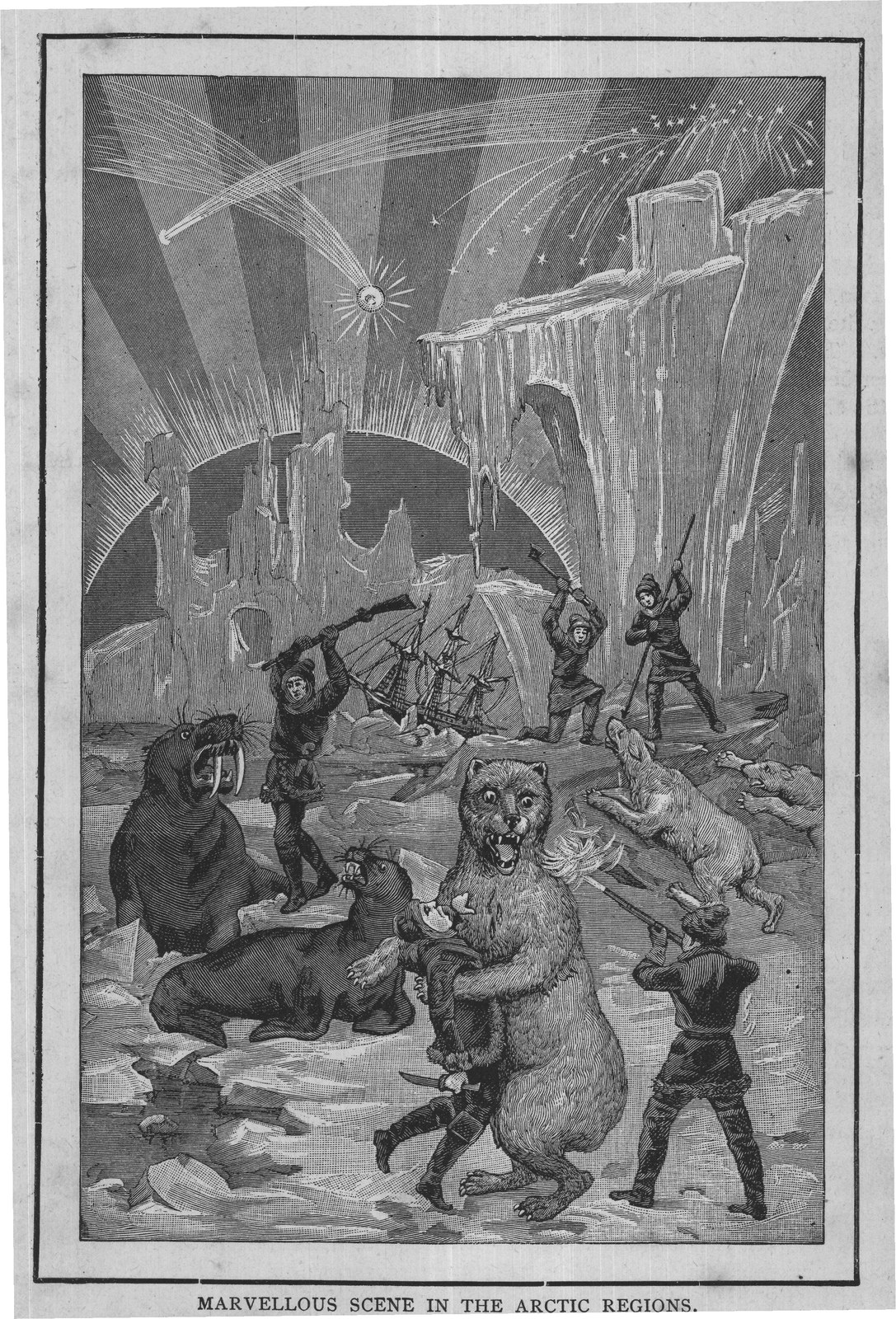
While on a Polar expedition a ship was In winter this animal sleeps, like locked in the ice. Early one morning other species of the genus, but takes up the man at the mast-head gave notice its residence in a different situation, gen- that three Bears were making their way erally under the declivities of rocks, or at very fast over the frozen ocean, and the foot of a bank where the snow drifts directing their course towards the ship. over it to a greater depth. A small hole They had, doubtless, been invited by the for the admission of fresh air is con- scent of some blubber of a hippopotamus, stantly observed in the dome of its den. which the crew had killed a few days before, and which, having been set on fire, was burning on the ice at the time of their approach.
This, however, has regard solely to the She-bear, who retires to her winter quarters in November, where she lives with out food, brings forth two young about They proved to be a She-bear and her Christmas, and leaves the den in the two cubs, but the cubs were nearly as month of March, when the cubs are as large as the dam. They ran eagerly to large as a shepherd's dog. If, perchance, the fire, and drew out from the flames her offspring are tired, they ascend the part of the flesh of the sea-horse that bank of the dam, where they ride securely remained unconsumed, and ate it voraeither in water or ashore. Though they ciously. The crew of the ship threw sometimes go as far as thirty miles from great lumps they had still left on the ice, the sea in winter, they always come down which the old Bear fetched away singly, to the shore in the spring with their cubs, laying each piece before the cubs as she where they subsist on seals and sea-weed. brought it, and, dividing it, gave each a The He-bear wanders about the marshes share, reserving only a small portion for and adjacent parts until November, and herself. As she was fetching away the