Home › Contents › Gaveston's Last Ride
Gaveston's Last Ride
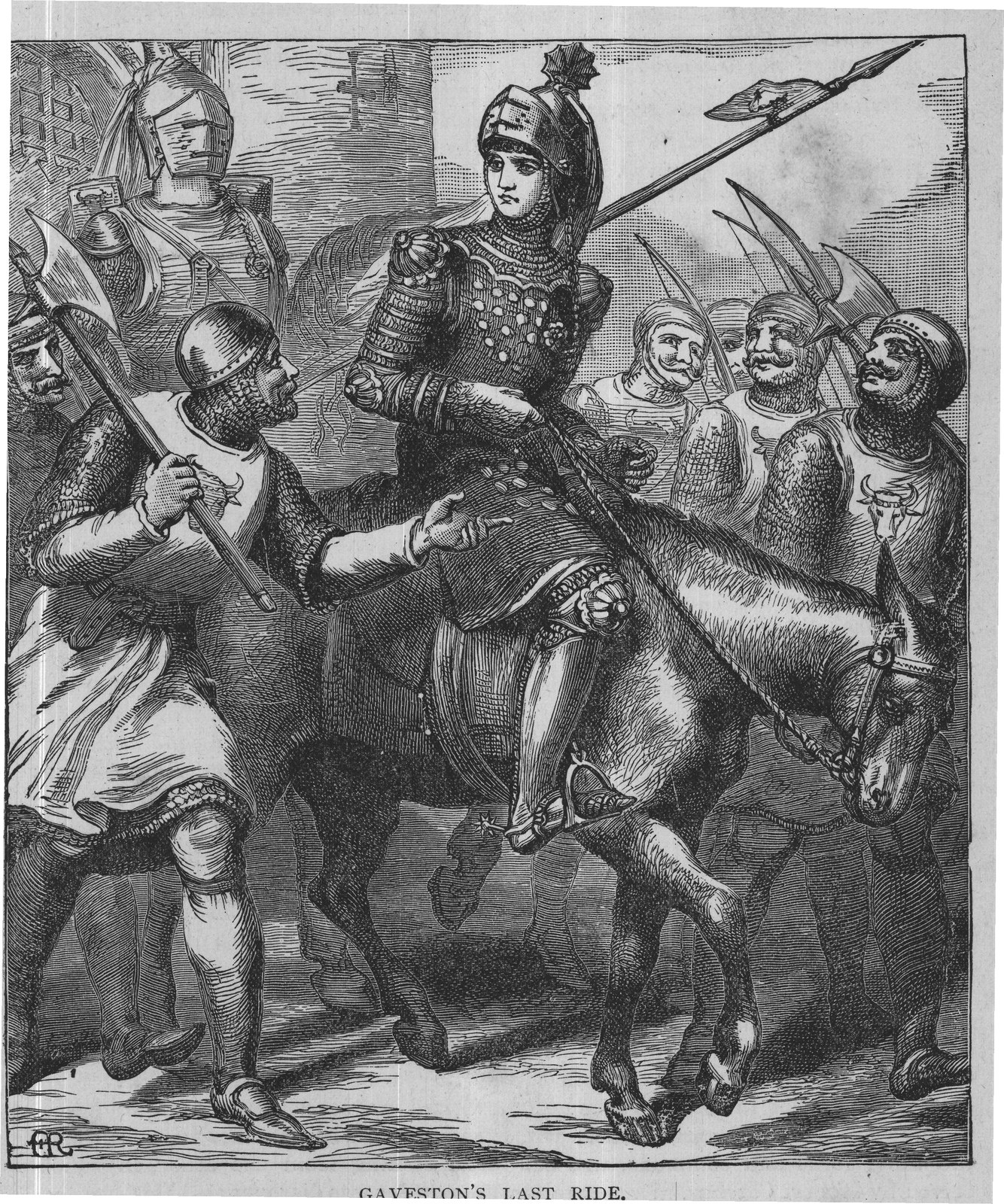
25 (385) With hope and terror mingled, He left his narrow room, To see a sight that froze him, Sure presage of his doom; For, there, upon a war-horse, Amid his jeering men, Was the grim Earl he'd slighted, The black dog of Ardenne!
Said he, "My lord of Cornwall, Methinks it will be best For thee to go to Warwick, And be mine honored guest.
No thanks! I owe thee somewhat, And all who know the man, Say Warwick pays what's owing, As well as any can."
Now must he ride to Warwick, Upon a sorry mule; The soldiers round him noisy, Like boys let loose from school.
A burst of martial music Received him at the gate; Within his judges tarried To seal the captive's fate.
As some one spake of mercy, And hoped no blood would flow, A voice cried, "Ye have taken The fox-he must not go."
And so to death they doomed him, A death that self-same day; And when he knelt for pity, Each turned his face away.
To Blacklow Hill they haled him, Through crowds of wondering folk, Where he Death's sharpness suffered, Beneath the headsman's stroke.
And, now, one wish we utter, Ere we lay down the pen, We trust he found high Heaven More merciful than men!
Making the Guy.
Fawkes was admitted into the conspiracy, and returned to England in May of that year.
Thomas Percy, one of the confederates, rented a house adjoining that in which Parliament was to assemble, of which Fawkes, who was unknown in London, took possession as his servant, under the assumed name of Johnson. Parliament was soon after adjourned till February 7, 1605, and on December 11th preceding the conspirators met in the hired house of Percy, and began to excavate a mine.
Seven men were thus occupied until Christmas Eve, never appearing in the upper part of the house, while Fawkes kept constant watch above.
Parliament was again prorogued from February 7th to October 3d, and the conspirators therefore dispersed for a time, but completed their arrangements between February and May. They hired a vault immediately below the house of lords, which had just been vacated by a dealer in coal, into which they conveyed by night thirty-six barrels of powder and covered them with fagots. They again dispersed, Fawkes proceeding to Flanders to secure foreign co-operation. As money was needed, three wealthy gentlemen, Sir Everard Digby, Ambrose Rookwood, and Francis Thresham, were made privy to the plot. The meeting of Parliament was again deferred to November 5th, and Fawkes was appointed to fire the mine.
The conspiracy was detected by an Guy Fawkes was an English conspira- anonymous letter entreating Lord Montor, born in Yorkshire, executed in Lon- teagle, a Roman Catholic peer, to absent don, January 30, 1606. He was a soldier himself from the Parliament, and intiof fortune in the Spanish army in the mating a terrible danger. The letter Netherlands, when in 1604 the scheme of resulted in a search on the night of Noblowing up the Parliament house, with vember 4th, when Fawkes was seized just the king, lords and commons, was con- after issuing from the cellar, in which ceived by Robert Catesby, in revenge for the powder was discovered. Matches and the penal laws against Roman Catholics. touchwood were found in his pocket.