Home › Contents › Cromwell Dissolving the Long Parliament
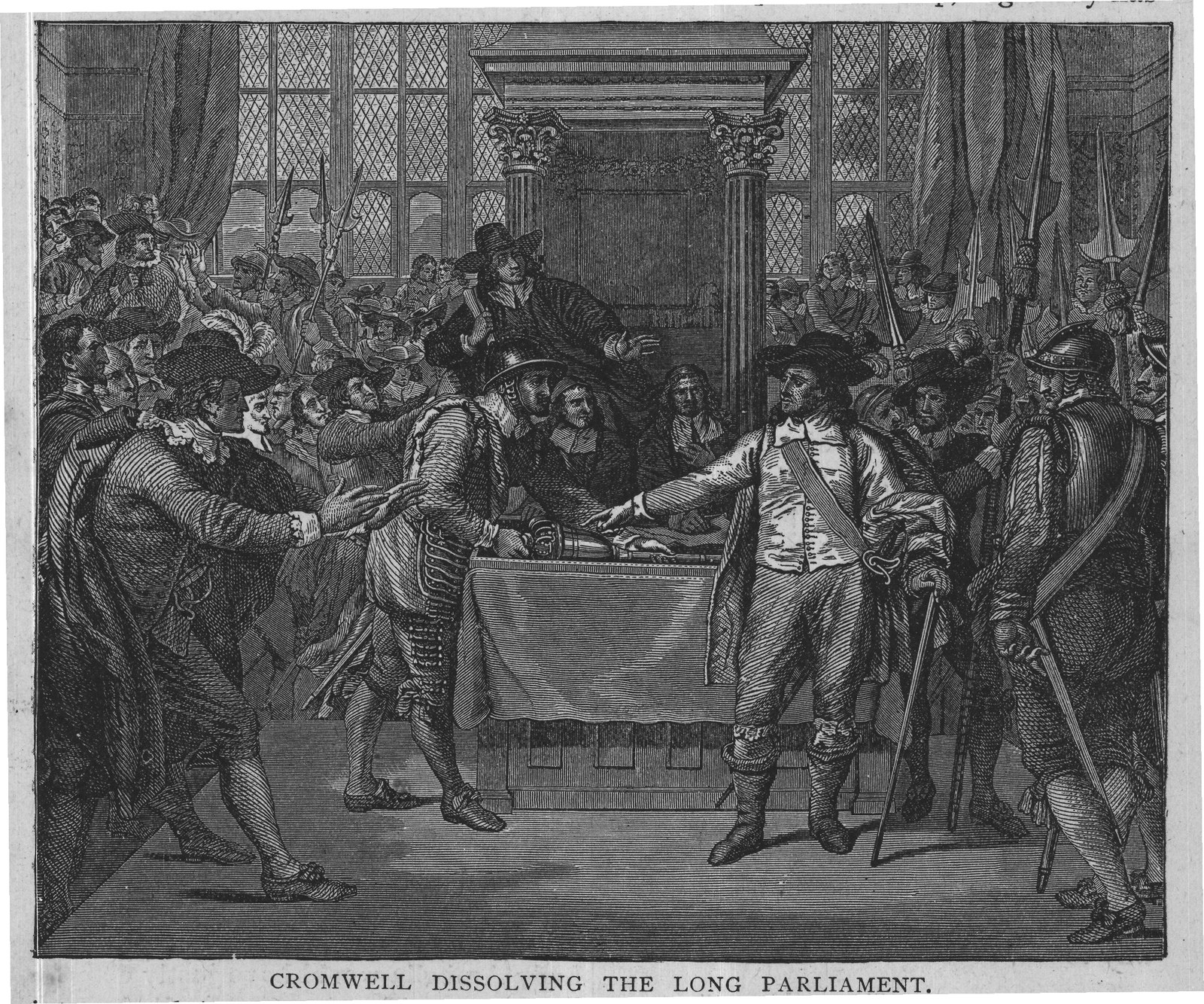
Cromwell Dissolving the Long Parliament
interrupted, in consequence of the receipt tened to inform Cromwell at Whitehall. of a notice by the general, that it was the His resolution was immediately formed, intention of the House to comply with and a company of musketeers received the desires of the army. This was a mis- orders to accompany him to the House. take; the opposite party had, indeed, re- At this eventful moment, big with the solved to pass a bill of dissolution; not, most important consequences both to however, the bill proposed by the officers, himself and his country, whatever were but their own bill, containing all the the workings of Cromwell's mind, he had the art to conceal them from the eyes of the water-way and the celebrated 'Traithe beholders. tors' Gate. This Traitors' Gate was the With one bold move he cleared the entrance by which all traitors, or so-called House, scattered the members, took the traitors, entered the gloomy building power into his own hands, and continued from which so few escaped with life. the conflict he was waging in behalf of Here, amongst others, was brought the rights and liberties of the English Queen Elizabeth, during the reign of her people. Out of the civil war which he elder half-sister, Mary Tudor; and here, conducted came a more beneficent rule and the overthrow of tyrannical power.
Tower of London. on the steps of Traitors' Gate, she sat down and refused to move, vowing herself the queen's truest subject. But she arose at last, and made the best of her Immediately below London Bridge are to be found on both sides the river imprisonment, which was in the strong Thames various stairs, or gates, whence tower where now the crown jewels are passengers still take ferry-boats across the kept.
The Tower is made up of many towers, crowded river. The boatmen are very smart fellows, equally clever in contend. the chief of which is the white, in the cening with the tide and avoiding collisions. tre. This is the oldest portion of the We have Battle Bridge Stairs, Cherry vast edifice. Here it was that the sover- Garden and Wapping Old Stairs, Iron- eigns of England, even to the time of gate and many others, especially Execu- Queen Mary Tudor, held state between tion Dock Stairs, as it is still called, albeit the time of their proclamation and the the proper name of the place is King day of their coronation in Westminster Henry's Stairs. Here, in the ghastly old Abbey.
Here have died some of the best of times, pirates were hanged in chains, as a warning to sailors, and there remained English men and women-amongst others, unhappy Lady Jane Grey-and Sir Waluntil time reduced the bones to dust. And now through the forest of ship. ter Raleigh, whose only crime was that he possessed, or had possessed, land ping crowding the Upper Pool comes in view the huge, square, four-turreted which James I wished for one of his White Tower, the chief building of the Tower of London.
Tradition ascribes the first building of this Tower to Julius Cæsar. The Queen in Shakespeare's Richard II talks of the way to "Julius Cæsar's ill-erected tower." favorites.
Here also died the Lady Arabella Stuart, cousin of James I, who dreaded that the people might prefer her to himself as the sovereign of England. After James, if he had had no children, the Lady Arabella would have justly claimed the throne. Here in 1615 she died, borne down by her afflictions, her reason having fled some time before death released her.
The last to suffer on the block at the Tower were certain lords, who, in 1745, As we come abreast the Tower we see assisted the Scotch to rise against George a water-gate opening on the river in front II, in the hope of placing Prince Charles of the embankment which lies between Edward (grandson of James II) on the Or, again- "The towers of Julius, London's lasting shame, By many a sad and midnight murder fed."